. 2022 Aug 17;42(33):6445-6452.
doi: 10.1523/JNEUROSCI.0832-22.2022.

A Role for the Anterior Hippocampus in Autobiographical Memory Construction Regardless of Temporal Distance

Affiliations

A Role for the Anterior Hippocampus in Autobiographical Memory Construction Regardless of Temporal Distance

Sam Audrain et al. J Neurosci. .

Abstract

Mounting evidence suggests distinct functional contributions of the anterior and posterior hippocampus to autobiographical memory retrieval, but how these subregions function under different retrieval demands as memories age is not yet understood. Specifically, autobiographical memory retrieval is not a homogeneous process; rather, it is thought to consist of the following multiple stages: an early stage of memory construction and a later stage of detailed elaboration, which may differently engage the hippocampus over time. In the present study, we analyzed data from 40 participants (23 female/17 male) who constructed and overtly elaborated on recent and remote memories in response to picture cues in the fMRI scanner. We previously reported a temporal gradient in the posterior hippocampus during the elaboration period of autobiographical retrieval, with posterior hippocampal activation observed for recent but not remote time points. Here, we consider the previously unanalyzed construction stage of retrieval, where participants searched for and selected a memory. We found no evidence of a temporal gradient during memory construction, instead observing strong anterior hippocampus activity regardless of memory remoteness. Our findings suggest a unique contribution of the anterior hippocampus to the construction process of autobiographical retrieval over time. These findings highlight that retrieval processes, which have yet to be integrated with current models of systems consolidation, offer novel insights into hippocampal subregion function over time.SIGNIFICANCE STATEMENT Hippocampal contributions to autobiographical memory retrieval may depend on several distinct factors including memory age and the retrieval process engaged. We previously found that the contribution of the posterior hippocampus to detailed elaborative retrieval diminishes as memories age, with no reliable activation of the anterior hippocampus over time. Here, we report that consideration of the earlier "construction" period of retrieval, where participants search for and retrieve general aspects of the memory, yielded significant anterior hippocampus activation regardless of memory age. These results provide evidence for a unique contribution of the anterior hippocampus to the constructive process of autobiographical retrieval over time and suggest that component processes of retrieval should be integrated into models of systems consolidation.

Keywords: anterior hippocampus; autobiographical memory; construction; retrieval; systems consolidation; temporal gradient.


Figures

Figure 1.
Figure 1.
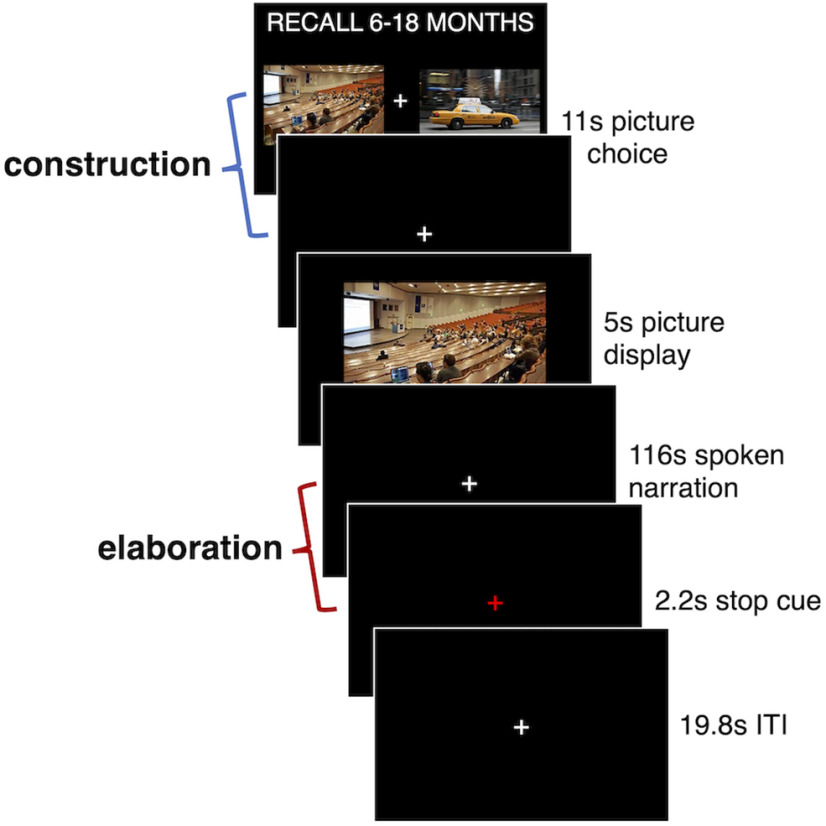
Trial structure of the autobiographical retrieval task. During the construction stage, participants selected their preferred picture cue to use to retrieve autobiographical memories from earlier in the day, 6–18 months ago, or 5–10 years ago. During elaboration, participants overtly described the retrieved memory in as much detail as possible. The trial structure for the control task was the same, except participants chose a picture (construction stage) to describe in detail (elaboration stage), without retrieving a long-term memory. ITI, intertrial interval.
Figure 2.
Figure 2.
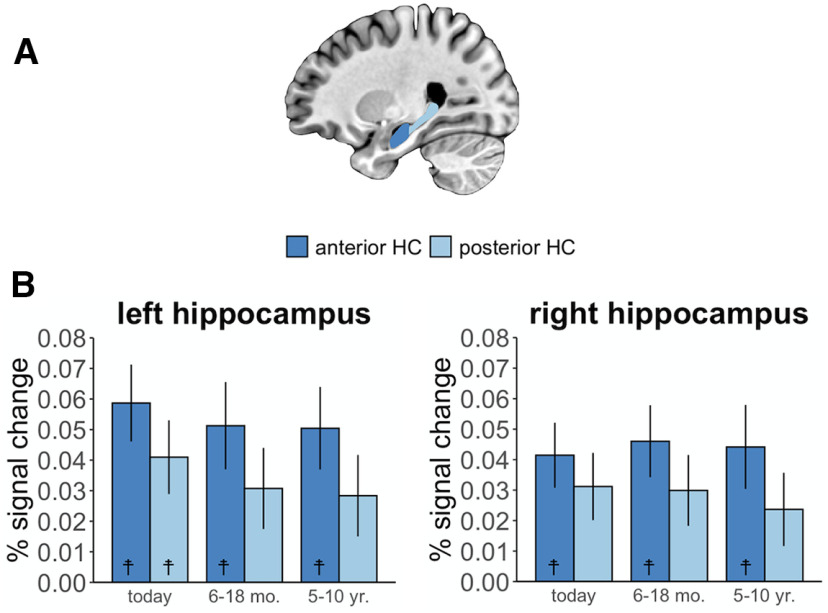
Hippocampal activation during the autobiographical construction phase over time. A, Anterior and posterior hippocampal ROIs, manually segmented for each participant. B, Percent signal change in the anterior and posterior hippocampi during construction of autobiographical memories of varying remoteness relative to the same period of the control picture description task. Error bars reflect the SEM. ☨ p < 0.05, construction phase > baseline control task after Bonferroni's correction for multiple comparisons. HC, Hippocampus.
Figure 3.
Figure 3.
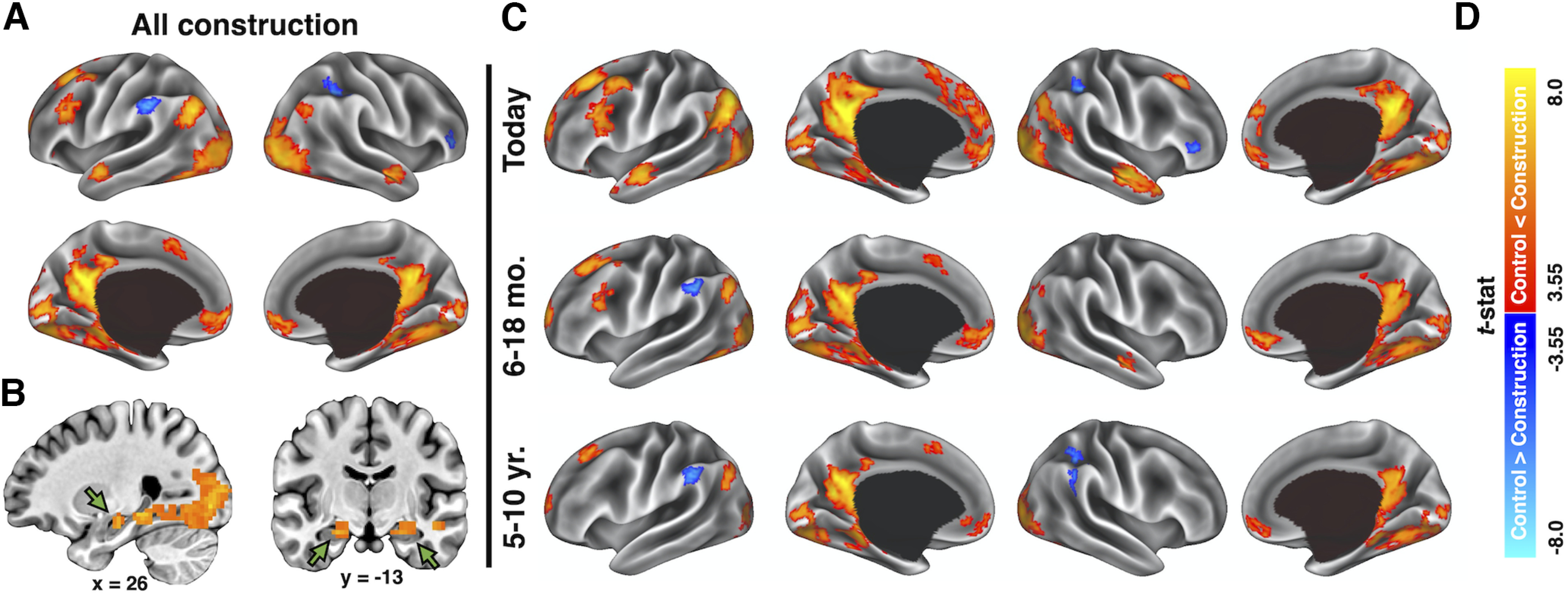
Whole-brain univariate analysis of the memory construction phase relative to the control task. A, Surface reconstruction of cortical regions with significant activation during memory construction relative to the same period of the control task, averaged across temporal distances. B, Sagittal and coronal slices of the same contrast displaying activations identified in the anterior hippocampus, as pointed to by the green arrows. C, Surface reconstruction of cortical regions with significant activation during memory construction relative to the same period of the control task at each temporal distance. D, Color bar of statistical maps for A–C. Data in A and C were surface projected using Connectome Workbench software (Marcus et al., 2011).
Figure 4.
Figure 4.
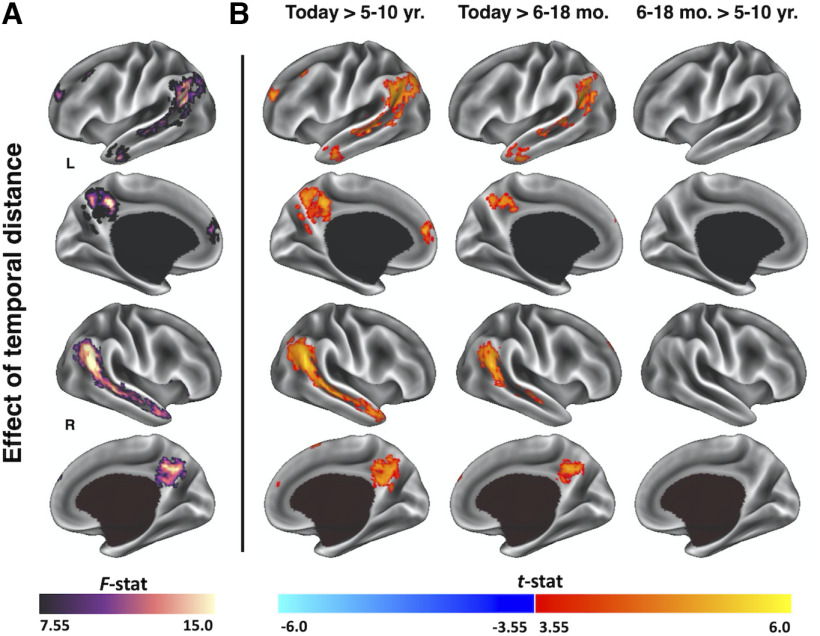
Whole-brain univariate analysis of temporal distance during memory construction. A, Surface reconstruction of cortical regions with significantly different activation as a function of temporal distance. B, Surface reconstruction of significant cortical activation differences between pairwise temporal distances. Data were surface projected using Connectome Workbench (software Marcus et al., 2011).

References

    1. Addis DR, Schacter DL (2008) Constructive episodic simulation: temporal distance and detail of past and future events modulate hippocampal engagement. Hippocampus 18:227–237. 10.1002/hipo.20405 - DOI - PubMed
    1. Addis DR, Schacter DL (2012) The hippocampus and imagining the future: where do we stand? Front Hum Neurosci 5:173. 10.3389/fnhum.2011.00173 - DOI - PMC - PubMed
    1. Addis DR, Wong AT, Schacter DL (2007) Remembering the past and imagining the future: common and distinct neural substrates during event construction and elaboration. Neuropsychologia 45:1363–1377. 10.1016/j.neuropsychologia.2006.10.016 - DOI - PMC - PubMed
    1. Addis DR, Cheng T, Roberts RP, Schacter DL (2011) Hippocampal contributions to the episodic simulation of specific and general future events. Hippocampus 21:1045–1052. 10.1002/hipo.20870 - DOI - PMC - PubMed
    1. Audrain S, McAndrews MP (2020) Schemas provide a scaffold for neocortical integration at the cost of memory specificity over time. bioRxiv 335166. doi: 10.1101/2020.10.11.33516610.1101/2020.10.11.335166. - DOI - DOI

LinkOut - more resources