. 2023 Feb;41(2):262-272.
doi: 10.1038/s41587-022-01393-0. Epub 2022 Jul 18.

Engineering circular RNA for enhanced protein production

Affiliations

Engineering circular RNA for enhanced protein production

Robert Chen et al. Nat Biotechnol. 2023 Feb.

Erratum in

Abstract

Circular RNAs (circRNAs) are stable and prevalent RNAs in eukaryotic cells that arise from back-splicing. Synthetic circRNAs and some endogenous circRNAs can encode proteins, raising the promise of circRNA as a platform for gene expression. In this study, we developed a systematic approach for rapid assembly and testing of features that affect protein production from synthetic circRNAs. To maximize circRNA translation, we optimized five elements: vector topology, 5' and 3' untranslated regions, internal ribosome entry sites and synthetic aptamers recruiting translation initiation machinery. Together, these design principles improve circRNA protein yields by several hundred-fold, provide increased translation over messenger RNA in vitro, provide more durable translation in vivo and are generalizable across multiple transgenes.


Conflict of interest statement

Stanford University has filed patent applications based on this work in which R.C., S.K.W., L.A. and H.Y.C. are named as inventors. R.C. is an advisor to Circ Bio. H.Y.C. is a co-founder of Accent Therapeutics, Boundless Bio, Cartography Biosciences and Circ Bio and an advisor to 10x Genomics, Arsenal Biosciences and Spring Discovery. P.A.W. is a co-founder of BryoLogyx and N1 Life and an advisor to BryoLogyx, N1 Life, Synaptogenix, Cytokinetics, Evonik, Super Trans Medical, Ativo and Vault Pharma. The remaining authors declare no competing interests.

Figures
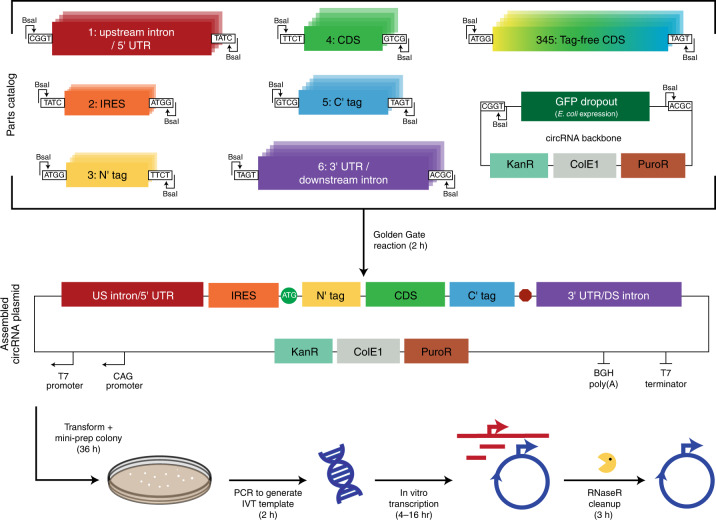
Fig. 1
Fig. 1. A modular cloning platform for circRNA enables rapid design–build–test cycles.
Schematic describing the modular cloning platform used to create template plasmids for circRNA synthesis. Parts 1–6 corresponding to the upstream intron and 5′ UTR, IRES, N-terminal (N′) tag, coding sequence (CDS), C-terminal (C′) tag and 3′ UTR and the downstream intron were individually cloned into part plasmids via Golden Gate reactions (Supplementary Fig. 1). Part plasmids and the circRNA backbone were then combined in a second Golden Gate reaction to create a circRNA plasmid. The circRNA backbone contains a CAG promoter enabling circRNA transcription after transient transfection in cellulo, a T7 promoter enabling IVT, homology sequences that assist with RNA circularization, low-structure regions that facilitate RNaseR processivity and a bacterially expressed GFP dropout sequence to negatively select for incorrect assemblies. If a CDS without N′ or C′ tags was used, parts 3–5 were replaced with a single part. PCR products from circRNA plasmids were subsequently used as templates for IVT to synthesize RNA. Lastly, RNaseR cleanup was performed to digest linear RNAs and isolate circRNA. DS, downstream.
Fig. 2
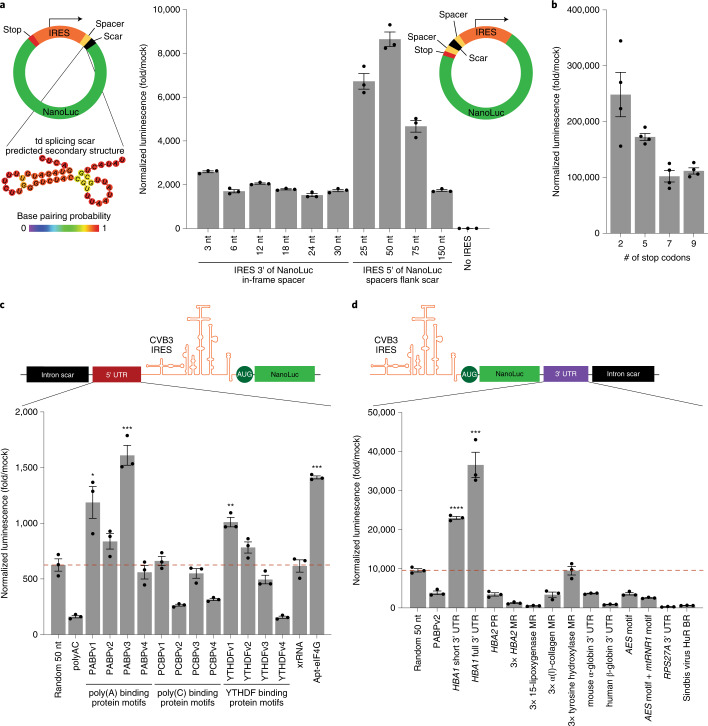
Fig. 2. Optimization of RNA non-coding elements enable stronger circRNA translation.
a, NanoLuc activity after transfection of HeLa cells with circRNAs containing either a 3′ or a 5′ IRES and spacer sequences of varying lengths. When the IRES is 3′ to the NanoLuc reporter, translation through the td splicing scar is unavoidable. The predicted secondary structure of this scar is shown. NanoLuc activity was normalized to constitutive firefly luciferase activity from the same sample and then divided by values from mock transfection. Data are mean ± s.e.m. for n = 3 biological replicates. b, NanoLuc activity at 24 hours after transfection of HeLa cells with circRNAs containing the indicated number of stop codons. NanoLuc activity was normalized to constitutive firefly luciferase activity from the same sample and then divided by values from mock transfection. Data are mean ± s.e.m. for n = 4 biological replicates. c, NanoLuc activity after transfection of HeLa cells with circRNAs containing different 5′ spacer sequences. NanoLuc activity was normalized to constitutive firefly luciferase activity from the same sample and then divided by values from mock transfection. Data are mean ± s.e.m. for n = 3 biological replicates. *P = 0.0213, **P = 0.0051 and ***P < 0.001 by unpaired two-sided t-test compared to a random 50-nt spacer sequence. d, NanoLuc activity after transfection of HeLa cells with circRNAs containing different 3′ UTR sequences. NanoLuc activity was normalized to constitutive firefly luciferase activity from the same sample and then divided by values from mock transfection. Data are mean ± s.e.m. for n = 3 biological replicates. ***P = 0.0012 and ****P < 0.0001 by unpaired two-sided t-test compared to a random 50-nt spacer sequence. BR, binding region; MR, minimal region; PR, protected region. Source data
Fig. 3
Fig. 3. IRES truncations and the secondary structure of the IRES-coding sequence junction affect circRNA translation.
a, NanoLuc activity at 24 hours after transfection of HeLa cells with circRNAs containing deletions of successive IRES domains starting from the 5′ end. Secondary structure and truncation points are indicated on the diagram. NanoLuc activity was normalized to constitutive firefly luciferase activity from the same sample and then divided by values from mock transfection. Data are mean ± s.e.m. for n = 3 biological replicates. b, NanoLuc activity at 24 hours after transfection of HeLa cells with circRNAs containing deletions of individual IRES domains. NanoLuc activity was normalized to constitutive firefly luciferase activity from the same sample and then divided by values from mock transfection. Data are mean ± s.e.m. for n = 3 biological replicates. c, NanoLuc activity at 24 hours after transfection of HeLa cells with circRNAs containing successive 10-nt deletions starting from the 3′ end of the IRES, immediately before the AUG start codon. NanoLuc activity was normalized to constitutive firefly luciferase activity from the same sample and then divided by values from mock transfection. Data are mean ± s.e.m. for n = 3 biological replicates. d, Correlations between the indicated properties and NanoLuc activity at 24 hours after transfection of HeLa cells with circRNAs containing different N-terminal leader sequences between the AUG start codon and NanoLuc reporter. NanoLuc activity was normalized to constitutive firefly luciferase activity from the same sample and then divided by values from mock transfection. Data are mean ± s.e.m. for n = 3 biological replicates. D, domain; WT, wild-type. Source data
Fig. 4
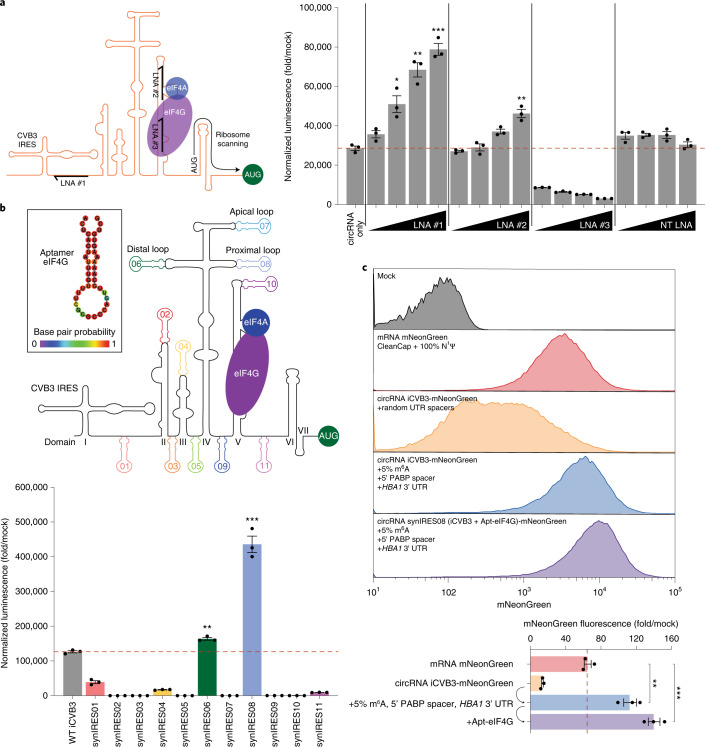
Fig. 4. A synthetic IRES containing an eIF4G-recruiting aptamer drives stronger circRNA translation.
a, NanoLuc activity at 24 hours after co-transfection of HeLa cells with circRNA and escalating doses (4.2–33.3 nM) of LNAs #1–3 or an NT LNA. LNAs #1–3 were designed to be complementary to regions of iCVB3 as indicated in the schematic. NanoLuc activity was normalized to constitutive firefly luciferase activity from the same sample and then divided by values from mock transfection. Data are mean ± s.e.m. for n = 3 biological replicates. *P = 0.0233, **P < 0.01 and ***P = 0.0001 by unpaired two-sided t-test compared to an equal dose of NT LNA. b, NanoLuc activity at 24 hours after transfection of HeLa cells with circRNAs containing an eIF4G-recruiting aptamer (Apt-eIF4G), shown in inset. Apt-eIF4G was inserted into iCVB3 at 11 different positions as indicated in the schematic. NanoLuc activity was normalized to constitutive firefly luciferase activity from the same sample and then divided by values from mock transfection. Data are mean ± s.e.m. for n = 3 biological replicates. **P = 0.0017 and ***P = 0.0002 by unpaired two-sided t-test compared to wild-type iCVB3. c, mNeonGreen fluorescence at 24 hours after electroporation of HEK293T cells with mRNA or circRNAs containing successive optimizations. mRNA was synthesized with CleanCap reagent, 100% N1Ψ incorporation and a 120-nt poly(A) tail. Mean mNeonGreen fluorescence was measured by flow cytometry and divided by values from mock electroporation. Data are histograms for n > 50,000 live singlet cells per condition and mean ± s.e.m. for n = 3 biological replicates. **P = 0.0044 and ***P = 0.0006 by unpaired two-sided t-test. For gating strategy, see Supplementary Fig. 10a. WT, wild-type. Source data
Fig. 5
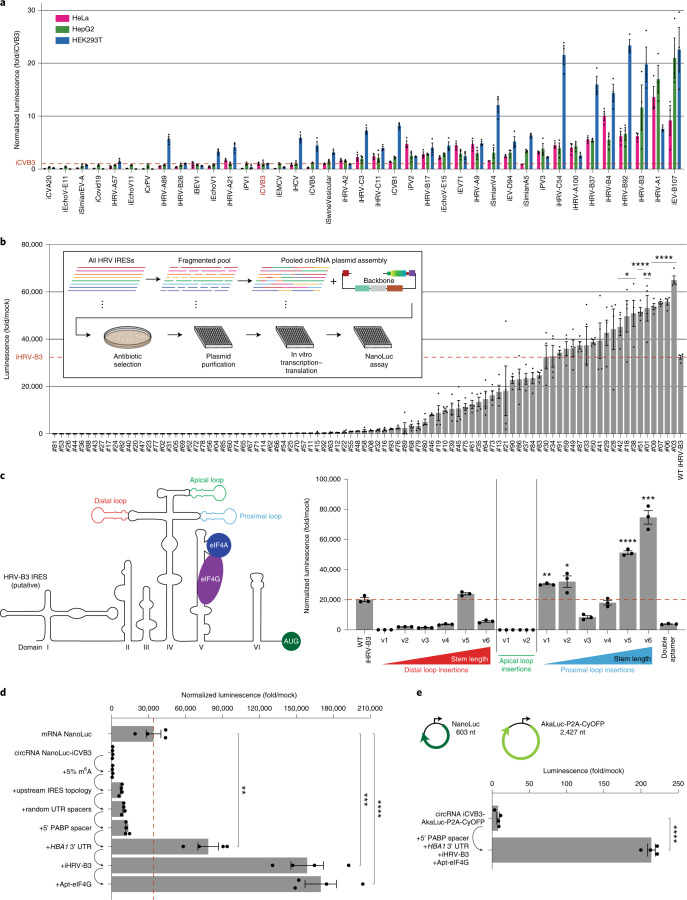
Fig. 5. Large-scale screens and IRES engineering expand the repertoire of strong IRESs.
a, NanoLuc activity at 24 hours after transfection of HeLa, HepG2 and HEK293T cells with circRNAs containing the indicated IRESs. NanoLuc activity was normalized to constitutive firefly luciferase activity from the same sample and then divided by values from mock transfection. Data are mean ± s.e.m. for n = 3 biological replicates. b, NanoLuc activity after IVTT of circRNA plasmids containing shuffled human rhinovirus IRESs. NanoLuc activity was divided by values from mock IVTT. Data are mean ± s.e.m. for n = 4 biological replicates. *P < 0.05, **P = 0.0095 and ****P < 0.0001 by unpaired two-sided t-test compared to wild-type iHRV-B3. c, NanoLuc activity at 24 hours after transfection of HeLa cells with circRNAs containing different insertions of Apt-eIF4G into iHRV-B3. The putative iHRV-B3 secondary structure, predicted eIF4G and eIF4A binding sites and Apt-eIF4G insertion locations are shown. Versions (v1–v6) of each insertion differ in stem length. Double aptamer refers to Apt-eIF4G insertion at both distal and proximal loops. NanoLuc activity was normalized to constitutive firefly luciferase activity from the same sample and then divided by values from mock transfection. Data are mean ± s.e.m. for n = 3 biological replicates. *P = 0.0422, **P = 0.0018, ***P = 0.0003 and ****P < 0.0001 by unpaired two-sided t-test compared to wild-type iHRV-B3. d, NanoLuc activity at 24 hours after transfection of HeLa cells with mRNA or circRNAs containing successive optimizations. mRNA was synthesized with CleanCap reagent, 100% N1Ψ incorporation and a 120-nt poly(A) tail. NanoLuc activity was normalized to constitutive firefly luciferase activity from the same sample and then divided by values from mock transfection. Data are mean ± s.e.m. for n = 4 biological replicates. **P = 0.0051, ***P = 0.0001 and ****P < 0.0001 by unpaired two-sided t-test. e, AkaLuc activity at 24 hours after electroporation of HeLa cells with circRNAs encoding AkaLuc-P2A-CyOFP. CircRNA iCVB3-AkaLuc-P2A-CyOFP was synthesized with 5% m6A, upstream IRES topology and random UTR spacers. AkaLuc activity was divided by values from mock electroporation. Sizes indicate coding sequence lengths for NanoLuc and AkaLuc-P2A-CyOFP. Data are mean ± s.e.m. for n = 4 biological replicates. ****P < 0.0001 by unpaired two-sided t-test. WT, wild-type. Source data
Fig. 6
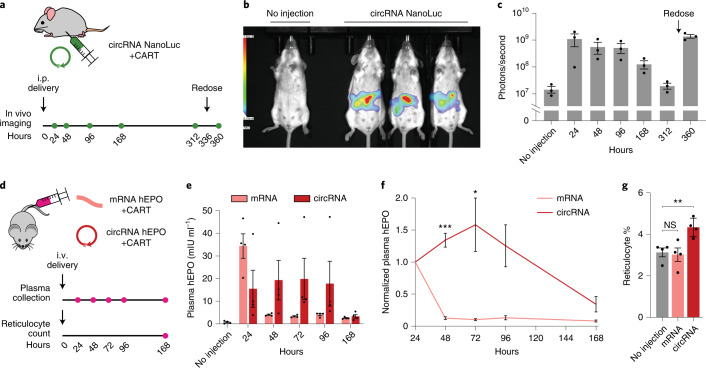
Fig. 6. Engineered circRNAs demonstrate more durable translation and functional activity in vivo.
a, CircRNA with 5% m6A incorporation encoding NanoLuc was synthesized with the following optimizations: upstream IRES topology, 5′ PABP spacer, HBA1 3′ UTR and HRV-B3 IRES with proximal loop Apt-eIF4G insertion. CircRNAs were formulated for intraperitoneal delivery in mice using CARTs. Expression was assayed using an optical imaging system after intraperitoneal injections of the fluorofurimazine substrate at the indicated timepoints. At 336 hours (14 days) after circRNA NanoLuc administration, mice were redosed. b, In vivo luminescence image of an untreated mouse (left) versus mice receiving circRNA NanoLuc (right) at 24 hours after dosing. c, Quantification of luminescence per mouse at different timepoints after circRNA NanoLuc administration. Redosing was performed at 336 hours (14 days). Data are mean ± s.e.m. for n = 3 animals per condition. d, CircRNA with 5% m6A incorporation encoding hEPO was synthesized with the following optimizations: upstream IRES topology, 5′ PABP spacer, HBA1 3′ UTR and HRV-B3 IRES with proximal loop Apt-eIF4G insertion. mRNA-encoding hEPO was synthesized with CleanCap reagent, 100% N1Ψ incorporation and a 120-nt poly(A) tail. Equimolar doses of circRNA and mRNA were formulated for intravenous delivery in mice using CARTs. Plasma hEPO was measured by ELISA in one cohort at the indicated timepoints. Reticulocytes were counted in a separate cohort at 168 hours (7 days). e, Quantification of plasma hEPO at different timepoints after circRNA hEPO or mRNA hEPO administration. Data are mean ± s.e.m. for n = 4 animals per condition. f, Plasma hEPO expression normalized to the 24-hour level of each mouse at different timepoints after circRNA hEPO or mRNA hEPO administration. Data are mean ± s.e.m. for n = 4 animals per condition. *P = 0.0487 and ***P = 0.0001 by unpaired two-sided t-test with Bonferroni correction compared to mRNA. g, Reticulocyte percentage among red blood cells at 168 hours after circRNA hEPO or mRNA hEPO administration. Data are mean ± s.e.m. for n = 4 animals per condition. **P = 0.0080 by unpaired two-sided t-test. NS, not significant. For gating strategy, see Supplementary Fig. 10b. i.p., intraperitoneal; i.v., intravenous. Source data

References

    1. Baden LR, et al. Efficacy and safety of the mRNA-1273 SARS-CoV-2 vaccine. N. Engl. J. Med. 2021;384:403–416. doi: 10.1056/NEJMoa2035389. - DOI - PMC - PubMed
    1. Walsh EE, et al. Safety and immunogenicity of two RNA-based Covid-19 vaccine candidates. N. Engl. J. Med. 2020;383:2439–2450. doi: 10.1056/NEJMoa2027906. - DOI - PMC - PubMed
    1. Obi P, Chen YG. The design and synthesis of circular RNAs. Methods. 2021;196:85–103. doi: 10.1016/j.ymeth.2021.02.020. - DOI - PMC - PubMed
    1. Chen YG, et al. Sensing self and foreign circular RNAs by intron identity. Mol. Cell. 2017;67:228–238. doi: 10.1016/j.molcel.2017.05.022. - DOI - PMC - PubMed
    1. Wesselhoeft RA, Kowalski PS, Anderson DG. Engineering circular RNA for potent and stable translation in eukaryotic cells. Nat. Commun. 2018;9:2629. doi: 10.1038/s41467-018-05096-6. - DOI - PMC - PubMed

Publication types