Shift in Clinical Epidemiology of Human Parainfluenza Virus Type 3 and Respiratory Syncytial Virus B Infections in Korean Children Before and During the COVID-19 Pandemic: A Multicenter Retrospective Study
- PMID: 35851860
- PMCID: PMC9294504
- DOI: 10.3346/jkms.2022.37.e215
Shift in Clinical Epidemiology of Human Parainfluenza Virus Type 3 and Respiratory Syncytial Virus B Infections in Korean Children Before and During the COVID-19 Pandemic: A Multicenter Retrospective Study
Abstract
Background: Parainfluenza virus type 3 (PIV3) and respiratory syncytial virus (RSV) B epidemics occurred in South Korea in late 2021. We investigated epidemiological changes of PIV3 and RSV B infections in Korean children before and during the coronavirus disease 2019 (COVID-19) pandemic.
Methods: In this multicenter retrospective study, we enrolled patients aged less than 19 years with PIV3 or RSV infection in four university hospitals from January 2018 to January 2022. Demographic and clinical data were extracted from the subject's medical records and analyzed for each virus.
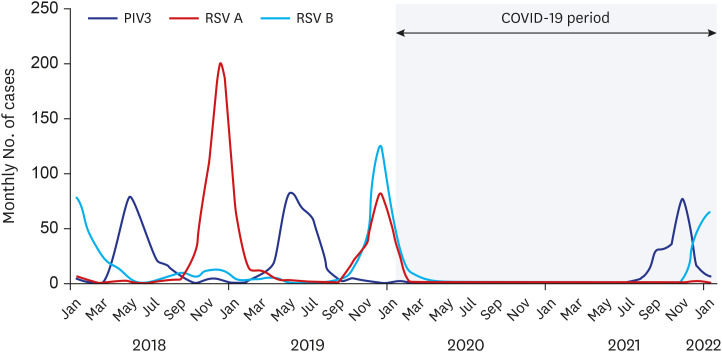
Results: A total of 652 children with PIV3 were identified including three epidemics: 216 in 2018, 260 in 2019, and 167 in 2021. Among 627 RSV B cases, 169 were identified in 2017/2018, 274 in 2019/2020, and 115 in 2021/2022. The peak circulation of PIV3 and RSV B epidemics were delayed by 6 and 2 months, respectively, in 2021, compared with those in the pre-COVID-19 period. The median age of PIV3 infections increased in 2021 (21.5 months in 2021 vs. 13.0-14.0 in 2018-2019; P < 0.001), whereas that of RSV B infections remained unchanged (3.6-4.0 months). During the COVID-19 pandemic, less frequent hospitalization rates were observed for both PIV3 and RSV B infections, but more children needed respiratory assistance for RSV B infection in 2021/2022 epidemic (32.5%) than before (14.7-19.4%, P = 0.014).
Conclusion: We observed changes in the epidemiology and clinical presentation of PIV3 and RSV B infections in Korean children during the COVID-19 pandemic.
Keywords: COVID-19; Children; Human Parainfluenza Virus 3; Nonpharmaceutical Intervention; Respiratory Syncytial Virus.
© 2022 The Korean Academy of Medical Sciences.
Conflict of interest statement
The authors have no potential conflicts of interest to disclose.
Figures
References
Publication types
MeSH terms
Substances
LinkOut - more resources
Full Text Sources
Medical