Review
. 2022 Oct 4;61(40):e202206631.
doi: 10.1002/anie.202206631. Epub 2022 Sep 5.

Chemically Driven Rotatory Molecular Machines

Affiliations
Review

Chemically Driven Rotatory Molecular Machines

Anirban Mondal et al. Angew Chem Int Ed Engl. .

Abstract

Molecular machines are at the frontier of biology and chemistry. The ability to control molecular motion and emulating the movement of biological systems are major steps towards the development of responsive and adaptive materials. Amazing progress has been seen for the design of molecular machines including light-induced unidirectional rotation of overcrowded alkenes. However, the feasibility of inducing unidirectional rotation about a single bond as a result of chemical conversion has been a challenging task. In this Review, an overview of approaches towards the design, synthesis, and dynamic properties of different classes of atropisomers which can undergo controlled switching or rotation under the influence of a chemical stimulus is presented. They are categorized as molecular switches, rotors, motors, and autonomous motors according to their type of response. Furthermore, we provide a future perspective and challenges focusing on building sophisticated molecular machines.

Keywords: Chemically Driven Molecular Machines; Molecular Motors; Molecular Rotors; Molecular Switches.


Conflict of interest statement

The authors declare no conflict of interest.

Figures

Figure 1
Figure 1
a) Schematic illustrations of different controlled movements and types of molecular machines. They consist of a rotator (green) and a stator (orange) which are held together with an axle (black). b) Illustrative examples of the early pioneering developments of restricted molecular rotation about a C−C single bond which resulted in various applications in the area of asymmetric catalysis and molecular machines.
Scheme 1
Scheme 1
Molecular switch Rac ‐1 a regulated by intermolecular H‐bonds.
Scheme 2
Scheme 2
Conformational control of a cannabidiol derivative by solvent polarity.
Scheme 3
Scheme 3
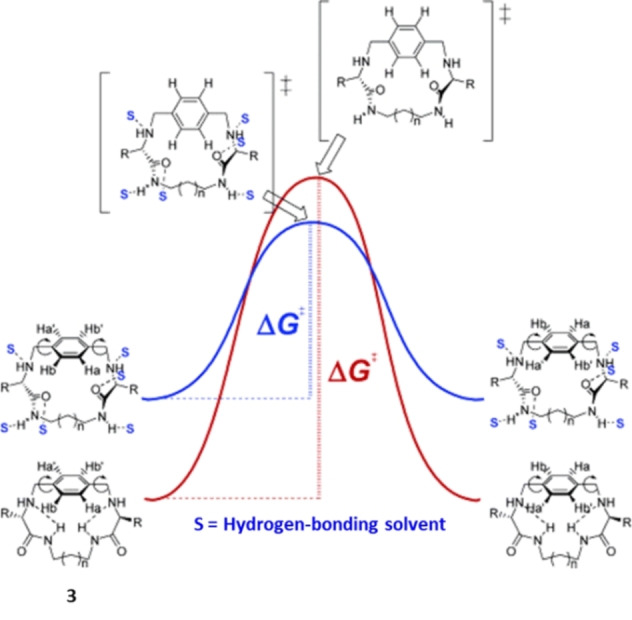
The effect of polar solvents on the energy barrier of the aromatic ring rotation of peptidomimetic cyclophanes. Reproduced with permission from ref.  Copyright 2006, American Chemical Society.
Scheme 4
Scheme 4
a) Base‐controlled switching of molecular conformation by controlling rotation in anthracene trimer 4. b) Mechanism of the cistrans isomerization via a quinoid‐type planar conformation.
Scheme 5
Scheme 5
a) Schematic representation of a pH‐driven biaryl switch. b) Change in photoluminescence upon switching. Reproduced with permission from ref.  Copyright 2012, Elsevier.
Scheme 6
Scheme 6
A 180° rotation about the acetylene axis by modulation of the H‐bonding interaction.
Scheme 7
Scheme 7
a) An acid/base‐mediated uptake and release of halide ion through a conformational switching. b) An illustration of halide anions being taken up and released when switching between 7 and (7‐2H). Reproduced with permission from ref.  Copyright 2015, Wiley‐VCH.
Scheme 8
Scheme 8
Molecular strands switchable between the extended and contracted forms. Reproduced with permission from ref.  Copyright 2002, National Academy of Sciences.
Scheme 9
Scheme 9
a) Fe3+‐sensitive molecular fluorimetric switch. b) Fluorogenic changes between 9 and 9′. Reproduced with permission from ref.  Copyright 2014, Royal Society of Chemistry.
Scheme 10
Scheme 10
Catalytic nanoswitch regulated by metal coordination. Reproduced with permission from ref.  Copyright 2012, Wiley‐VCH.
Scheme 11
Scheme 11
Redox‐active switch based on a copper‐bipyrimidine complex. Reproduced with permission from ref. [67d] Copyright 2013, Royal Society of Chemistry.
Scheme 12
Scheme 12
a) Blueprint of reversible molecular tweezers (black) for fullerene recognition (purple) controlled by an atropoisomerization of bpy. b) CuI‐mediated reversible syn/anti conformational switching.
Scheme 13
Scheme 13
Bisarylanthracene rotary switch responsive to singlet oxygen and possible electrostatic interactions in the radical intermediate Int‐13.
Scheme 14
Scheme 14
a, b) Molecular rotors regulated by hydrogen bonds.[ 73 , 74 ]
Scheme 15
Scheme 15
a) An acid‐accelerated molecular rotor b) H‐bonding interaction stabilizes the planar TS. Reproduced with permission from ref.  Copyright 2012, American Chemical Society.
Scheme 16
Scheme 16
a) Rotational pathways of acid accelerated molecular rotor. b) DFT calculations of two different planar transition states of 16. c) An acid acid/base‐mediated rotational switch. d) DFT calculations of two different planar transition state of 16‐H+ .
Scheme 17
Scheme 17
An acid‐accelerated molecular rotor.
Scheme 18
Scheme 18
a) Succinimide molecular rotor with tunable rotation speed via chemical stimuli. b) An illustration of the molecular rotor which can mimic a macroscopic electric fan.
Scheme 19
Scheme 19
a) Kelly's molecular brake regulated by metal coordination. b) Paddlewheel rotor with indenyl‐metal complex. Reproduced with permission from ref.  Copyright 1994, American Chemical Society, and ref. [81b] Copyright 2012, American Chemical Society.
Figure 2
Figure 2
a) Proposed mechanism for the atropisomerization of a configurationally stable biaryl compound; b–d) a directed facile atropisomerization of the bridged biaryl; e) Proposed mechanism for the racemization of (R)‐2 AA; f) Schematic representation of a biaryl molecular motor. g) Left: Energy profile diagram of the atropisomerization process from (M)‐A to (P)‐A, where the barrier of rotation without chemical fuel is high; right: the energy profile of unidirectional rotation from (M)‐A to (P)‐A using a chemical fuel.
Scheme 20
Scheme 20
a) Unidirectional 120° rotation in a three‐bladed triptycene unit using phosgene as “fuel”. Reproduced with permission from ref.  Copyright 1999, Springer Nature. b) A schematic representation of a possible rotatory molecular motor by Kelly and co‐workers. Reproduced with permission from ref.  Copyright 2007, American Chemical Society.
Scheme 21
Scheme 21
a) A blueprint towards the unidirectional bond rotation around the biaryl single bond proposed by Branchaud and co‐workers. b) Demonstration of a unidirectional 180° rotation using chiral nucleophiles. c) Rotational behavior of lactone (S)‐21 B bearing an extra asymmetric center. Note: All the steps shown is performed using a racemic mixture, but only the rotational pathway of (S)‐21B is shown for clarity.
Scheme 22
Scheme 22
a) First example of a chemically driven rotary molecular motor by Feringa and co‐workers. Step 1: Enantioselective ring opening of cyclic lactone using (S)‐2‐methyl‐CBS‐oxazaborolidine solution then BH3; Step 2: Protection with allyl bromide; Step 3: Oxidation of benzyl alcohol using CrO3.H2SO4.H2O,then NaClO2; Step 4: Removal of PMB using Ce(OTf)3; Step 6: Another enantioselective ring opening of cyclic lactone using (S)‐2‐methyl‐CBS‐oxazaborolidine solution then BH3; Step 7: Protection with p‐methoxybenzyl chloride; Step 8: Oxidation of benzyl alcohol with MnO2 then NaClO2; Step 9: Removal of allyl ether with Pd(PPh3)4/HCO2H. b) The 360° rotation of a molecular motor via chiral bridged lactone formation by Feringa and Zhao. Step 1: Hydrolysis using HCl/MeOH; Step 2: Lactonization using EDCI; Step 3: Diastereoselective ring opening using MeONa and protection of phenolic hydroxyl group with MOMCl; Step 4: Removal of the benzyl protecting group using Pd/C, H2; Step 5: Lactonization using EDCI; Step 6: Diastereoselective ring opening using MeONa and protection of phenolic hydroxyl group with benzyl bromide.
Scheme 23
Scheme 23
Palladium redox cycle driven molecular motor developed by Feringa and co‐workers. One full rotational cycle in four steps, Step 1: C−H activation (using Pd(OAc)2), Step 2: Reintroduction of C−H bond (using NaBH(OAc)3); Step 3: Oxidative addition (using Pd2(dba)3), Step 4: Reintroduction of C−Br bond (using NBS).
Scheme 24
Scheme 24
The first autonomous engine to cause 360° rotation around a single bond by catalysis.1‐Phenylpyrrole‐2,2′‐dicarboxylic acid 24 can continuously convert energy from a chemical fuel to cause repeated 360° rotation of the two aromatic rings through the continuous intramolecular anhydride formation between the rings and hydrolysis of the anhydride. The chiral fuel 25 and the hydrolysis catalyst 26 are used to create a directional bias leading to a net rotation around the N−C bond.
Figure 3
Figure 3
Challenges and prospectives. a) A roadmap outlining some of the challenges, in transforming molecular motors and rotors into autonomous molecular motors. b) A proposed blueprint of a catalytic molecular motor.

References

    1. Feynman R., Eng. Sci. 1960, 23, 22–36.
    1. None
    1. Kinbara K., Aida T., Chem. Rev. 2005, 105, 1377–1400; - PubMed
    1. Browne W. R., Feringa B. L., Nat. Nanotechnol. 2006, 1, 25–35; - PubMed
    1. Champin B., Mobian P., Sauvage J.-P., Chem. Soc. Rev. 2007, 36, 358–366; - PubMed

Publication types

LinkOut - more resources