Meta-Analysis
. 2022 Jul 19;22(1):792.
doi: 10.1186/s12885-022-09816-6.

Integration of metabolites from meta-analysis with transcriptome reveals enhanced SPHK1 in PDAC with a background of pancreatitis

Affiliations
Meta-Analysis

Integration of metabolites from meta-analysis with transcriptome reveals enhanced SPHK1 in PDAC with a background of pancreatitis

Vijayasarathy Ketavarapu et al. BMC Cancer. .

Erratum in

Abstract

Background: Pathophysiology of transformation of inflammatory lesions in chronic pancreatitis (CP) to pancreatic ductal adenocarcinoma (PDAC) is not clear.

Methods: We conducted a systematic review, meta-analysis of circulating metabolites, integrated this data with transcriptome analysis of human pancreatic tissues and validated using immunohistochemistry. Our aim was to establish biomarker signatures for early malignant transformation in patients with underlying CP and identify therapeutic targets.

Results: Analysis of 19 studies revealed AUC of 0.86 (95% CI 0.81-0.91, P < 0.0001) for all the altered metabolites (n = 88). Among them, lipids showed higher differentiating efficacy between PDAC and CP; P-value (< 0.0001). Pathway enrichment analysis identified sphingomyelin metabolism (impact value-0.29, FDR of 0.45) and TCA cycle (impact value-0.18, FDR of 0.06) to be prominent pathways in differentiating PDAC from CP. Mapping circulating metabolites to corresponding genes revealed 517 altered genes. Integration of these genes with transcriptome data of CP and PDAC with a background of CP (PDAC-CP) identified three upregulated genes; PIGC, PPIB, PKM and three downregulated genes; AZGP1, EGLN1, GNMT. Comparison of CP to PDAC-CP and PDAC-CP to PDAC identified upregulation of SPHK1, a known oncogene.

Conclusions: Our analysis suggests plausible role for SPHK1 in development of pancreatic adenocarcinoma in long standing CP patients. SPHK1 could be further explored as diagnostic and potential therapeutic target.

Keywords: Chronic pancreatitis; Metabolomic biomarkers; PDAC with background of CP; Pancreatic ductal adenocarcinoma; SPHK1; Transcriptomics.


Conflict of interest statement

The authors declare no competing interest.

Figures

Fig. 1
Fig. 1
Schematic flowchart of systematic review
Fig. 2
Fig. 2
Forest plots of altered metabolites identified in meta-analysis (A) Forest plot of 19 metabolomic studies using AUC values and computed standard error. Heterogeneity (I2) was assessed for fixed and random effects (B) Forest plot of lipid metabolites retrieved from 11 studies (C) Forest plot of carbohydrate metabolites retrieved from 6 studies (D) Forest plot of amino acid metabolites retrieved from 13 studies. Metabolic pathway analysis using metaboAnalyst identified (E) Enriched glycerophospholipid pathway for circulatory metabolites detected in healthy control and PDAC. Metabolites marked in red are altered in PDAC patients as compared to healthy controls (F) metaboAnalyst analysis identified enriched arginine and glutamate metabolism for circulatory metabolites detected in PDAC as compared to healthy controls/chronic pancreatitis. Metabolites are marked in red and their fold changes are in blue color (G) metaboAnalyst analysis identified enriched sphingomyelin pathway and TCA cycle for circulatory metabolites detected in PDAC and CP patients. Metabolites are marked in red and their fold changes are in blue color
Fig. 3
Fig. 3
Metabolic networks, genes and integration of transcriptome (A) Metabolites mapped from selected studies (red) and their networks of significance operating in chronic pancreatitis and pancreatic cancer patients. PIGC, PPIB and PKM are upregulated in CP, PDAC-CP. AZGP1, EGLN1 and GNMT are downregulated in CP and PDAC-CP. SPHK1 upregulated in PDAC-CP and AK1RB1, KMT2C are downregulated in PDAC-CP. These genes are mapped to their respective metabolic pathways (B) Integration of metabolome and transcriptome yielding 102 common genes in chronic pancreatitis and pancreatic cancer human tissues (C) Distribution of genes and types of metabolites
Fig. 4
Fig. 4
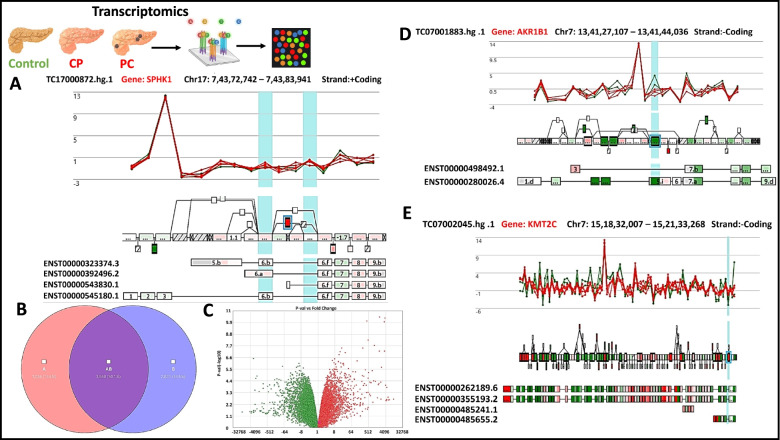
Transcriptomics (A) Splicing index of SPHK1(4.01), upregulated gene in PDAC-CP tissue, red and green lines represent splicing index between CP and PDAC-CP (B) Venn diagram of genes overlapped in CP and PDAC-CP tissues, genes unique in CP, 1553 genes (pink) 13.4%, unique in PDAC-CP, 4220 genes 36.5%(blue), overlapped between CP and PDAC, 5912 genes, 50.1%(purple) (C) Volcano plot of CP, PDAC-CP, fold-change vs P-value for genes (D) Splicing index of AKR1B1 (− 9.65) down regulated gene in PDAC-CP tissue, red and green lines represent splicing index between CP and PDAC-CP (E) Splicing index of KMT2C (− 59.4) downregulated gene in PDAC-CP tissue, red and green lines represent splicing index between CP and PDAC-CP
Fig. 5
Fig. 5
Representative images of SPHK1 expression in acini (A)-(C), duct (D)-(F), islet (G-I), blood vessel(J-L) and CD31 expression in blood vessel(M-O) among CP, PDAC-CP and PDAC. Images were captured using Olympus BX63 microscope, 40X objective, scale bar = 10 μm
Fig. 6
Fig. 6
Integration of metabolome data derived from meta-analysis and experimental transcriptome among healthy control, CP, and PDAC-CP patients.

References

    1. Collaborators GBDPC. The global, regional, and national burden of pancreatic cancer and its attributable risk factors in 195 countries and territories, 1990-2017: a systematic analysis for the global burden of disease study 2017. Lancet. Gastroenterol Hepatol. 2019;4(12):934–947. - PMC - PubMed
    1. Munigala S, Singh A, Gelrud A, Agarwal B. Predictors for pancreatic Cancer diagnosis following new-onset diabetes mellitus. Clin Transl Gastroenterol. 2015;6:e118. doi: 10.1038/ctg.2015.44. - DOI - PMC - PubMed
    1. Brodovicz KG, Kou TD, Alexander CM, O'Neill EA, Engel SS, Girman CJ, et al. Impact of diabetes duration and chronic pancreatitis on the association between type 2 diabetes and pancreatic cancer risk. Diabetes Obes Metab. 2012;14(12):1123–1128. doi: 10.1111/j.1463-1326.2012.01667.x. - DOI - PubMed
    1. Siegel RL, Miller KD, Jemal A. Cancer statistics, 2018. CA Cancer J Clin. 2018;68(1):7–30. doi: 10.3322/caac.21442. - DOI - PubMed
    1. Hezel AF, Kimmelman AC, Stanger BZ, Bardeesy N, Depinho RA. Genetics and biology of pancreatic ductal adenocarcinoma. Genes Dev. 2006;20(10):1218–1249. doi: 10.1101/gad.1415606. - DOI - PubMed

MeSH terms