Repeated cerebellar infarction in the affected nondominant vertebral artery distribution with reversible vertebral artery occlusion elicited by head tilt: illustrative case
- PMID: 35855310
- PMCID: PMC9241342
- DOI: 10.3171/CASE2061
Repeated cerebellar infarction in the affected nondominant vertebral artery distribution with reversible vertebral artery occlusion elicited by head tilt: illustrative case
Abstract
Background: Bow hunter's syndrome or stroke (BHS) is characterized by rotational vertebrobasilar insufficiency elicited by rotation of the neck. It is caused by dynamic and reversible occlusion of the vertebral artery (VA). Reversible symptoms of rotational vertebrobasilar insufficiency are described as bow hunter's syndrome, although brain infarction is rarely reported as bow hunter's stroke.
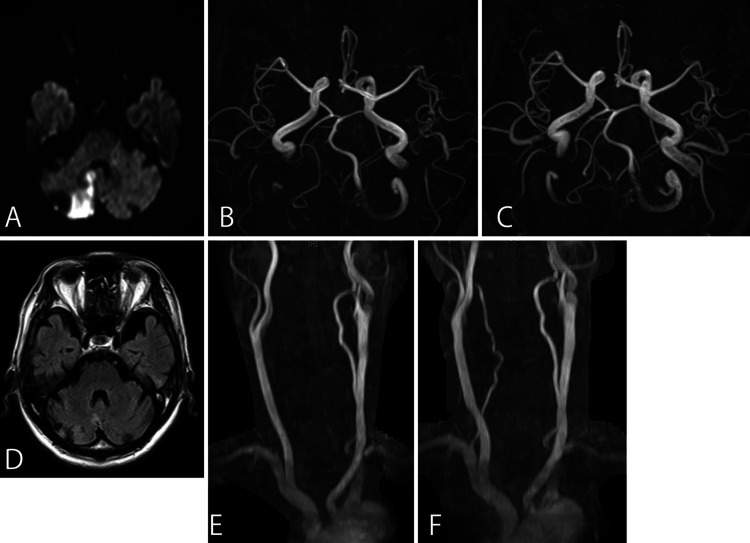
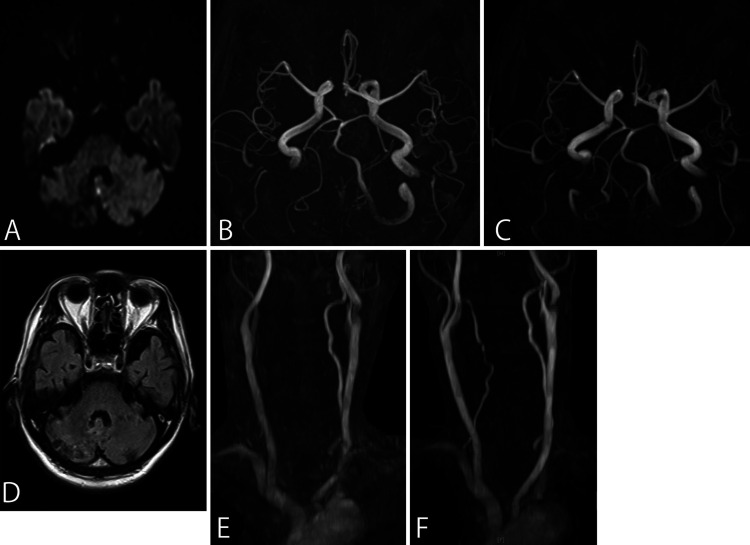
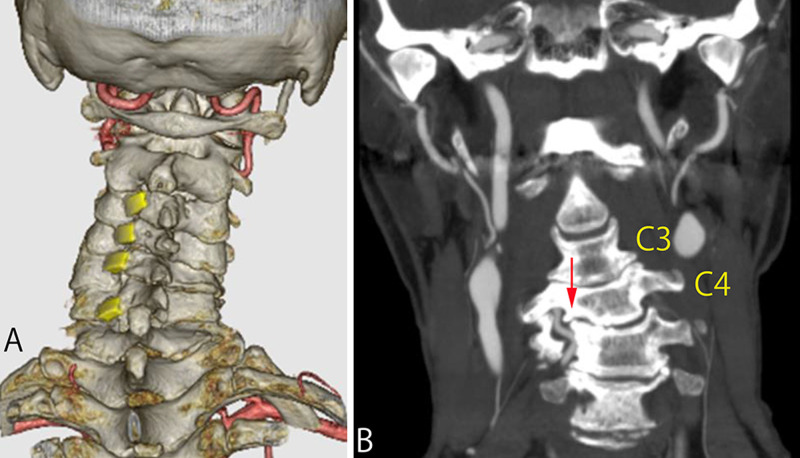
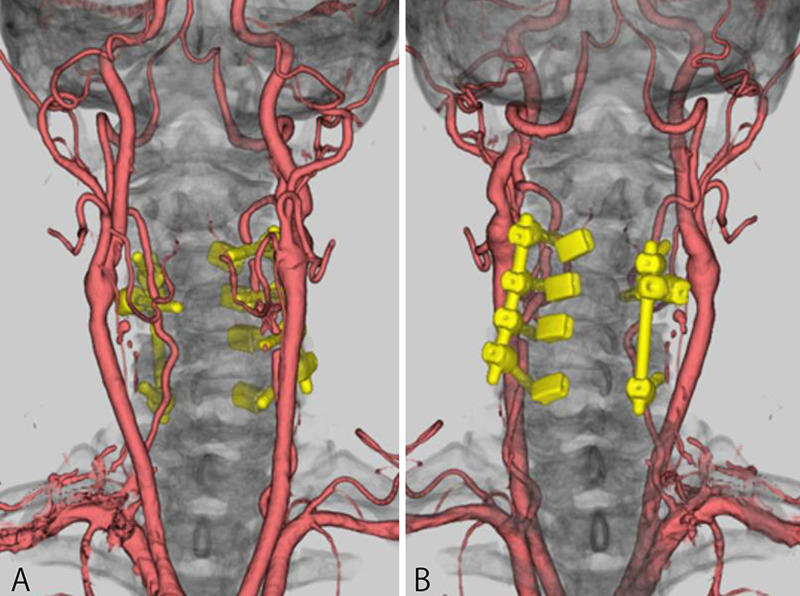
Observations: A 70-year-old man experienced repeated cerebellar infarctions three times in the posterior inferior cerebellar artery (PICA) distribution of the nondominant right VA connecting the basilar artery. The onset of symptoms indicating cerebellar infarcts and the patient's head position changes were unrelated. Dynamic digital angiography (DA) revealed that the nondominant right VA was occluded by an osteophyte from the C4 vertebral body, and the right PICA branches were shown to be passing through the distal right VA from the left VA. These findings were observed when the patient's head was tilted to the right. An arterio-arterial embolic mechanism was suggested as the cause of repeated cerebellar infarctions.
Lessons: Transient nondominant VA occlusion has been rarely reported as a cause of BHS when the head is tilted. To confirm the diagnosis of BHS, additional head tilt is recommended when performing dynamic DA in patients with a cervical osteophyte.
Keywords: 3D-CTA = three-dimensional computed tomography angiography; BHS = bow hunter’s syndrome or stroke; DA = digital angiography; DSA = digital subtraction angiography; DWI = diffusion-weighted imaging; MRA = magnetic resonance angiography; MRI = magnetic resonance imaging; PICA = posterior inferior cerebellar artery; VA = vertebral artery; bow hunter’s syndrome; cervical osteophyte; head tilt; repeated cerebellar infarction; stroke; transient vertebral artery occlusion.
© 2021 The authors.
Conflict of interest statement
Disclosures The authors report no conflict of interest concerning the materials or methods used in this study or the findings specified in this paper.
Figures

References
-
- Bakay L, Leslie EV. Surgical treatment of vertebral artery insufficiency caused by cervical spondylosis. J Neurosurg. 1965;23(6):596–602. - PubMed
-
- Nagashima C. Surgical treatment of vertebral artery insufficiency caused by cervical spondylosis. J Neurosurg. 1970;32(5):512–521. - PubMed
-
- Husni EA, Bell HS, Storer J. Mechanical occlusion of the vertebral artery. A new clinical concept. JAMA. 1966;196(6):475–478. - PubMed
-
- Jost GF, Dalley AT. Bow hunter’s syndrome revisited: 2 new cases and literature review of 124 cases. Neurosurg Focus. 2015;38(4):E7. - PubMed
-
- Sorensen BF. Bow hunter’s stroke. Neurosurgery. 1978;2(3):259–261. - PubMed
Publication types
LinkOut - more resources
Full Text Sources
Miscellaneous