. 2022 Jul 11;13(4):1015-1029.
doi: 10.14336/AD.2021.1204.

SIRT6 in Vascular Diseases, from Bench to Bedside

Affiliations

SIRT6 in Vascular Diseases, from Bench to Bedside

Si-Chong Ren et al. Aging Dis. .

Abstract

Aging is a key risk factor for angiogenic dysfunction and cardiovascular diseases, including heart failure, hypertension, atherosclerosis, diabetes, and stroke. Members of the NAD+-dependent class III histone deacetylase family, sirtuins, are conserved regulators of aging and cardiovascular and cerebrovascular diseases. The sirtuin SIRT6 is predominantly located in the nucleus and shows deacetylase activity for acetylated histone 3 lysine 56 and lysine 9 as well as for some non-histone proteins. Over the past decade, experimental analyses in rodents and non-human primates have demonstrated the critical role of SIRT6 in extending lifespan. Recent studies highlighted the pleiotropic protective actions of SIRT6 in angiogenesis and cardiovascular diseases, including atherosclerosis, hypertension, heart failure, and stroke. Mechanistically, SIRT6 participates in vascular diseases via epigenetic regulation of endothelial cells, vascular smooth muscle cells, and immune cells. Importantly, SIRT6 activators (e.g., MDL-800/MDL-811) have provided therapeutic value for treating age-related vascular disorders. Here, we summarized the roles of sirtuins in cardiovascular diseases; reviewed recent advances in the understanding of SIRT6 in vascular biology, cardiovascular aging, and diseases; highlighted its therapeutic potential; and discussed future perspectives.

Keywords: activator; aging; angiogenesis; sirt6; sirtuin; vascular disease.


Conflict of interest statement

Conflict of interest The authors declare that they have no competing interests.

Figures
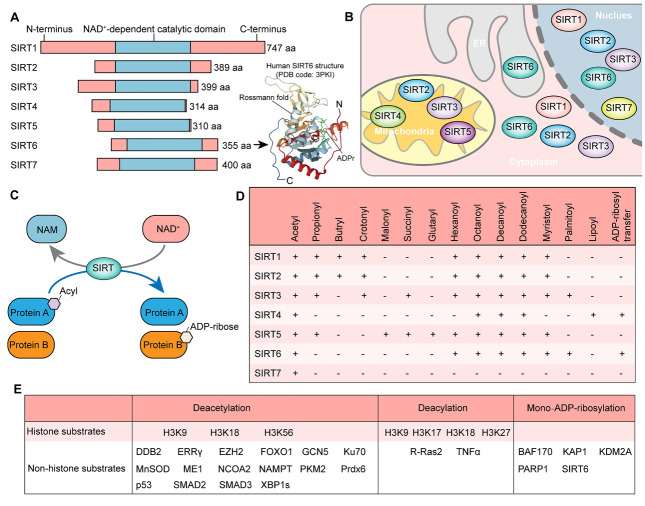
Figure 1.
Figure 1.
Basic information about Sirtuins. (A) Structures of Sirtuin members (left) and key domains of SIRT6 (PDB code: 3PKI). (B) Subcellular locations of Sirtuin members. ER, endoplasmic reticulum. (C) The enzymatic activity model catalyzed by Sirtuin members. NAD, nicotinamide adenine dinucleotide; NAM, nicotinamide. (D) Enzyme activity of Sirtuins for deacylation and ADP-ribosylation. (E) Substrates of SIRT6. DDB2, Damage specific DNA binding protein 2; ERRγ, Estrogen-related receptor γ; EZH2, Enhancer Of Zeste 2 polycomb repressive complex 2 subunit; FOXO1, Forkhead Box O1; GCN5, General control nonderepressible 5; Ku70, Ku autoantigen P70 subunit; MnSOD, Manganese-containing superoxide dismutase; ME1, Malic enzyme 1; NCOA2, Nuclear receptor coactivator 2; NAMPT, Nicotinamide phosphoribosyltransferase; PKM2, Pyruvate kinase M2; Prdx6, Peroxiredoxin 6; SMAD2, SMAD family member 2; XBP1s, Spliced form of X-box binding protein 1; R-Ras2, RAS related 2; TNFα, Tumor necrosis factor-alpha; BAF170, BRG1-associated factor 170; KAP1, KRAB domain-associated protein 1; KDM2A, Lysine demethylase 2A; PARP1, Poly (ADP-ribose) polymerase 1.
Figure 2.
Figure 2.
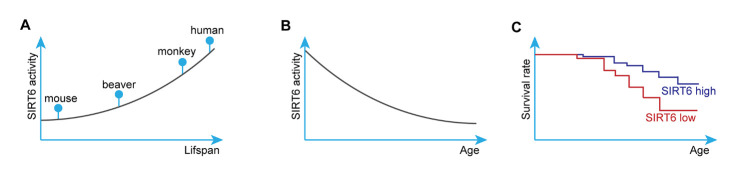
SIRT6 function in regulating aging. (A) SIRT6 activity is higher in long-lived species. SIRT6 is responsible for more efficient DNA double-strand break repair in long-lived species. (B) SIRT6 activity declines with aging in primates and rodents. (C) SIRT6 high expression expands lifespan in mice.
Figure 3.
Figure 3.
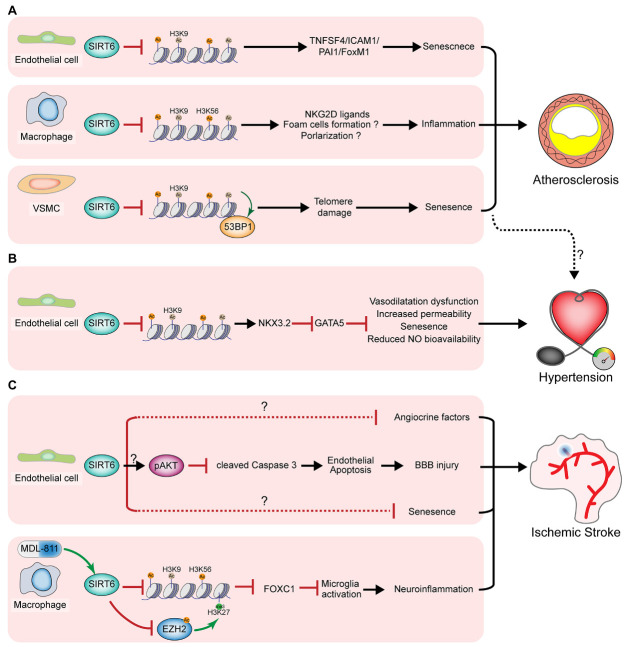
SIRT6 function in regulating vascular disease (Central Illustration). (A) SIRT6 represses the initiation, development, and plaque instability of atherosclerosis. In endothelial cells, SIRT6 epigenetically represses the production of pro-inflammatory angiocrine factors and senescence-associated secretory phenotype, thus inhibiting endothelial dysfunction and senescence to reduce initiation and development of atherosclerosis. In macrophages, SIRT6 deacetylates H3K9ac and H3K56ac to reduce the expression of natural-killer group 2, member D (NKG2D) ligands, inhibiting the activation of immune cells and atherosclerosis development. SIRT6 also maintains the telomere integrity by deacetylating H3K9ac at the telomere and inhibiting 53BP1 binding, thus suppressing vascular smooth muscle cells (VSMCs) senescence. SIRT6 deficiency leads to VSMC senescence and plaque instability of atherosclerosis. PAI1, plasminogen activator inhibitor-1; TNFSF4, TNF superfamily member 4; FoxM1, Forkhead box protein M1; ICAM1, intercellular adhesion molecule-1. (B) SIRT6 suppresses hypertension. By deacetylating H3K9ac, endothelial SIRT6 inhibits NKX3.2 (NK3 homeobox 2) expression to reduce the transcription of GATA5 (GATA-binding protein 5), a transcriptional factor controlling blood pressure. Endothelial loss of SIRT6 facilitates hypertension and associated cardiorenal injury. SIRT6-mediated suppression of VSMC may also contribute to its role in preventing hypertension. (C) SIRT6 inhibits ischemic stroke. Endothelial loss of SIRT6 induces AKT inhibition via an unknown mechanism, which activates Caspase 3 to cause endothelial apoptosis and subsequent blood-brain barrier (BBB) injury and ischemic stroke. It remains unknown whether SIRT6 regulates endothelial senescence and angiocrine phenotype to participate in ischemic stroke. Chemical drug MDL-811 can activate macrophage SIRT6 and repress ischemic stroke via targeting histone acetylation and EZH2 activation to promote the expression of FOXC1.

References

    1. Ma Y, Bhuiyan MS, Kim I, Tang X (2021). Editorial: Metabolic regulation in the development of cardiovascular diseases. Frontiers in Cell and Developmental Biology, 9:768689. - PMC - PubMed
    1. Ren S-C, Mao N, Yi S, Ma X, Zhou J-Q, Tang X, et al. (2022). Vascular calcification in chronic kidney disease: An update and perspective. Aging and Disease, 13. - PMC - PubMed
    1. Ding YN, Tang X, Chen HZ, Liu DP (2018). Epigenetic regulation of vascular aging and age-related vascular diseases. Adv Exp Med Biol, 1086:55-75. - PubMed
    1. Ajoolabady A, Aslkhodapasandhokmabad H, Aghanejad A, Zhang Y, Ren J (2020). Mitophagy Receptors and Mediators: Therapeutic Targets in the Management of Cardiovascular Ageing. Ageing Res Rev, 62:101129. - PubMed
    1. Turdi S, Fan X, Li J, Zhao J, Huff AF, Du M, et al. (2010). AMP-activated protein kinase deficiency exacerbates aging-induced myocardial contractile dysfunction. Aging Cell, 9:592-606. - PMC - PubMed

LinkOut - more resources