


COVID-19 chest X-ray detection through blending ensemble of CNN snapshots
- PMID: 35855489
- PMCID: PMC9283670
- DOI: 10.1016/j.bspc.2022.104000
COVID-19 chest X-ray detection through blending ensemble of CNN snapshots
Abstract
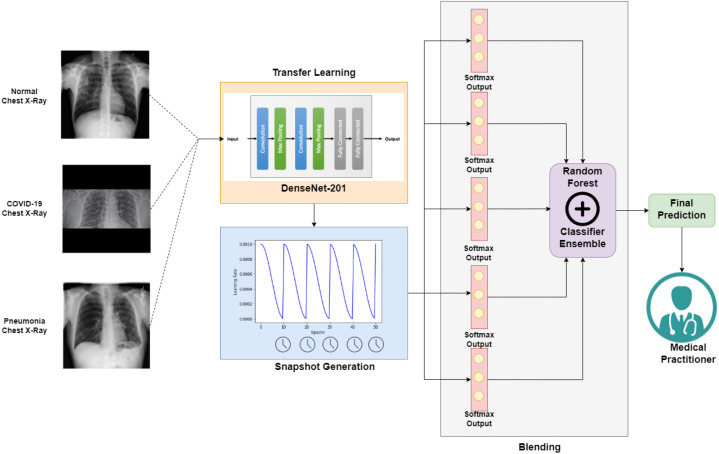
The novel COVID-19 pandemic, has effectively turned out to be one of the deadliest events in modern history, with unprecedented loss of human life, major economic and financial setbacks and has set the entire world back quite a few decades. However, detection of the COVID-19 virus has become increasingly difficult due to the mutating nature of the virus, and the rise in asymptomatic cases. To counteract this and contribute to the research efforts for a more accurate screening of COVID-19, we have planned this work. Here, we have proposed an ensemble methodology for deep learning models to solve the task of COVID-19 detection from chest X-rays (CXRs) to assist Computer-Aided Detection (CADe) for medical practitioners. We leverage the strategy of transfer learning for Convolutional Neural Networks (CNNs), widely adopted in recent literature, and further propose an efficient ensemble network for their combination. The DenseNet-201 architecture has been trained only once to generate multiple snapshots, offering diverse information about the extracted features from CXRs. We follow the strategy of decision-level fusion to combine the decision scores using the blending algorithm through a Random Forest (RF) meta-learner. Experimental results confirm the efficacy of the proposed ensemble method, as shown through impressive results upon two open access COVID-19 CXR datasets - the largest COVID-X dataset, as well as a smaller scale dataset. On the large COVID-X dataset, the proposed model has achieved an accuracy score of 94.55% and on the smaller dataset by Chowdhury et al., the proposed model has achieved a 98.13% accuracy score.
Keywords: Blending; COVID-19; Chest X-ray; Classifier fusion; Deep learning; Ensemble.
© 2022 Elsevier Ltd. All rights reserved.
Conflict of interest statement
The authors declare that they have no known competing financial interests or personal relationships that could have appeared to influence the work reported in this paper.
Figures
References
-
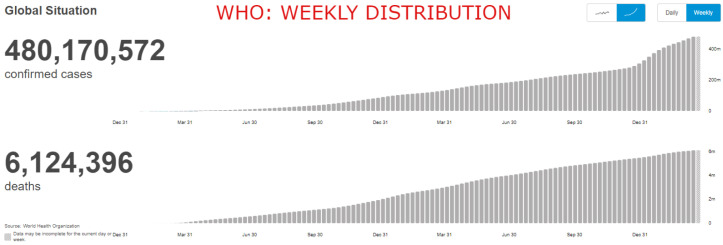
- 2022. WHO coronavirus (COVID-19) dashboard. URL https://covid19.who.int/ (Accessed 25 March 2022)
-
- Lakhani P., Sundaram B. Deep learning at chest radiography: automated classification of pulmonary tuberculosis by using convolutional neural networks. Radiology. 2017;284(2):574–582. - PubMed
-
- Wang P., Liu X., Berzin T.M., Brown J.R.G., Liu P., Zhou C., Lei L., Li L., Guo Z., Lei S., et al. Effect of a deep-learning computer-aided detection system on adenoma detection during colonoscopy (CADe-DB trial): a double-blind randomised study. Lancet Gastroenterol. Hepatol. 2020;5(4):343–351. - PubMed
-
- Golan R. Science; 2018. Deepcade: A deep learning architecture for the detection of lung nodules in ct scans.
LinkOut - more resources
Full Text Sources