


Clinical Outcomes and Risk Factors for Carbapenem-resistant Enterobacterales Bloodstream Infection in Solid Organ Transplant Recipients
- PMID: 35856636
- PMCID: PMC9772065
- DOI: 10.1097/TP.0000000000004265
Clinical Outcomes and Risk Factors for Carbapenem-resistant Enterobacterales Bloodstream Infection in Solid Organ Transplant Recipients
Abstract
Background: The clinical outcomes associated with, and risk factors for, carbapenem-resistant Enterobacterales (CRE) bloodstream infections (BSIs) in solid organ transplant (SOT) recipients remain ill-defined.
Methods: A multicenter retrospective cohort study was performed, including SOT recipients with an Enterobacterales BSI between 2005 and 2018. Exposed subjects were those with a CRE BSI. Unexposed subjects were those with a non-CRE BSI. A multivariable survival analysis was performed to determine the association between CRE BSI and risk of all-cause mortality within 60 d. Multivariable logistic regression analysis was performed to determine independent risk factors for CRE BSI.
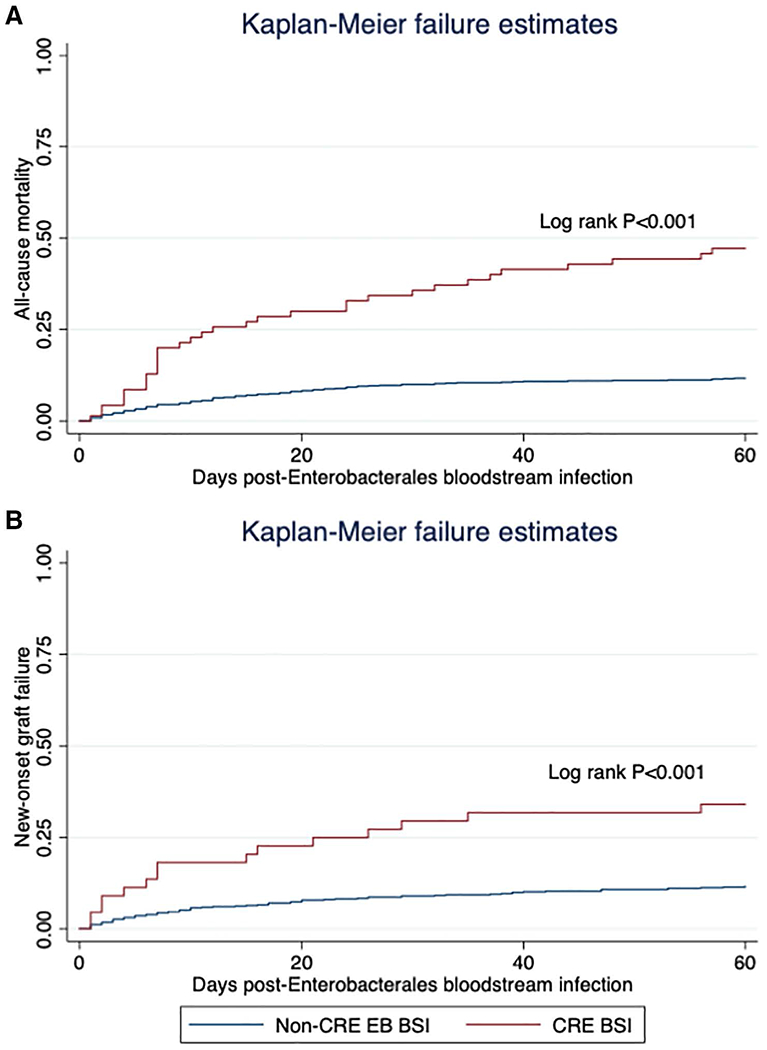
Results: Of 897 cases of Enterobacterales BSI in SOT recipients, 70 (8%) were due to CRE. On multivariable analysis, CRE BSI was associated with a significantly increased hazard of all-cause mortality (adjusted hazard ratio, 2.85; 95% confidence interval [CI], 1.68-4.84; P < 0.001). Independent risk factors for CRE BSI included prior CRE colonization or infection (adjusted odds ratio [aOR] 9.86; 95% CI, 4.88-19.93; P < 0.001)' liver transplantation (aOR, 2.64; 95% CI, 1.23-5.65; P = 0.012)' lung transplantation (aOR, 3.76; 95% CI, 1.40-10.09; P = 0.009)' and exposure to a third-generation cephalosporin (aOR, 2.21; 95% CI, 1.17-4.17; P = 0.015) or carbapenem (aOR, 2.80; 95% CI, 1.54-5.10; P = 0.001) in the prior 6 months.
Conclusions: CRE BSI is associated with significantly worse outcomes than more antibiotic-susceptible Enterobacterales BSI in SOT recipients.
Copyright © 2022 Wolters Kluwer Health, Inc. All rights reserved.
Conflict of interest statement
E.A.B. receives research support from Merck, Takeda, and Hologic; is a member of a Data and Safety Monitoring Board (DSMB) for Amplyx; and is a member of Scientific Advisory Committees for Merck and Takeda. E.L. is a member of a DSMB for Merck and is a member of a scientific advisory committee for Paratek and Shionogi. K.A. serves on a scientific advisory board for Becton Dickinson. J.H.H. was affiliated with the University of Pennsylvania during the conduct of this research and is now employed by, and holds shares in, the GlaxoSmithKline group of companies. None of these conflicts are relevant to this article. The other authors declare no conflicts of interest.
Figures
References
-
- Centers for Disease Control and Prevention. Antibiotic resistance threats in the United States. 2019. Available at https://www.cdc.gov/drugresistance/pdf/threats-report/2019-ar-threats-re.... Accessed March 7, 2022.
-
- Ferreira J, Couto B, Starling C. Secular trends in nosocomial carbapenem-resistant enterobacteriaceae (CRE): twenty-five years of surveillance in Brazilian hospitals. Infect Control Hosp Epidemiol. 2020;41:S383–S384.
Publication types
MeSH terms
Substances
Grants and funding
LinkOut - more resources
Full Text Sources
Medical
