


Convergent and criterion validity of PROMIS anxiety measures relative to six legacy measures and a structured diagnostic interview for anxiety in cancer patients
- PMID: 35857151
- PMCID: PMC9300804
- DOI: 10.1186/s41687-022-00477-4
Convergent and criterion validity of PROMIS anxiety measures relative to six legacy measures and a structured diagnostic interview for anxiety in cancer patients
Abstract
Background: Detecting anxiety in oncology patients is important, requiring valid yet brief measures. One increasingly popular approach is the Patient Reported Outcomes Measurement Information System (PROMIS); however, its validity is not well established in oncology. We assessed the convergent and criterion validity of PROMIS anxiety measures in an oncology sample.
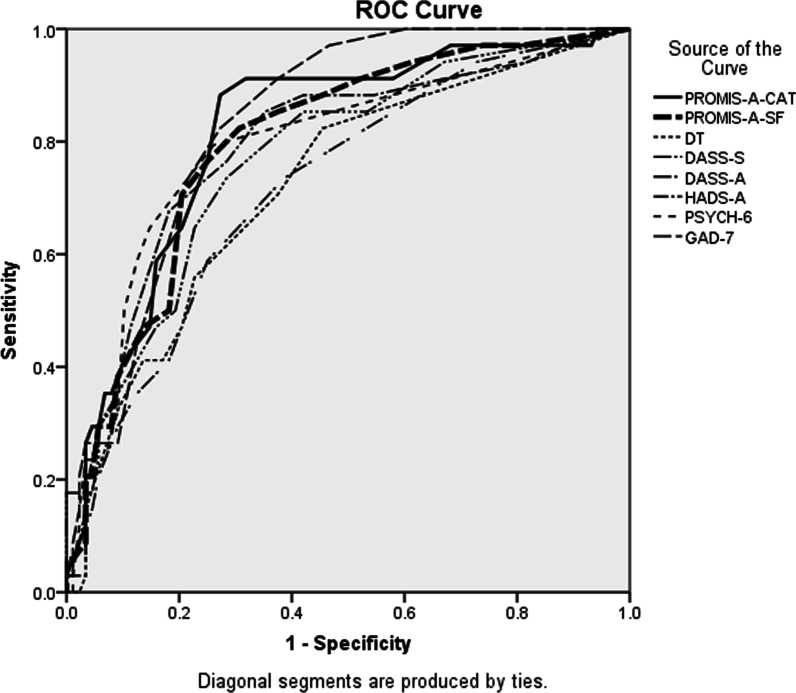
Methods: 132 oncology/haematology outpatients completed the PROMIS Anxiety Computer Adaptive Test (PROMIS-A-CAT) and the 7 item (original) PROMIS Anxiety Short Form (PROMIS-A-SF) along with six well-established measures: Hospital Anxiety and Depression Scale-Anxiety (HADS-A); Generalised Anxiety Disorder-7 (GAD-7); Depression, Anxiety and Stress Scale-Anxiety (DASS-A) and Stress (DASS-S); Distress Thermometer (DT) and PSYCH-6. Correlations, area under the curve (AUC) and diagnostic accuracy statistics were calculated with Structured Clinical Interview as the reference standard.
Results: Both PROMIS measures correlated with all legacy measures at p < .001 (Rho = .56-.83). AUCs (> .80) were good for both PROMIS measures and comparable to or better than all legacy measures. At the recommended mild cut-point (55), PROMIS-A-SF had sensitivity (.67) comparable to or better than all the legacy measures, whereas PROMIS-A-CAT sensitivity (.59) was lower than GAD-7 (.67) and HADS-A (.62), but comparable to PSYCH-6 and higher than DASS-A, DASS-S and DT. Sensitivity for both was .79. A reduced cut-point of 51 on both PROMIS measures improved sensitivity (.83-.84) although specificity was only adequate (.61-.62).
Conclusions: The convergent and criterion validity of the PROMIS anxiety measures in cancer populations was confirmed as equivalent, but not superior to, established measures (GAD-7 and HADS-A). The PROMIS-A-CAT did not demonstrate clear advantages over PROMIS-A-SF.
Keywords: Anxiety; Anxiety disorders; Cancer; Patient-reported outcome measures; Psycho-oncology; Psychology; Reproducibility of results; Surveys and questionnaires; Validation study.
© 2022. The Author(s).
Conflict of interest statement
The authors declare that they have no competing interests.
Figures
References
-
- Institute of Medicine Committee on Psychosocial Services to Cancer Patients/Families in a Community S (2008) Cancer care for the whole patient: meeting psychosocial health needs. Adler NE, Page AEK (eds). National Academies Press (US). National Academy of Sciences, Washington (DC) - PubMed
Grants and funding
LinkOut - more resources
Full Text Sources
Medical
Miscellaneous
