


Spinal Cord Injury: The Global Incidence, Prevalence, and Disability From the Global Burden of Disease Study 2019
- PMID: 35857624
- PMCID: PMC9554757
- DOI: 10.1097/BRS.0000000000004417
Spinal Cord Injury: The Global Incidence, Prevalence, and Disability From the Global Burden of Disease Study 2019
Abstract
Study design: A retrospective cohort study.
Objective: The authors aimed to estimate the incidence, prevalence and years lived with disability (YLDs) of spinal cord injury (SCI) by location, sex, age, injury site and socio-demographic index (SDI) based on the data of the Global Burden of Disease Study (GBD) 2019.
Summary of background data: GBD 2019 estimates the burden of 369 diseases and injuries worldwide in 2019 and the temporal trends in the past 30 years. SCI is estimated as a result of injury from various causes.
Methods: A Bayesian meta-regression tool, DisMod-MR2.1, was used to produce the estimates. Estimated annual percentage change (EAPC) was calculated based on a linear regression mode of the age standardized rates and the calendar year to represent the temporal trends of the age standardized rates. Spearman rank order correlation was used to determine the correlation between SDI and the incidence and burden of SCI.
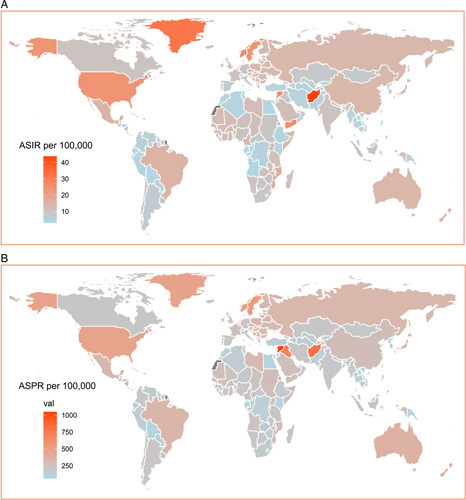
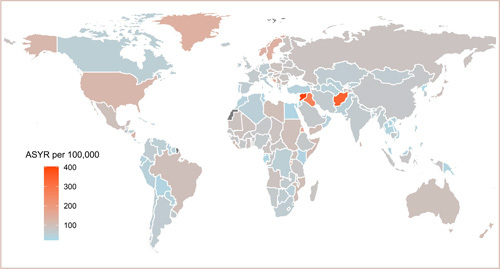
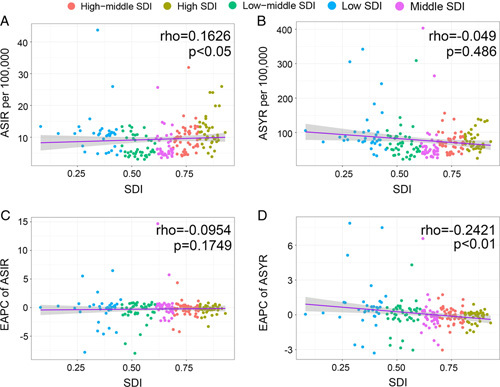
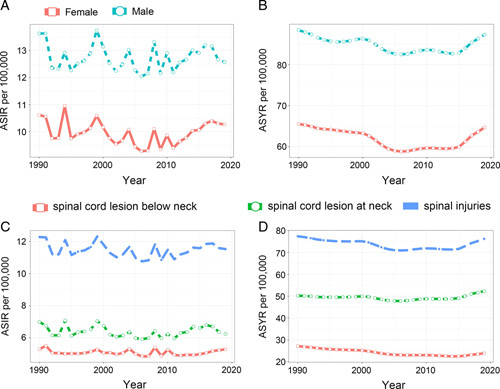
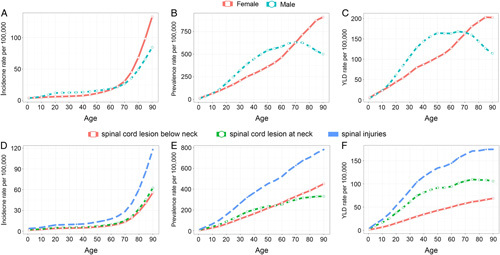
Results: Globally, there were 0.9 [95% uncertainty interval (UI), 0.7 to 1.2] million incident cases, 20.6 (95% UI, 18.9-23.6) million prevalent cases and 6.2 (95% UI, 4.5-8.2) million YLDs of total SCI in 2019. The ASPR increased (EAPC, 0.1; 95% confidence interval, -0.01 to 0.2), while the age standardized incidence rate (ASIR) (EAPC, -0.08; 95% UI, -0.24 to 0.09) and age standardized YLD rate (ASYR) (EAPC, -0.08; 95% confidence interval, -0.24 to 0.09) decreased. Males had higher ASIR and ASYR, and the rate of incidence, prevalence and YLD increased with age. Spinal injuries at neck level caused higher ASYR than injuries below neck level. A positive correlation existed between SDI and ASIR (ρ=0.1626, P <0.05), while a negative correlation was observed between SDI and EAPC of ASYR (ρ=-0.2421, P <0.01).
Conclusion: Conclusively, the incidence and burden of SCI has increased over the last 30 years. Males and the elderly were affected to a greater degree than females and younger individuals.
Level of evidence: Level III.
Copyright © 2022 The Author(s). Published by Wolters Kluwer Health, Inc.
Conflict of interest statement
The authors report no conflicts of interest.
Figures
Comment in
-
Spinal Cord Injury: The Global Incidence, Prevalence, and Disability From the Global Burden of Disease Study 2019.Spine (Phila Pa 1976). 2023 Dec 15;48(24):1767. doi: 10.1097/BRS.0000000000004726. Epub 2023 May 22. Spine (Phila Pa 1976). 2023. PMID: 37235787 No abstract available.
References
-
- Hamid R, Averbeck MA, Chiang H, et al. . Epidemiology and pathophysiology of neurogenic bladder after spinal cord injury. World J Urol. 2018;36:1517–1527. - PubMed
-
- Holmes D. Spinal-cord injury: spurring regrowth. Nature. 2017;552:S49. - PubMed
-
- Zamarioli A, de Andrade Staut C, Volpon JB. Review of secondary causes of osteoporotic fractures due to diabetes and spinal cord injury. Curr Osteoporos Rep. 2020;18:148–156. - PubMed
MeSH terms
LinkOut - more resources
Full Text Sources
Medical
Research Materials
Miscellaneous
