


Impact of COVID-19 on the HIV care continuum in Asia: Insights from people living with HIV, key populations, and HIV healthcare providers
- PMID: 35857755
- PMCID: PMC9299301
- DOI: 10.1371/journal.pone.0270831
Impact of COVID-19 on the HIV care continuum in Asia: Insights from people living with HIV, key populations, and HIV healthcare providers
Abstract
Background: The COVID-19 pandemic has threatened continued access to public health services worldwide, including HIV prevention and care. This study aimed to evaluate the impact of the COVID-19 pandemic on HIV service access and delivery in the Asia region.
Methods: A descriptive, cross-sectional, online study, conducted between October-November 2020, assessed the impact of COVID-19 on HIV prevention and care among people living with HIV (PLHIV), key populations (KPs), and healthcare providers (HCPs). The study populations were recruited across ten Asian countries/territories, covering Hong Kong, India, Japan, Malaysia, Philippines, Singapore, Korea, Taiwan, Thailand, and Vietnam.
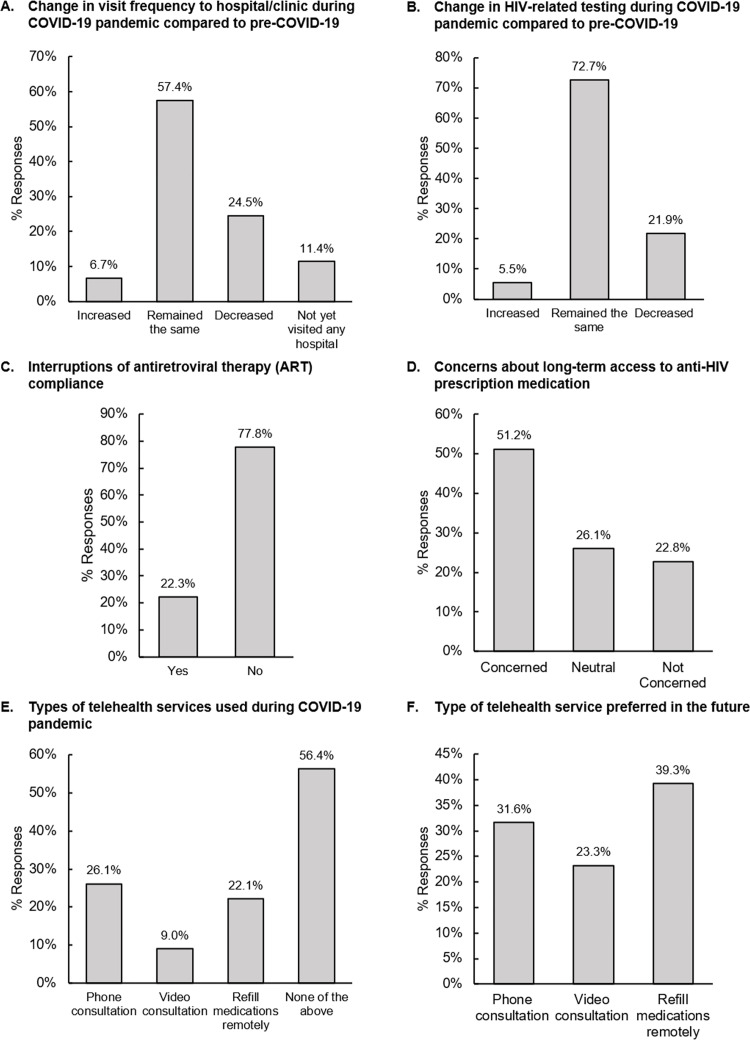
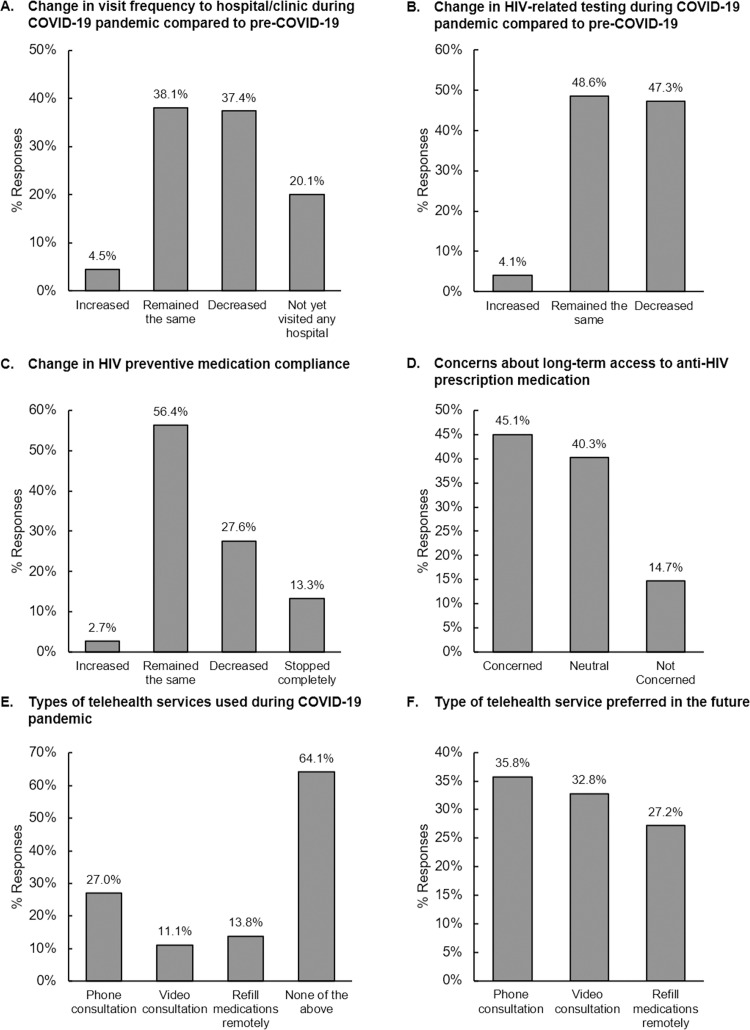
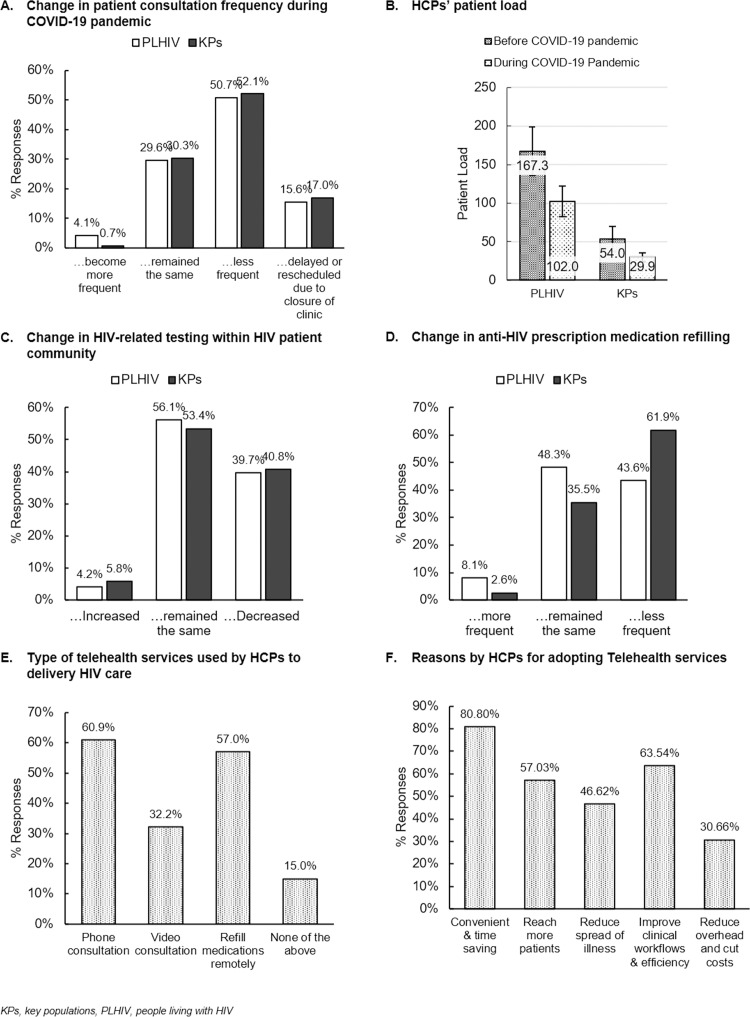
Results: Across the region, 702 PLHIV, 551 KPs, and 145 HCPs were recruited. Both PLHIV and KPs reported decreased or had yet to visit hospitals/clinics (PLHIV: 35.9%; KPs: 57.5%), reduced HIV RNA viral load testing (21.9%; 47.3%), and interruptions in antiretroviral therapy (ART) (22.3%) or decreased/complete stop of HIV prevention medication consumption (40.9%). Travel constraints (40.6%), financial issues (28.9%), and not receiving prescription refills (26.9%) were common reasons for interrupted ART access, whereas reduced engagements in behaviours that could increase the risks of HIV acquisition and transmission (57.7%), travel constraints (41.8%), and less hospital/clinic visits (36.7%) underlie the disruptions in HIV preventive medications. Decreased visits from PLHIV/KPs and rescheduled appointments due to clinic closure were respectively reported by 50.7%-52.1% and 15.6%-17.0% of HCPs; 43.6%-61.9% observed decreased ART/preventive medication refills. Although 85.0% of HCPs adopted telemedicine to deliver HIV care services, 56.4%-64.1% of PLHIV/KPs were not using telehealth services.
Conclusions: The COVID-19 pandemic substantially disrupted HIV prevention to care continuum in Asia at the time of the study. The findings highlighted differences in HIV prevention to care continuum via telehealth services utilisation by PLHIV, KPs, and HCPs. Efforts are needed to optimise infrastructure and adapt systems for continued HIV care with minimal disruptions during health emergency crises.
Conflict of interest statement
I have read the journal’s policy and the authors of this manuscript have the following competing interests: C-C.H. has received research support from Merck, Gilead Sciences, and ViiV and speaker honoraria from Gilead Sciences and ViiV and served on advisory boards for Gilead Sciences and ViiV. K.L. received compensation from Gilead Sciences for SHIP projects. T-H.W. is an employee of Gilead Sciences, Hong Kong. S.S. is an employee of Cerner Enviza. J-Y.C., S.B., I.G., K.G., Y.I., A.K, N.P., and T.W. declare no conflicts of interest. This does not alter our adherence to PLOS ONE policies on sharing data and materials.
Figures
References
-
- Baral Stefan, Rao Amrita, Rwema Jean Oliver Twahirwa, Lyons Carrie, Cevik Muge, Kågesten Anna E., et al. Competing Health Risks Associated with the COVID-19 Pandemic and Response: A Scoping Review | medRxiv. 2021. Available: https://www.medrxiv.org/content/10.1101/2021.01.07.21249419v1.full.pdf. - DOI - PMC - PubMed
-
- WHO releases guidelines to help countries maintain essential health services during the COVID-19 pandemic. [cited 18 Mar 2021]. Available: https://www.who.int/news/item/30-03-2020-who-releases-guidelines-to-help....
-
- Division of HIV/AIDS Prevention, National Center for HIV/AIDS, Viral Hepatitis, STD, and TB Prevention. Understanding the HIV Care Continuum. Centers for Disease Control and Prevention; 2019. p. 4. Available: https://www.cdc.gov/hiv/pdf/library/factsheets/cdc-hiv-care-continuum.pdf.
Publication types
MeSH terms
LinkOut - more resources
Full Text Sources
Medical
