


Comment
doi: 10.1073/pnas.2208745119.
Epub 2022 Jul 11.
Plants change their clocks to flower at the right time
Affiliations
- PMID: 35858367
- PMCID: PMC9304005
- DOI: 10.1073/pnas.2208745119
Item in Clipboard
Comment
Plants change their clocks to flower at the right time
Proc Natl Acad Sci U S A.
.
No abstract available
Conflict of interest statement
The author declares no competing interest.
Figures
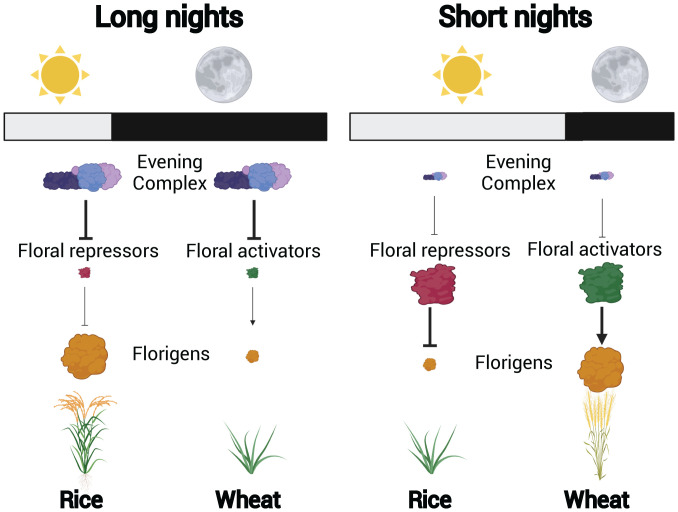
A simplified model for the hypothesized role of the Evening Complex in photoperiodism. In long nights, functional Evening Complex proteins accumulate, increasing the suppression of their target genes. For short-day plants, such as rice, the Evening Complex suppresses floral repressors, resulting in increased florigen synthesis and accelerated flowering. For long-day plants, such as wheat, the Evening Complex suppresses floral activators, resulting in reduced florigen synthesis and delayed flowering. In short nights, the levels of functional Evening Complex proteins are much lower, resulting in the inverse response.
Comment on
-
The evening complex integrates photoperiod signals to control flowering in rice.Proc Natl Acad Sci U S A. 2022 Jun 28;119(26):e2122582119. doi: 10.1073/pnas.2122582119. Epub 2022 Jun 21. Proc Natl Acad Sci U S A. 2022. PMID: 35733265 Free PMC article.
References
-
- Andrés F., Coupland G., The genetic basis of flowering responses to seasonal cues. Nat. Rev. Genet. 13, 627–639 (2012). - PubMed
-
- Garner W. W., Allard H. A., Effect of the relative length of day and night and other factors of the environment on growth and reproduction in plants. J. Agric. Res. 18, 553–606 (1920).
-
- Thomas B., Vince-Prue D., Photoperiodism in Plants (Academic Press, London, United Kingdom, ed. 2, 1997).
Publication types
MeSH terms
LinkOut - more resources
Full Text Sources
