. 2022 Jul 26;119(30):e2122154119.
doi: 10.1073/pnas.2122154119. Epub 2022 Jul 18.

Behavioral genetics and genomics: Mendel's peas, mice, and bees

Affiliations

Behavioral genetics and genomics: Mendel's peas, mice, and bees

Hopi E Hoekstra et al. Proc Natl Acad Sci U S A. .

Abstract

The question of the heritability of behavior has been of long fascination to scientists and the broader public. It is now widely accepted that most behavioral variation has a genetic component, although the degree of genetic influence differs widely across behaviors. Starting with Mendel's remarkable discovery of "inheritance factors," it has become increasingly clear that specific genetic variants that influence behavior can be identified. This goal is not without its challenges: Unlike pea morphology, most natural behavioral variation has a complex genetic architecture. However, we can now apply powerful genome-wide approaches to connect variation in DNA to variation in behavior as well as analyses of behaviorally related variation in brain gene expression, which together have provided insights into both the genetic mechanisms underlying behavior and the dynamic relationship between genes and behavior, respectively, in a wide range of species and for a diversity of behaviors. Here, we focus on two systems to illustrate both of these approaches: the genetic basis of burrowing in deer mice and transcriptomic analyses of division of labor in honey bees. Finally, we discuss the troubled relationship between the field of behavioral genetics and eugenics, which reminds us that we must be cautious about how we discuss and contextualize the connections between genes and behavior, especially in humans.

Keywords: Apis mellifera; Peromyscus; burrow; division of labor; eugenics.


Conflict of interest statement

The authors declare no competing interest.

Figures
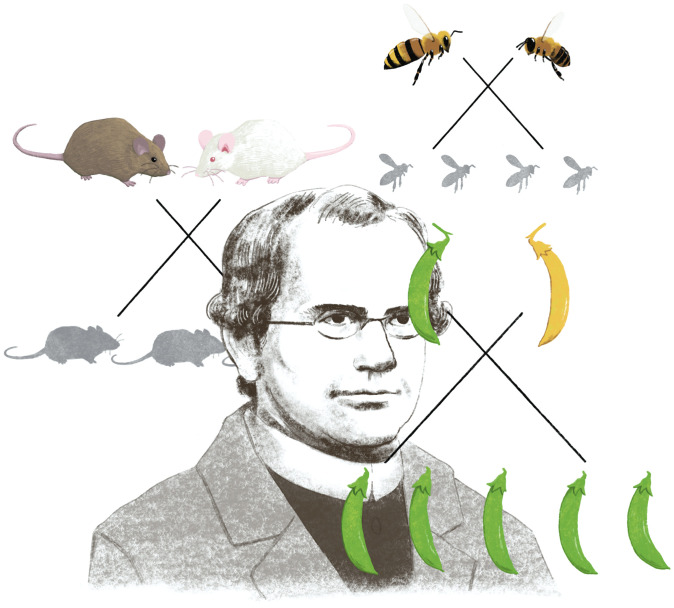
Fig. 1.
Fig. 1.
Mendel’s diverse interests. Other organisms, including house mice and honey bees, piqued Mendel’s interest but, for both biological and nonbiological reasons, his ability to perform genetic crosses on those species was limited. Instead, it is from his elegant study of the progeny of pea plants that he derived his laws of inheritance.
Fig. 2.
Fig. 2.
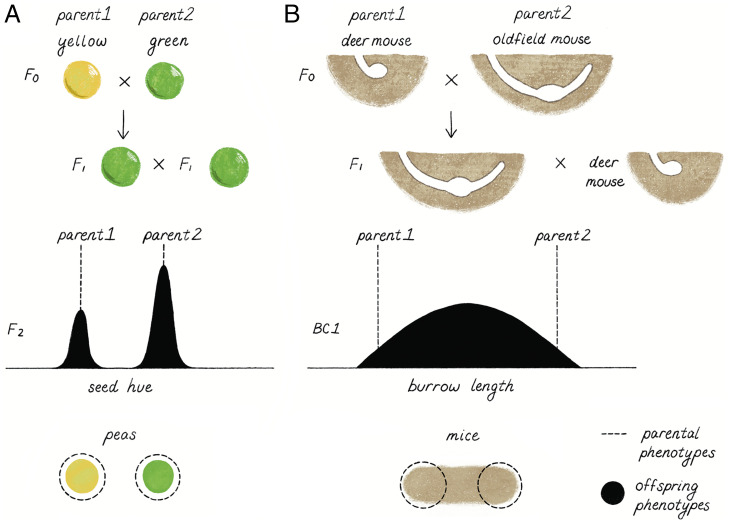
Simple versus complex inheritance. (A) Pea seed color, as studied by Mendel, exhibits a simple genetic basis. When pea plants that generate yellow- and green-colored seeds are crossed (F0), the seeds of all progeny are green (F1). When F1 progeny are crossed, the resulting F2 progeny produce either yellow seeds or green seeds, fully recapitulating the F0 parental phenotypes with no intermediates. These results can be explained by a single gene for seed coat color, identified as staygreen (sgr; ref. 90), with a dominant green and recessive yellow allele. (B) Burrow architecture in Peromyscus mice exhibits a more complex genetic basis. When oldfield mice are crossed with deer mice (F0), the resulting offspring dig burrows like oldfield mice (F1). However, when F1 mice are backcrossed with deer mice, BC1 offspring display a continuous distribution of burrow length that spans parental species phenotypes. These results are consistent with multiple, dominant loci from oldfield mice contributing to longer burrows.
Fig. 3.
Fig. 3.
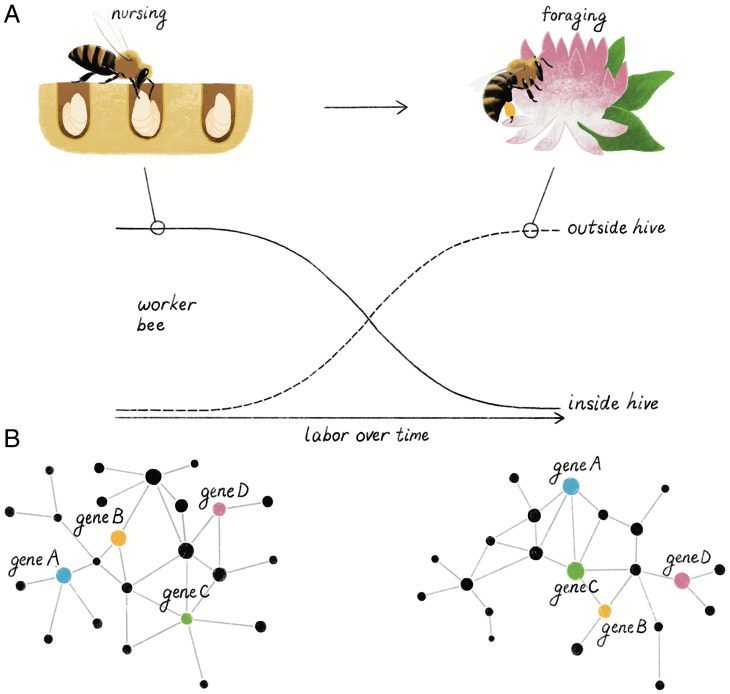
Gene expression networks underlie behavioral plasticity. (A) A honey bee worker will begin its adult life working inside the hive as a nurse and then will transition through a middle-age phase of tasks before a shift to working outside the hive as a forager. (B) The behavioral changes associated with this labor transition are tied to changes in brain gene expression in thousands of genes. The coordinated changes in brain gene expression result in markedly different gene expression networks between nurse and forager worker bees.
Fig. 4.
Fig. 4.
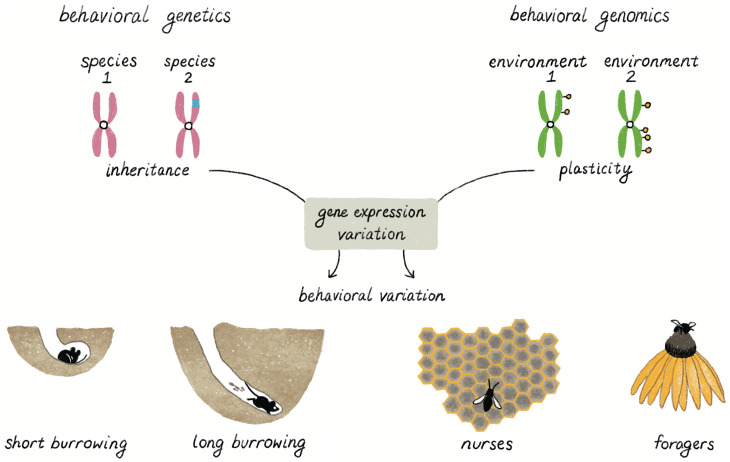
Behavioral genetics and behavioral genomics as complementary approaches. Both behavioral genetics and behavioral genomics investigate the link between genes and behavioral variation. Behavioral genetics, as exemplified by Peromyscus burrowing, seeks to connect inherited genetic variation to behavioral variation. Changes in genetic sequence are represented by different colors of chromosomes (pink vs. green). Behavioral genomics, as exemplified by honey bee division of labor, seeks to connect changes in gene expression to behavioral plasticity. Behavioral plasticity can be caused by changes in the environment (external or internal), which can lead to, for example, epigenetic modifications (yellow circles) without changing DNA sequence (purple). Both changes in DNA sequence and the environment result in changes in gene regulation, and, ultimately, behavior.

References

    1. Mendel G., Versuche über Pflanzen-Hybriden (Experiments in plant hybridization). Verhandlungen des naturforschenden Vereines in Brünn (Abhandlungen) 4, 3–47 (1866).
    1. McKusick-Nathans Institute of Genetic Medicine, Johns Hopkins University, OMIM Online Mendelian Inheritance in Man: An online catalog of human genes and genetic disorders. https://www.omim.org. Accessed 15 January 2022.
    1. Irion U., Nüsslein-Volhard C., Developmental genetics with model organisms. Proc. Natl. Acad. Sci. U.S.A. 119, e2122148119 (2022). - PMC - PubMed
    1. Andersson L., Purugganan M., Molecular genetic variation of animals and plants under domestication. Proc. Natl. Acad. Sci. U.S.A. 119, e2122150119 (2022). - PMC - PubMed
    1. Bomblies K., Peichel C. L., Genetics of adaptation. Proc. Natl. Acad. Sci. U.S.A. 119, e2122152119 (2022). - PMC - PubMed

Publication types

LinkOut - more resources