


A qualitative assessment of gender roles in child nutrition in Central Malawi
- PMID: 35858910
- PMCID: PMC9297552
- DOI: 10.1186/s12889-022-13749-x
A qualitative assessment of gender roles in child nutrition in Central Malawi
Abstract
Background: Child malnutrition persists globally with men and women playing distinct roles to support children's nutrition. Women frequently carry the bulk of the workload related to food, care, and health, all of which are critical factors in child nutrition. For this reason, development efforts have emphasised women ignoring the potential role of men in supporting children's nutrition. This study sought to understand the different roles that Malawian men and women play in children's nutrition.
Methods: This qualitative was conducted in rural Central Malawi as part of a baseline study in 2017 for the CARE Southern Africa Nutrition Initiative. Seventy-six participants were interviewed, including 19 men and 57 women, using focus group discussions and in-depth interviews. We sought to understand the gender distribution of men's and women's roles and how these roles influence child nutrition.
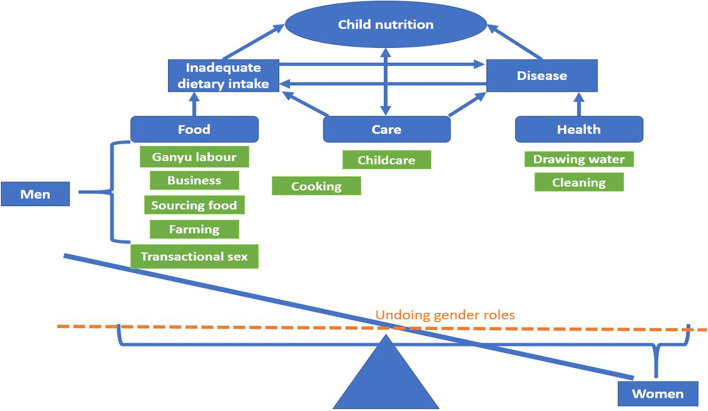
Results: We found that both men and women were involved in productive, reproductive, and community work. However, consistent with the literature, women carried a disproportionate workload in supporting child nutrition compared to men. Women's heavier workloads often prevented them from being able to meet children's food needs. Nevertheless, shifts in gender roles were observed in some of the sampled communities, with men taking up responsibilities that have been typically associated with women. These changes in gender roles, however, did not necessarily increase women's power within the household.
Conclusions: Traditional gender roles remain prevalent in the sampled communities. Women continue to be primarily responsible for the food, care, and health of the household. Women's heavy workloads prevent them from providing optimal care and nutrition for children. While efforts to advance gender equality by encouraging men to participate in child care and other household responsibilities appear to have had marginal success, the extent to which these efforts have successfully encouraged men to share power remains unclear. Improving gender equality and child nutrition will require efforts to redistribute gendered work and encourage men to move towards shared power with women over household decision-making and control over income.
Keywords: Care-giving; Child nutrition; Focus group; Food Security; Inequalities; Low-income countries.
© 2022. The Author(s).
Conflict of interest statement
CARE Malawi funded fieldwork for this research. Lucy Mkandawire-Valhmu was paid by CARE Malawi to conduct the research. Elizabeth Dyke was paid to design the study and to train the research assistants in data collection methods. The remaining authors have no competing interests.
Figures
References
-
- FAO et al. The state of Food Security and nutrition in the world 2020 - transforming food systems for affordable healthy diets. Rome: FAO; 2020.
-
- Blössner M, de Onis M. Malnutrition: quantifying the health impact at national and local levels. WHO environmental burden of disease series, no. 12. Geneva: WHO; 2005.
-
- Ltd DIPR. 2021 global nutrition report: the state of global nutrition. Bristol: Development Initiatives; 2021.
-
- UN . UN Convention on economic social and cultural rights. New York: UN; 1976.
-
- Hoddinott J. The economics of reducing malnutrition in sub-Saharan Africa. Global panel on agriculture and Food Systems for Nutrition Working Paper. London: Global Panel on Agriculture and Food Systems for Nutrition; 2016.
Publication types
MeSH terms
LinkOut - more resources
Full Text Sources
