


Self-compassion and social anxiety: The mediating effect of emotion regulation strategies and the influence of depressed mood
- PMID: 35859529
- PMCID: PMC9796305
- DOI: 10.1111/papt.12417
Self-compassion and social anxiety: The mediating effect of emotion regulation strategies and the influence of depressed mood
Abstract
Objectives: Self-compassion constitutes a positive way of relating towards the self that enables emotional regulation and reduces emotional distress. This research first explored differences among a sample of persons with social anxiety disorder (SAD) and groups of high socially anxious (HSA) and low socially anxious (LSA) students on self-compassion, emotion regulation, and social anxiety. We then investigated emotional regulation as a mediator of the prediction of social anxiety by self-compassion and the influence of depressed mood on those relationships.
Design: Study 1 compared a SAD group to matched groups of HSA and LSA students. Study 2 utilized the total sample (n = 330 students and n = 33 SAD) to test mediation. Self-compassion and emotion regulation were predictors of social anxiety and depression a covariate.
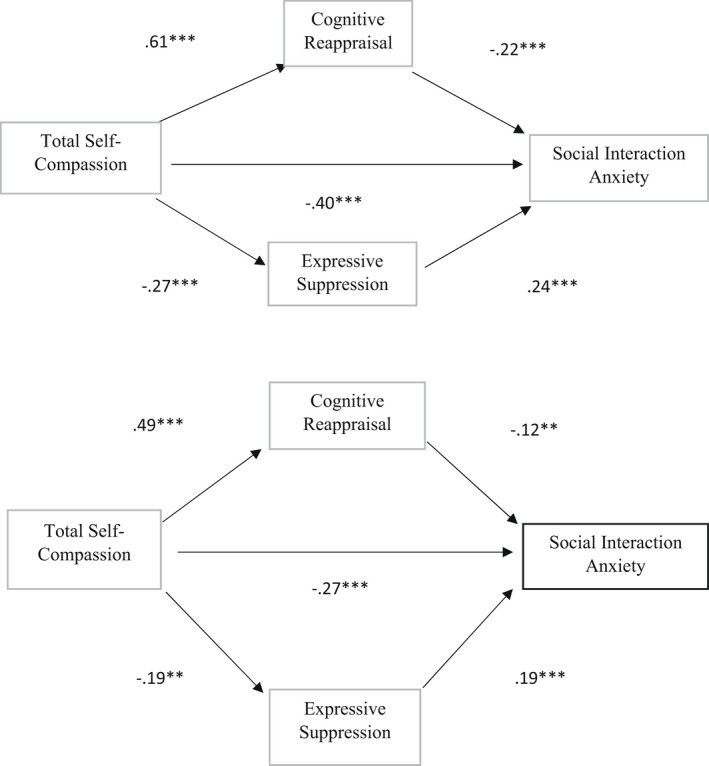
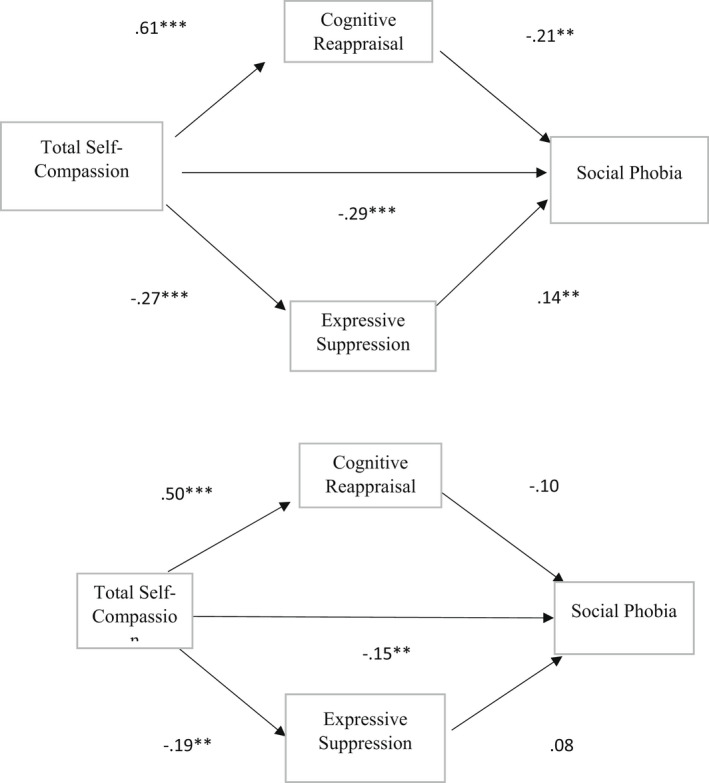
Results: In Study 1, the SAD group did not differ from the HSA group on most aspects of self-compassion and emotional regulation but was higher on depression. Both were lower on most measures and higher on depression than the LSA group. In Study 2, higher self-compassion predicted lower social interaction anxiety, and emotional regulation strategies mediated this effect, regardless of depression. However, for social performance anxiety, controlling for depression removed mediation. Refraining from uncompassionate responses was directly connected to social anxiety, whereas compassionate responses influenced social anxiety via emotional regulation.
Conclusions: Results affirm the ameliorative role of self-compassion on social anxiety and emotion regulation strategies as mechanisms of that influence. However, self-compassion's influence was affected by depression and type of social anxiety. Also, refraining from uncompassionate self-responding appears to be of prime importance in predicting social anxiety, whereas compassionate self-responding influences social anxiety via emotion regulation.
Keywords: attitude to self; depression; emotion regulation; self-compassion; social anxiety.
© 2022 The Authors. Psychology and Psychotherapy: Theory, Research and Practice published by John Wiley & Sons Ltd on behalf of The British Psychological Society.
Conflict of interest statement
All authors report no conflict of interests.
Figures
References
-
- Adie, T. , Steindl, S. R. , Kirby, J. N. , Kane, R. T. , & Mazzuchelli, T. G. (2021). The relationshipbetween self‐compassion and depressive symptoms: Avoidance and activation as mediators. Mindfulness, 12, 1748–1756. 10.1007/s1267-021-01637-1 - DOI
-
- Akin, A. , & Çetın, B. (2007). The depression anxiety and stress scale (DASS): The study of validity and reliability. Educational Sciences: Theory & Practice, 7(1), 260–268.
-
- American Psychiatric Association . (2022). Diagnostic and statistical manual of mental disorders fifth edition, text revision (DSM‐5‐TR). Author.
Publication types
MeSH terms
LinkOut - more resources
Full Text Sources
