


A Study on the Correlation Between Undergraduate Students' Exercise Motivation, Exercise Self-Efficacy, and Exercise Behaviour Under the COVID-19 Epidemic Environment
- PMID: 35859845
- PMCID: PMC9292573
- DOI: 10.3389/fpsyg.2022.946896
A Study on the Correlation Between Undergraduate Students' Exercise Motivation, Exercise Self-Efficacy, and Exercise Behaviour Under the COVID-19 Epidemic Environment
Abstract
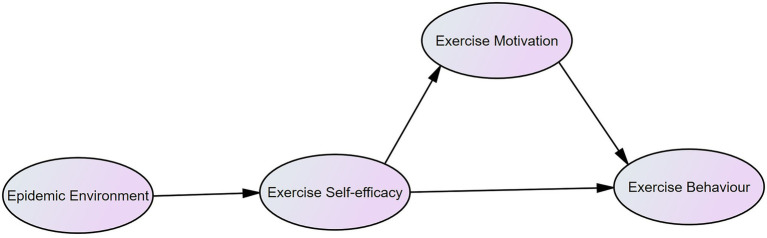
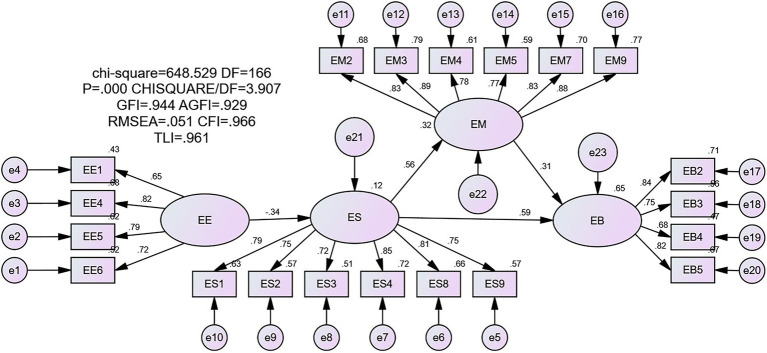
The outbreak of COVID-19 epidemic has influenced human beings from various aspects including physical exercise behaviours. This study aims to explore the influence of the COVID-19 epidemic on exercise self-efficacy and exercise behaviour, as well as the intermediary effects of exercise motivation. A sample of 1,115 undergraduate students was investigated using the physical exercise behaviour scale, exercise self-efficacy scale, and exercise motivation scale, combined with the COVID-19 epidemic environment as an influencing factor. SPSS was used for statistical analysis and AMOS for the prediction model building. Logical analysis was undertaken to sort out and analyse the data. The structural equation model reveals that exercise self-efficacy has a positive effect on exercise motivation and exercise behaviour. Meanwhile, the COVID-19 epidemic environment negatively influences exercise behaviour through the intermediary role of exercise self-efficacy and exercise motivation. Moreover, the intermediary effect of exercise self-efficacy is greater than that of exercise self-efficacy and exercise motivation. This study provides both theoretical implications and practical guidelines for society and undergraduate students to improve their exercise behaviour during epidemic.
Keywords: COVID-19 epidemic; exercise behaviour; exercise motivation; exercise self-efficacy; undergraduate students.
Copyright © 2022 Wang, Gao, Chen, Liu, Wu, Zhou and Sun.
Conflict of interest statement
The authors declare that the research was conducted in the absence of any commercial or financial relationships that could be construed as a potential conflict of interest.
Figures
References
-
- Ajzen I. (1991). The theory of planned behavior. Organ. Behav. Hum. Decis. Process. 50, 179–211. doi: 10.1016/0749-5978(91)90020-T - DOI
-
- Ajzen I., Driver B. (1992). Contingent value measurement: On the nature and meaning of willingness to pay. J. Consum. Psychol. 1, 297–316. doi: 10.1016/S1057-7408(08)80057-5 - DOI
LinkOut - more resources
Full Text Sources
