


Asymmetric Cell Division and Tumor Heterogeneity
- PMID: 35859890
- PMCID: PMC9289117
- DOI: 10.3389/fcell.2022.938685
Asymmetric Cell Division and Tumor Heterogeneity
Abstract
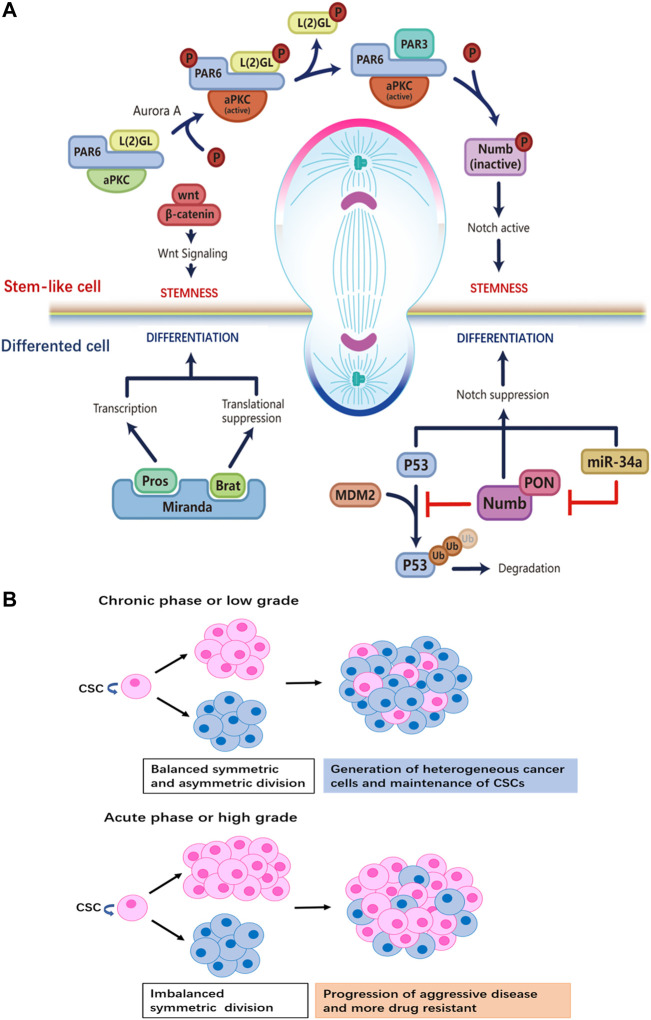
Asymmetric cell division (ACD) gives rise to two daughter cells with different fates after mitosis and is a fundamental process for generating cell diversity and for the maintenance of the stem cell population. The cancer stem cell (CSC) theory suggests that CSCs with dysregulated self-renewal and asymmetric cell division serve as a source of intra-tumoral heterogeneity. This heterogeneity complicates the diagnosis and treatment of cancer patients, because CSCs can give rise to aggressive clones that are metastatic and insensitive to multiple drugs, or to dormant tumor cells that are difficult to detect. Here, we review the regulatory mechanisms and biological significance of asymmetric division in tumor cells, with a focus on ACD-induced tumor heterogeneity in early tumorigenesis and cancer progression. We will also discuss how dissecting the relationship between ACD and cancer may help us find new approaches for combatting this heterogeneity.
Keywords: asymmetric cell division; drug resisitance; symmetric cell division; tumor heterogeneity; tumorgenesis.
Copyright © 2022 Li, Zhang, Zhang, Yang, Chen and Lu.
Conflict of interest statement
The authors declare that the research was conducted in the absence of any commercial or financial relationships that could be construed as a potential conflict of interest.
Figures
References
-
- Armah H. B. (2010). Malignant Astrocytomas Originate from Neural Stem/Progenitor Cells in a Somatic Tumor Suppressor Mouse Model. Yearb. Pathology Laboratory Med. 2010, 171–172. 10.1016/s1077-9108(09)79438-1 - DOI
Publication types
LinkOut - more resources
Full Text Sources
