


Epidemiology of spinal metastases, metastatic epidural spinal cord compression and pathologic vertebral compression fractures in patients with solid tumors: A systematic review
- PMID: 35860387
- PMCID: PMC9289863
- DOI: 10.1016/j.jbo.2022.100446
Epidemiology of spinal metastases, metastatic epidural spinal cord compression and pathologic vertebral compression fractures in patients with solid tumors: A systematic review
Abstract
Introduction: Spinal metastases (SM) are a frequent complication of cancer and may lead to pathologic vertebral compression fractures (pVCF) and/or metastatic epidural spinal cord compression (MESCC). Based on autopsy studies, it is estimated that about one third of all cancer patients will develop SM. These data may not provide a correct estimation of the incidence in clinical practice.
Objective: This systematic review (SR) aims to provide a more accurate estimation of the incidence of SM, MESCC and pVCF in a clinical setting.
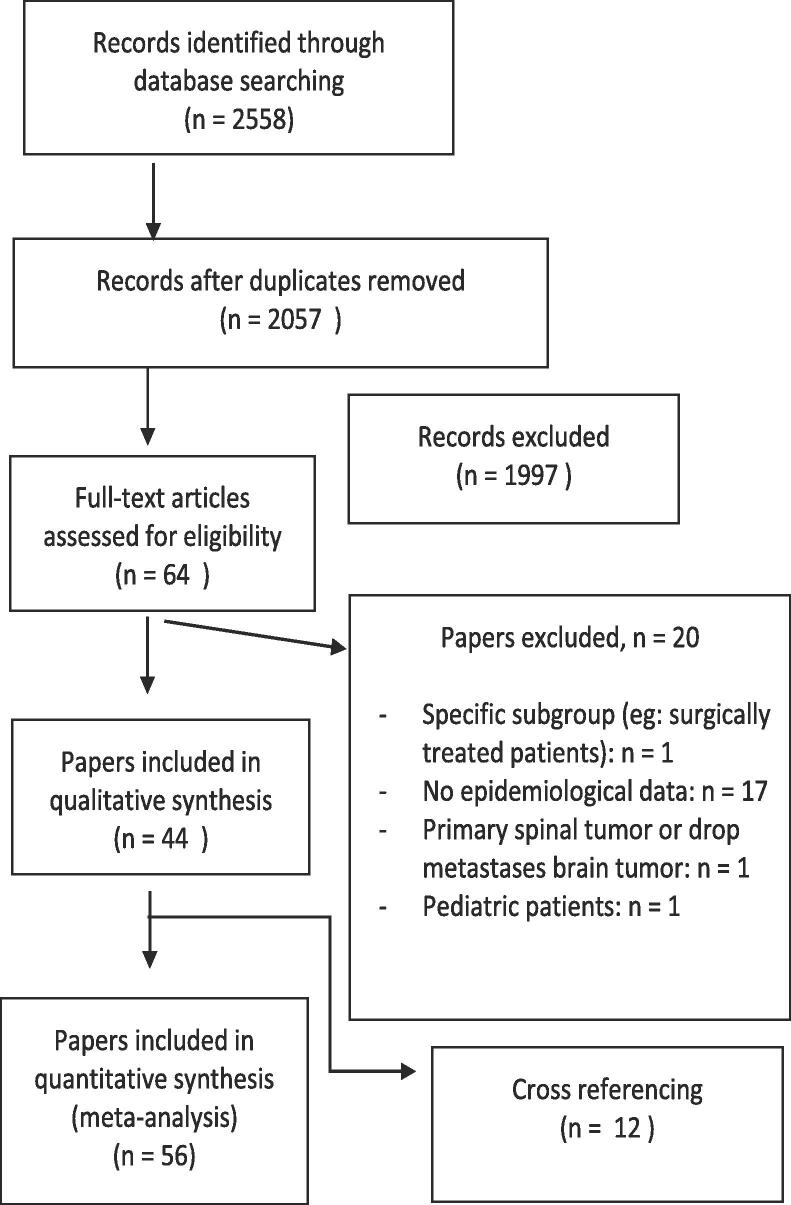
Methods: We performed a SR of papers regarding epidemiology of SM, pVCF, and MESCC in patients with solid tumors conform PRISMA guidelines. A search was conducted in the PubMed and Web of Science database using the terms epidemiology, prevalence, incidence, global burden of disease, cost of disease, spinal metastas*, metastatic epidural spinal cord compression, pathologic fracture, vertebral compression fracture, vertebral metastas* and spinal neoplasms. Papers published between 1975 and august 2021 were included. Quality was evaluated by the STROBE criteria.
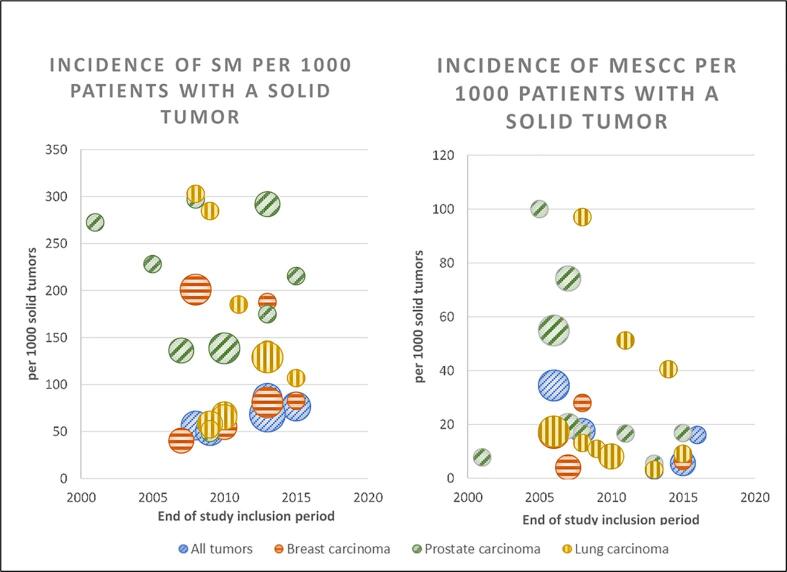
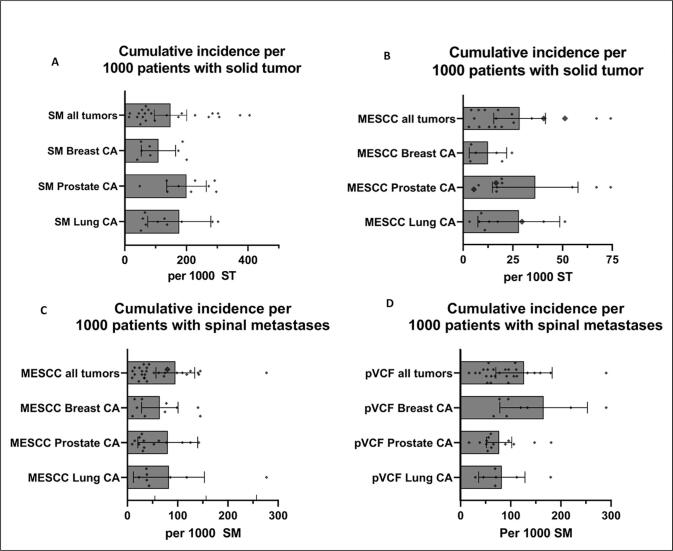
Results: While 56 studies were included, none of them reports the actual definition used for MESCC and pVCF, inevitably introducing heterogenity. The overall cumulative incidence of SM and MESCC is 15.67% and 2.84% respectively in patients with a solid tumor. We calculated a mean cumulative incidence in patients with SM of 9.56% (95% CI 5.70%-13.42%) for MESCC and 12.63% (95% CI 7.00%-18.25%) for pVCF. Studies show an important delay between onset of symptoms and diagnosis.
Conclusions: While the overall cumulative incidence for clinically diagnosed SM in patients with a solid tumor is 15.67%, autopsy studies reveal that SM are present in 30% by the time they die, suggesting underdiagnosing of SM. Approximately 1 out of 10 patients with SM will develop MESCC and another 12.6% will develop a pVCF. Understanding these epidemiologic data, should increase awareness for first symptoms, allowing early diagnosis and subsequent treatment, thus improving overall outcome.
Keywords: CA, carcinoma; CI, confidence interval; Epidemiology; HCC, hepatocellular carcinoma; LOL, length of life; MESCC, metastastic epidural spinal cord compression; MRI, magnetic resonance imaging; Metastatic epidural spinal cord compression; OR, odds ratio; Oncology; PRISMA, Preferred Reporting Items for Systematic Reviews and Meta-Analyses; Pathologic vertebral compression fracture; QOL, quality of life; RCT, randomized controlled trial; SINS, spinal instability neoplastic score; SM, spinal metastases; SR, systematic review; SRE, skeletal related event; ST, solid tumor; STROBE, Strengthening the reporting of observational studies in epidemiology; Spinal metastases; WHO, World Health Organization; pVCF, pathologic vertebral compression fractures; rMESCC, subclinical radiographic MESCC.
© 2022 The Authors. Published by Elsevier GmbH.
Conflict of interest statement
The authors declare that they have no known competing financial interests or personal relationships that could have appeared to influence the work reported in this paper.
Figures
References
-
- World Health Organization. Who Report on Cancer: Setting Priorities, Investing Wesely and Providing Care for All.; 2020.
-
- Allemani C., Matsuda T., di Carlo V., et al. Global surveillance of trends in cancer survival: analysis of individual records for 37,513,025 patients diagnosed with one of 18 cncers during 2000–2014 from 322 populatio-based registries in 71 countries (CONCORD-3) Lancet. 2018;391(10125):1023–1075. doi: 10.1016/S0140-6736(17)33326-3.Global. - DOI - PMC - PubMed
Publication types
LinkOut - more resources
Full Text Sources
Research Materials
