


Investigation of an Enterobacter hormaechei OXA-436 carbapenemase outbreak: when everything goes down the drain
- PMID: 35860606
- PMCID: PMC9289634
- DOI: 10.1016/j.infpip.2022.100228
Investigation of an Enterobacter hormaechei OXA-436 carbapenemase outbreak: when everything goes down the drain
Abstract
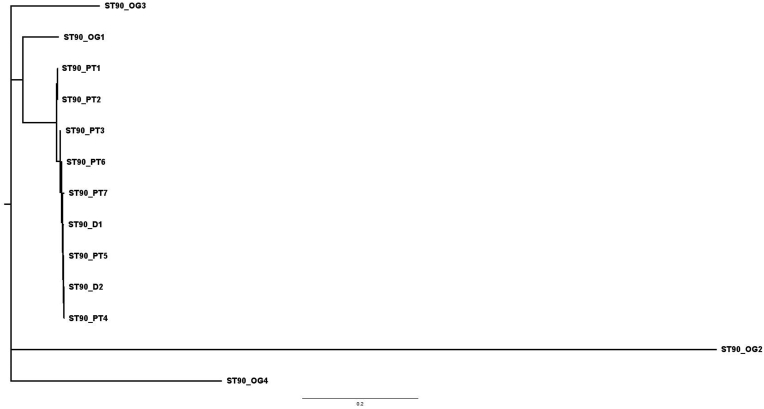
Over a time period of 18 months an Enterobacter hormaechei sequence type (ST) 90, harboring a bla OXA-436 carbapenemase gene, was isolated from seven patients at Odense University Hospital, Denmark. The patients were all from the same department, but there was no apparent direct epidemiological link. Whole genome sequencing (WGS) was performed on all clinical isolates as well as on a number of environmental samples including two E. hormaechei ST90 isolates carrying the bla OXA-436 gene, which were isolated in samples from two shower drains at the department. These drains were suspected to be the source of the outbreak.
Keywords: Carbapenemase producing organisms; Enterobacter hormaechei; Environmental transmission; Whole genome sequencing.
© 2022 The Authors.
Figures

References
-
- DANMAP. DANMAP 2020 – Use of antimicrobial agents and occurrence of antimicrobial resistance in bacteria from food animals, food and humans I Denmark. https://www.danmap.org/reports/2020 [accessed October 12, 2021].
-
- Samuelsen Ø., Hansen F., Aasnæs B., Hasman H., Lund B.A., Leiros H.S., et al. Dissemination and Characteristics of a Novel Plasmid-Encoded Carbapenem-Hydrolyzing Class D β-Lactamase, OXA-436, Found in Isolates from Four Patients at Six Different Hospitals in Denmark. Antimicrob Agents Chemother. 2017;62(1) doi: 10.1128/AAC.01260-17. e01260-17. - DOI - PMC - PubMed
LinkOut - more resources
Full Text Sources
