


Protective Effects of Polysaccharides in Neurodegenerative Diseases
- PMID: 35860666
- PMCID: PMC9289469
- DOI: 10.3389/fnagi.2022.917629
Protective Effects of Polysaccharides in Neurodegenerative Diseases
Abstract
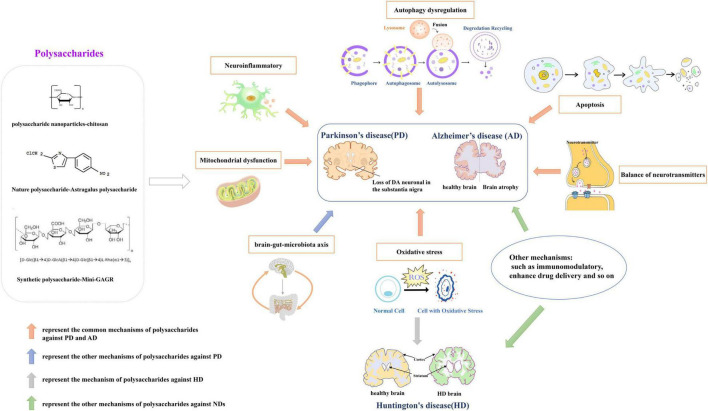
Neurodegenerative diseases (NDs) are characterized by progressive degeneration and necrosis of neurons, including Alzheimer's disease (AD), Parkinson's disease (PD), Huntington's disease and others. There are no existing therapies that correct the progression of these diseases, and current therapies provide merely symptomatic relief. The use of polysaccharides has received significant attention due to extensive biological activities and application prospects. Previous studies suggest that the polysaccharides as a candidate participate in neuronal protection and protect against NDs. In this review, we demonstrate that various polysaccharides mediate NDs, and share several common mechanisms characterized by autophagy, apoptosis, neuroinflammation, oxidative stress, mitochondrial dysfunction in PD and AD. Furthermore, this review reveals potential role of polysaccharides in vitro and in vivo models of NDs, and highlights the contributions of polysaccharides and prospects of their mechanism studies for the treatment of NDs. Finally, we suggest some remaining questions for the field and areas for new development.
Keywords: Alzheimer’s disease; Huntington’s disease; Parkinson’s disease; mechanism; polysaccharides.
Copyright © 2022 Wang, Chen, Yang, Wen, Cao, Zhao and Yan.
Conflict of interest statement
The authors declare that the research was conducted in the absence of any commercial or financial relationships that could be construed as a potential conflict of interest.
Figures
Similar articles
-
Role of traditional Chinese medicine in ameliorating mitochondrial dysfunction via non-coding RNA signaling: Implication in the treatment of neurodegenerative diseases.Front Pharmacol. 2023 Mar 1;14:1123188. doi: 10.3389/fphar.2023.1123188. eCollection 2023. Front Pharmacol. 2023. PMID: 36937876 Free PMC article. Review.
-
Naringenin: A prospective therapeutic agent for Alzheimer's and Parkinson's disease.J Food Biochem. 2022 Dec;46(12):e14415. doi: 10.1111/jfbc.14415. Epub 2022 Sep 15. J Food Biochem. 2022. PMID: 36106706 Review.
-
Therapeutic Potential of Natural Products in Treating Neurodegenerative Disorders and Their Future Prospects and Challenges.Molecules. 2021 Sep 2;26(17):5327. doi: 10.3390/molecules26175327. Molecules. 2021. PMID: 34500759 Free PMC article. Review.
-
Antioxidant and Anti-inflammatory Effect of Nrf2 Inducer Dimethyl Fumarate in Neurodegenerative Diseases.Antioxidants (Basel). 2020 Jul 17;9(7):630. doi: 10.3390/antiox9070630. Antioxidants (Basel). 2020. PMID: 32708926 Free PMC article. Review.
-
Physical Exercise-Induced Myokines in Neurodegenerative Diseases.Int J Mol Sci. 2021 May 28;22(11):5795. doi: 10.3390/ijms22115795. Int J Mol Sci. 2021. PMID: 34071457 Free PMC article. Review.
Cited by
-
Bibliometric analysis of research on Alzheimer's disease and non-coding RNAs: Opportunities and challenges.Front Aging Neurosci. 2022 Oct 18;14:1037068. doi: 10.3389/fnagi.2022.1037068. eCollection 2022. Front Aging Neurosci. 2022. PMID: 36329875 Free PMC article.
-
Therapeutic Potential of Fungal Polysaccharides in Gut Microbiota Regulation: Implications for Diabetes, Neurodegeneration, and Oncology.J Fungi (Basel). 2024 May 31;10(6):394. doi: 10.3390/jof10060394. J Fungi (Basel). 2024. PMID: 38921380 Free PMC article. Review.
-
Chitosan alleviates symptoms of Parkinson's disease by reducing acetate levels, which decreases inflammation and promotes repair of the intestinal barrier and blood-brain barrier.Neural Regen Res. 2026 Jan 1;21(1):377-391. doi: 10.4103/NRR.NRR-D-23-01511. Epub 2024 Jun 26. Neural Regen Res. 2026. PMID: 38934394 Free PMC article.
-
New Insights into the Gut Microbiota in Neurodegenerative Diseases from the Perspective of Redox Homeostasis.Antioxidants (Basel). 2022 Nov 18;11(11):2287. doi: 10.3390/antiox11112287. Antioxidants (Basel). 2022. PMID: 36421473 Free PMC article. Review.
-
Mushroom Polysaccharides as Potential Candidates for Alleviating Neurodegenerative Diseases.Nutrients. 2022 Nov 15;14(22):4833. doi: 10.3390/nu14224833. Nutrients. 2022. PMID: 36432520 Free PMC article. Review.
References
Publication types
LinkOut - more resources
Full Text Sources
