. 2022 Aug 31;10(4):e0206322.
doi: 10.1128/spectrum.02063-22. Epub 2022 Jul 5.

Mechanisms Behind the Indirect Impact of Metabolic Regulators on Virulence Factor Production in Staphylococcus aureus

Affiliations

Mechanisms Behind the Indirect Impact of Metabolic Regulators on Virulence Factor Production in Staphylococcus aureus

Amelia C Stephens et al. Microbiol Spectr. .

Abstract

Staphylococcus aureus is a human skin pathogen capable of causing invasive infections in many tissues in the human body. The host of virulence factors, such as toxins and proteases, available to S. aureus contribute to its diverse disease presentations. The majority of these virulence factors are under the control of the Agr quorum sensing system. The interaction between the Agr system and some well-established metabolic regulators has long been noted, but no mechanism has been provided as to these indirect interactions. In this study, we examine the connection between Agr and CcpA, a regulator of central carbon metabolism with a known positive impact on Agr function. We further investigated the interaction of Agr and CodY, a regulator of amino acid metabolism and a member of the stringent response with a known negative impact on Agr function. We show that though there are alterations in intracellular amino acid levels in each of these mutants that are consistent with their effect on Agr, there does not seem to be a direct impact on the translation of the Agr system itself that contributes to the altered expression observed in these mutants. Given the changes in cellular metabolism in a ΔccpA mutant, we find reduced levels of intracellular ATP even in the presence of glucose. This reduction in ATP, combined with the reduced affinity of the AgrC sensor kinase for ATP, explains the reduction in Agr activity long observed in ΔccpA strains. IMPORTANCE The human pathogen Staphylococcus aureus produces a great number of virulence factors that contribute to the pathogen's ability to cause dangerous, invasive infections. Understanding the full scope of the regulation of these virulence factors can provide us with new information about how to target virulence factor production. For years, researchers in the field have observed an impact of metabolic regulators on virulence factor production with no mechanistic explanation. Here, we describe the role of two of these regulators, CcpA and CodY, in virulence factor expression and provide evidence of indirect mechanisms contributing to the control of the Agr system and virulence factor production by these two metabolic regulators. Our study sheds light on the interplay between metabolism and virulence in S. aureus and provides an explanation as to how these concepts are linked.

Keywords: Staphylococcus aureus; carbon metabolism; metabolic regulation; metabolism; quorum sensing; virulence factors; virulence regulation.


Conflict of interest statement

The authors declare no conflict of interest.

Figures
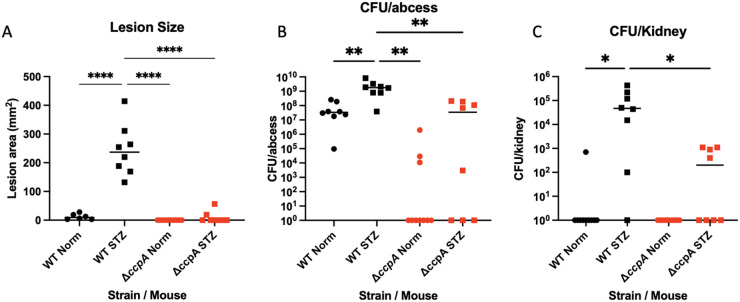
FIG 1
FIG 1
Deletion of ccpA results in severely attenuated infections in both normal and diabetic animals. Untreated and STZ treated mice were subcutaneously infected with 1 × 107 CFU WT S. aureus LAC and the isogenic ΔccpA mutant (n = 8 for each category). STZ treated mice infected with WT LAC showed larger lesion area (A) and higher bacterial burdens in the abscess and in the kidney (B, C). Mice infected with the ΔccpA mutant exhibited attenuated infection and lowered metrics in all categories (A–C) in both untreated and STZ treated animals. Statistics: unpaired t tests between groups *, P < 0.05; ****, P < .0001.
FIG 2
FIG 2
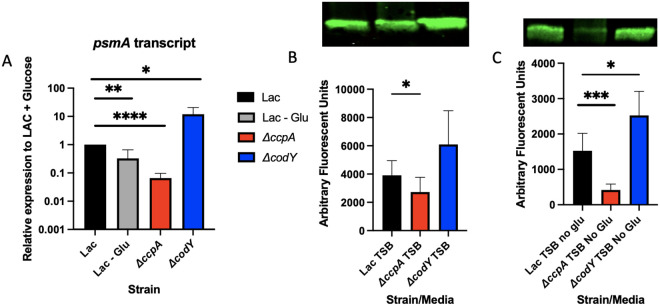
ΔccpA and a ΔcodY mutants have opposing effects on virulence factor expression. Cultures of WT LAC, ΔccpA, and ΔcodY were grown to midexponential phase (OD660 = ~3–4), and samples were taken for RNA extraction. QRT-PCR was performed on these for expression of psmA normalized to rpoD (A). The same cultures were also grown overnight in TSB with (B) or without (C) glucose, and their supernatants were run on an SDS-PAGE gel for Western blot stained for α-hemolysin (B, C). Statistics: (A) unpaired t test. *, P < 0.05; **, P < .01; ****, P < .0001; (B) paired t test. *, P < .05; (C) unpaired t test. *, P < .05; ***, P < .001.
FIG 3
FIG 3
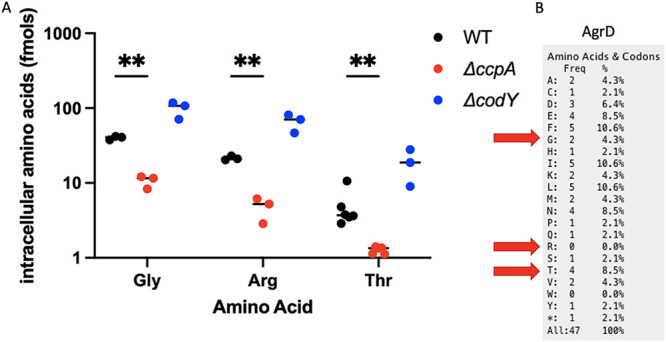
Intracellular levels of key amino acids are altered in a ΔccpA and ΔcodY mutant. Cell-free extracts were created from cultures of WT LAC, ΔccpA, and ΔcodY grown to midexponential phase to determine intracellular amino acid levels. Levels of glycine, arginine, and threonine were significantly altered from WT levels in both a ΔccpA and a ΔcodY mutant (A). Glycine and threonine are both present in the AgrD peptide (B). Statistics: mixed-effects model with Dunnett’s multiple-comparison test. **, P < .01.
FIG 4
FIG 4
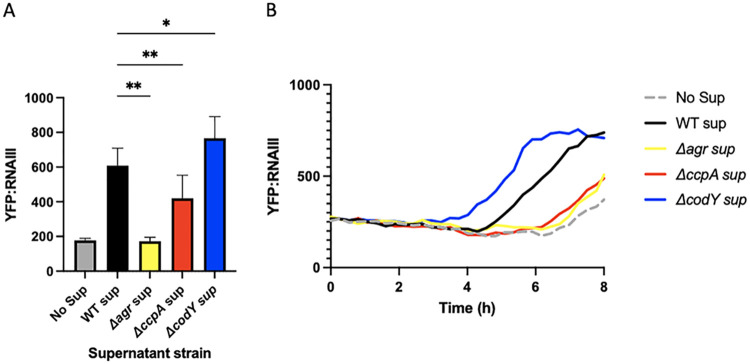
Supernatants from ΔccpA and ΔcodY mutants have opposing effects on the stimulation of an RNAIII::YFP reporter strain. Supernatants were removed from overnight cultures of WT LAC, ΔccpA, ΔcodY, and ΔagrA strains. These were added to fresh cultures of WT LAC harboring a pYFP::RNAIII reporter plasmid. Averages of peak expression levels at hour 6 are shown in A, and a representative curve is shown in B. Statistics: mixed-effect analysis with Tukey’s multiple comparisons. *, P < .05; **, P < .01.
FIG 5
FIG 5
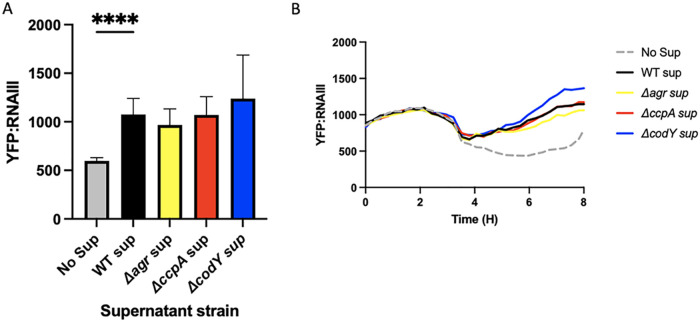
Constitutive expression of AgrBD equalizes RNAIII::YFP stimulation across all mutants. Supernatants were removed from overnight cultures of WT LAC, ΔccpA, ΔcodY, and ΔagrA strains harboring plgt::agrBD. These were added to fresh cultures of WT LAC harboring a pYFP::RNAIII reporter plasmid. Averages of peak expression levels at hour 6 are shown in A, and a representative curve is shown in B. Statistics: mixed-effects model with Dunnett’s multiple-comparison test. ****, P < .0001.
FIG 6
FIG 6
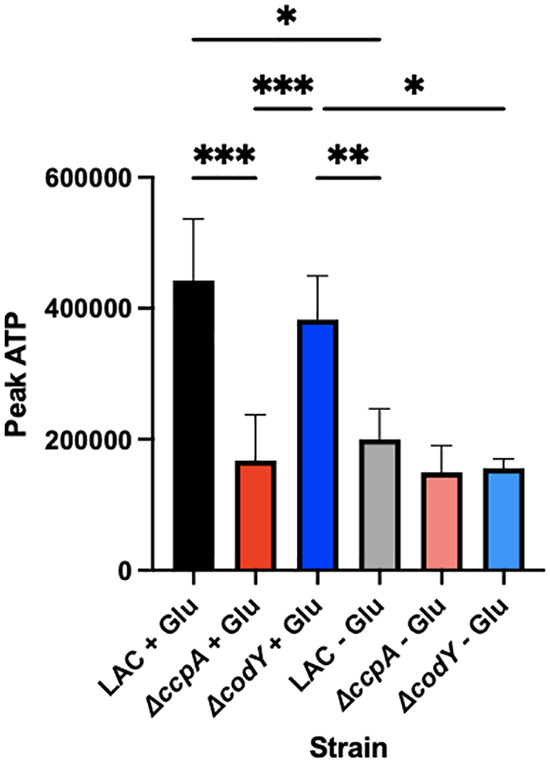
ATP levels in a ΔccpA mutant reflect those of WT LAC grown in the absence of glucose. ATP levels were determined in cultures of WT LAC, ΔccpA, and ΔcodY strains grown in TSB with and without glucose. Statistics: mixed effects model with Tukey’s multiple comparison test. *, P < .05; **, P < .01; ***, P < .001.

References

    1. Graham PL, Lin SX, Larson EL. 2006. A U.S. population-based survey of Staphylococcus aureus colonization. Ann Intern Med 144:318–325. doi: 10.7326/0003-4819-144-5-200603070-00006. - DOI - PubMed
    1. Sakr A, Brégeon F, Mège J-L, Rolain J-M, Blin O. 2018. Staphylococcus aureus nasal colonization: an update on mechanisms, epidemiology, risk factors, and subsequent infections. Front Microbiol 9:2419. doi: 10.3389/fmicb.2018.02419. - DOI - PMC - PubMed
    1. Vella V, Galgani I, Polito L, Arora AK, Creech CB, David MZ, Lowy FD, Macesic N, Ridgway JP, Uhlemann A-C, Bagnoli F. 2021. Staphylococcus aureus skin and soft tissue infection recurrence rates in outpatients: a retrospective database study at 3 US medical centers. Clin Infect Dis 73:e1045–e1053. doi: 10.1093/cid/ciaa1717. - DOI - PMC - PubMed
    1. Schmidt A, Bénard S, Cyr S. 2015. Hospital cost of staphylococcal infection after cardiothoracic or orthopedic operations in France: a retrospective database analysis. Surg Infect (Larchmt) 16:428–435. doi: 10.1089/sur.2014.045. - DOI - PMC - PubMed
    1. Horino T, Hori S. 2020. Metastatic infection during Staphylococcus aureus bacteremia. J Infect Chemother 26:162–169. doi: 10.1016/j.jiac.2019.10.003. - DOI - PubMed

Publication types

MeSH terms