. 2022 Aug 31;10(4):e0078122.
doi: 10.1128/spectrum.00781-22. Epub 2022 Jul 6.

RG203KR Mutations in SARS-CoV-2 Nucleocapsid: Assessing the Impact Using a Virus-Like Particle Model System

Affiliations

RG203KR Mutations in SARS-CoV-2 Nucleocapsid: Assessing the Impact Using a Virus-Like Particle Model System

Harsha Raheja et al. Microbiol Spectr. .

Abstract

The emergence and evolution of SARS-CoV-2 is characterized by the occurrence of diverse sets of mutations that affect virus characteristics, including transmissibility and antigenicity. Recent studies have focused mostly on spike protein mutations; however, SARS-CoV-2 variants of interest (VoI) or concern (VoC) contain significant mutations in the nucleocapsid protein as well. To study the relevance of mutations at the virion level, recombinant baculovirus expression system-based virus-like particles (VLPs) were generated for the prototype Wuhan sequence along with spike protein mutants like D614G and G1124V and the significant RG203KR mutation in nucleocapsid. All four structural proteins were assembled in a particle for which the morphology and size, confirmed by transmission electron microscopy, closely resembled that of the native virion. The VLP harboring RG203KR mutations in nucleocapsid exhibited augmentation of humoral immune responses and enhanced neutralization by immunized mouse sera. Results demonstrate a noninfectious platform to quickly assess the implication of mutations in structural proteins of the emerging variant. IMPORTANCE Since its origin in late 2019, the SARS-CoV-2 virus has been constantly mutating and evolving. Current studies mostly employ spike protein (S) pseudovirus systems to determine the effects of mutations on the infectivity and immunogenicity of variants. Despite its functional importance and emergence as a mutational hot spot, the nucleocapsid (N) protein has not been widely studied. The generation of SARS-CoV-2 VLPs in a baculoviral system in this study, with mutations in the S and N proteins, allowed examination of the involvement of all the structural proteins involved in viral entry and eliciting an immune response. This approach provides a platform to study the effect of mutations in structural proteins of SARS-CoV-2 that potentially contribute to cell infectivity, immune response, and immune evasion, bypassing the use of infectious virus for the same analyses.

Keywords: SARS-CoV-2; VLP; vaccine.


Conflict of interest statement

The authors declare no conflict of interest.

Figures
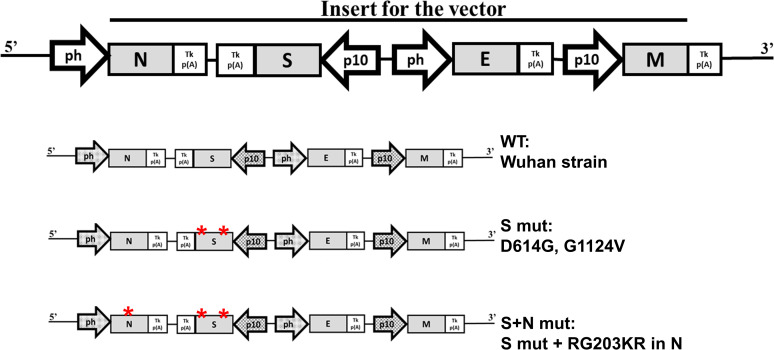
FIG 1
FIG 1
Schematic for SARS-CoV-2 VLP expression construct. ph, baculovirus polyhedrin promoter; p10, baculoviral p10 promoter; S, SARS-CoV-2 spike protein; E, SARS-CoV-2 envelope protein; M, SARS-CoV-2 membrane protein; N, SARS-CoV-2 nucleocapsid protein; Tk p(A), Thymidine kinase Poly-adenylation sequence.
FIG 2
FIG 2
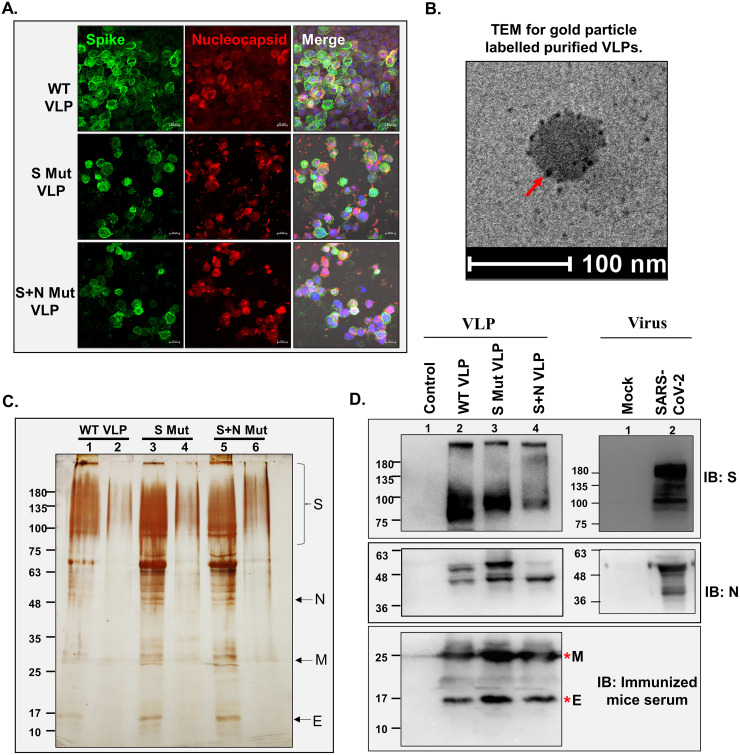
Characterization of SARS-CoV-2 VLPs. (A) Expression of SARS-CoV-2 proteins in Sf21 cells. Baculovirus-infected Sf21 cells were harvested after 96 h and processed for confocal staining using anti-S- and anti-N-specific primary antibodies and Alexa Fluor 488 (AF488)- and AF633-labeled secondary antibodies. Nuclei were counterstained using DAPI. Bar, 20 μm. (B) Transmission electron microscope images of purified VLPs. The purified VLPs were fixed, added to the copper grid, and stained for S protein using specific primary and immunogold-labeled secondary antibody. Negative staining was done using uranyl oxalate. The arrow indicates immunogold-labeled S protein. (C) The purified VLPs were loaded onto SDS–10% polyacrylamide gels, followed by silver staining (adjacent to the VLP lane, a lower fraction of the gradient was loaded, confirming the VLP purity). Lanes 1, 3, and 5 represent purified VLP lanes. (D) Western blot to detect the presence of S protein and N protein using specific primary antibodies and HRP-tagged secondary antibodies for purified VLPs and SARS-CoV-2-infected cell lysate. Sera from VLP-injected mice was used as primary antibody, followed by HRP-tagged anti-mouse antibody as secondary antibody for detecting M protein and E protein.
FIG 3
FIG 3
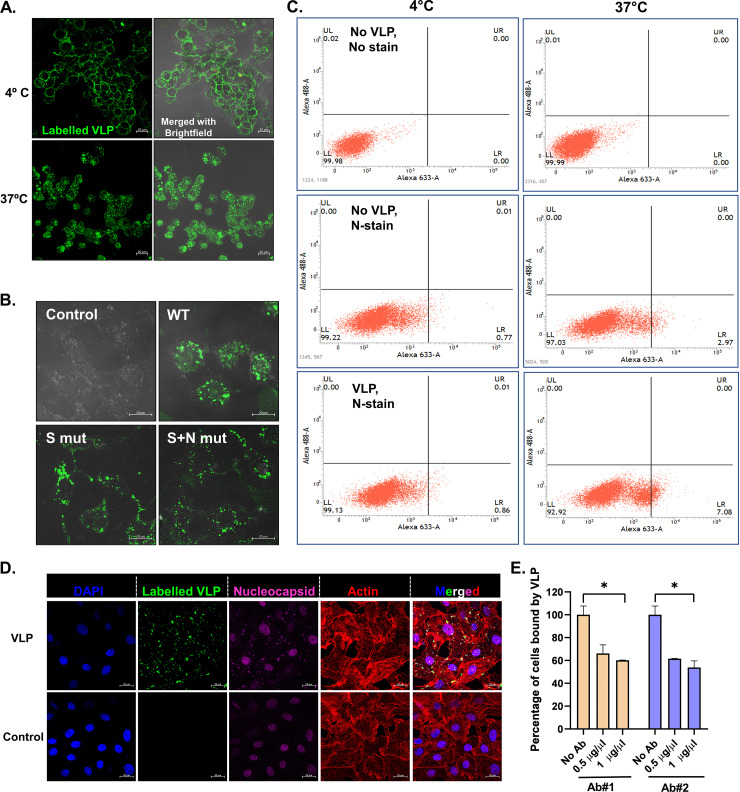
VLP binding and entry into cells. (A) Dynamics of VLP binding to cells. AF488-labeled VLPs were incubated with Vero cells at the indicated temperature, and VLP binding was visualized by confocal imaging. Bar, 20 μm. (B) Vero cells were incubated with AF488-labeled VLPs for 2 h and processed for confocal imaging. Bar, 20 μm. (C) Unlabeled VLPs were incubated with Vero cells at the indicated temperatures for 2 h, followed by immunostaining using nucleocapsid (N) protein-specific primary antibody and AF633-labeled secondary antibody. The percentage of cells bound by N antibody was quantified by flow cytometry. (D) AF488-labeled VLPs were incubated with Vero cells at 37°C for 2 h, followed by immunostaining using nucleocapsid (N) protein-specific primary antibody and AF633-labeled secondary antibody. Nucleus was counterstained with DAPI, and the cell boundary was visualized with rhodamine-phalloidin. Bar, 20 μm. (E) Labeled VLPs were incubated with the indicated concentration of commercial antibodies against S protein prior to binding with Vero cells. VLP binding to cells after preincubation was analyzed by flow cytometry and quantified. Blue and pink colors represent the two different antibodies used. Student’s t test was used for statistical analysis. Error bars represent standard errors of the means. *, P < 0.05; **, P < 0.01; ***, P < 0.001.
FIG 4
FIG 4
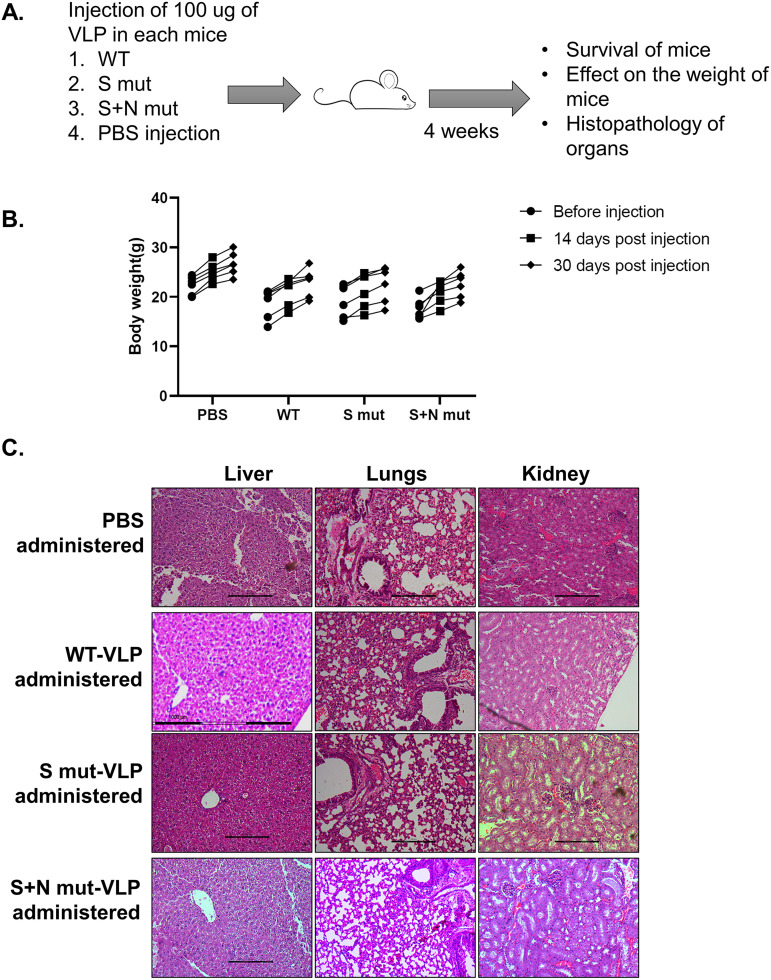
VLP toxicity analysis in mice. (A) Workflow for VLP toxicity analysis in mice. (B) Body weight of mice was recorded at the mentioned time points after VLP administration. Six animals were included for each group. Each dot represents a different animal. (C) Light microscopy images of liver, lungs, and kidney sections of PBS-treated or respective VLP-treated mice after hematoxylin and eosin staining of the sections. The images are representative of one animal from each group.
FIG 5
FIG 5
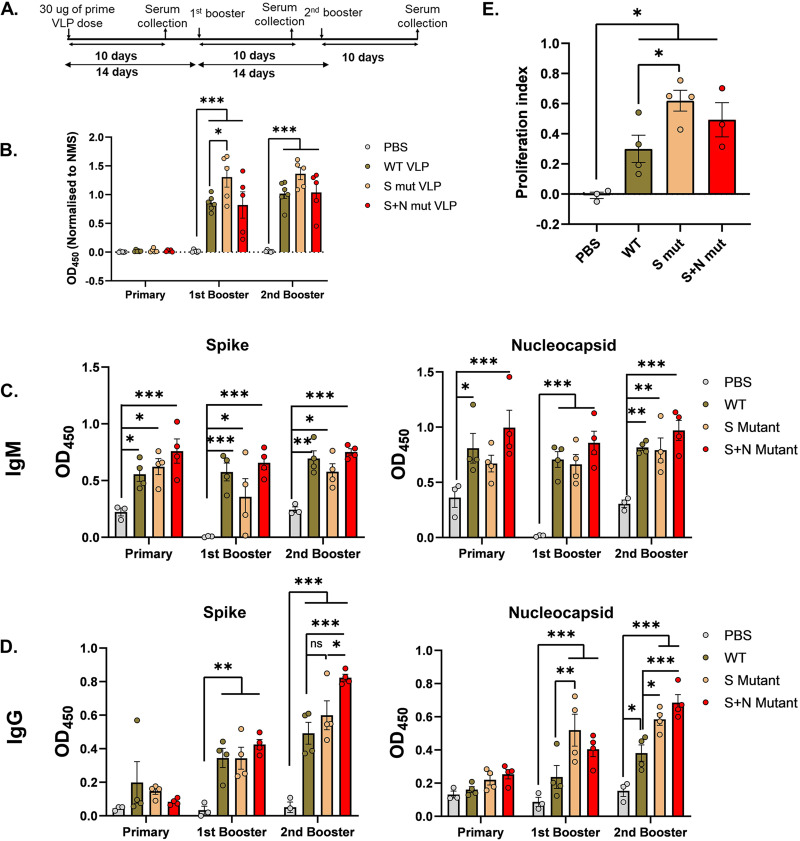
Immune response against SARS-CoV-2 VLP injection in mice. (A) Schematic of immunogenicity studies in mice. ELISA was performed with murine sera collected after immunization with the indicated VLPs at different time points. (B to D) WT-VLP or full-length spike protein or nucleocapsid protein were used as antigens. Mouse serum samples were added to the coated antigens and either HRP-tagged IgG and IgM (B) or biotin-labeled IgM and IgG antibodies (C and D) were used as secondary antibodies. Color development by streptavidin-HRP followed by addition of TMB substrate was quantified and plotted after normalization as described previously. Sera from 3 animals for PBS injection and 4 animals each for the VLP injection were analyzed by ELISA. Each point represents the value obtained from individual mouse serum. Two-way ANOVA was done for statistical analysis. Error bars represent SEM. *, P < 0.05; **, P < 0.01; ***, P < 0.001. (E) Splenocyte proliferation in response to peptides against spike protein was quantified in an MTT assay. MTT was added after 24 h of peptide stimulation, and color development was quantified and plotted. Each point represents splenocyte proliferation from a different mouse. Student’s t test was used for statistical analysis. Error bars represent SEM. *, P < 0.05; **, P < 0.01; ***, P < 0.001.
FIG 6
FIG 6
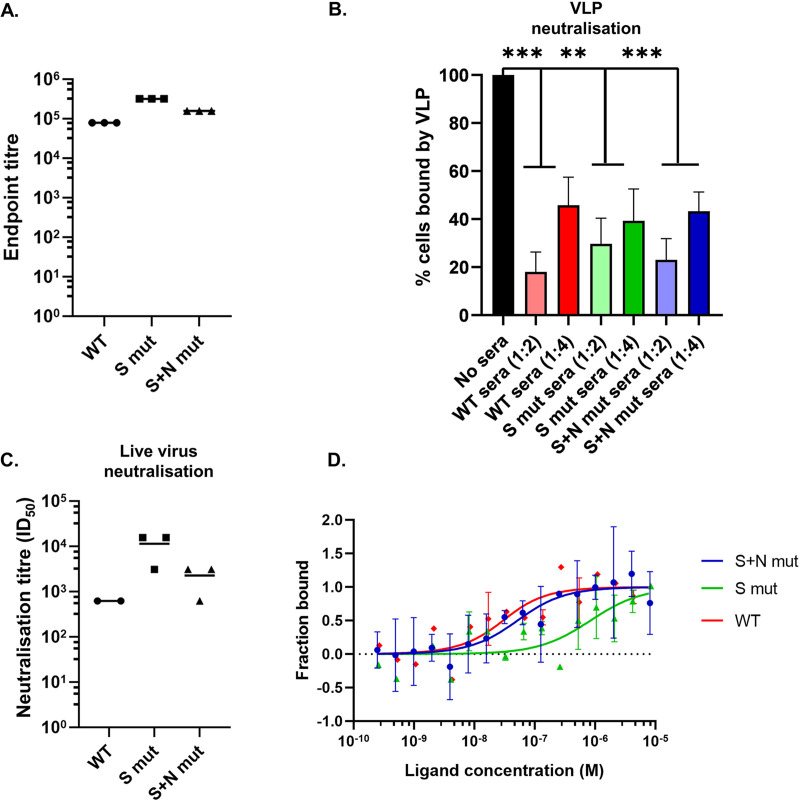
Applications of the VLP system with incorporated mutations. (A) Endpoint titration of sera from VLP-immunized animals. ELISA plates were coated with WT-VLP, and one representative serum sample from each VLP-immunized mouse was used to calculate the endpoint titer. (B) Neutralization of VLP binding to cells. Labeled VLPs were incubated with the indicated dilutions of sera prior to binding with Vero cells. VLP binding to cells after preincubation was analyzed by flow cytometry and quantified. Student’s t test was used for statistical analysis. Error bars represent SEM. *, P < 0.05; **, P < 0.01; ***, P < 0.001. (C) Live virus neutralization using sera from VLP-immunized animals. Virus was incubated with heat-inactivated sera from VLP-immunized animals prior to attachment to Vero cells. The serum dilution which resulted in a 50% reduction of plaque numbers compared to preincubation with serum from PBS-immunized animals was plotted. Each point represents a different mouse serum. (D) Binding affinity of VLPs with recombinant ACE-2 was calculated using microscale thermophoresis.

References

    1. Su S, Wong G, Shi W, Liu J, Lai ACK, Zhou J, Liu W, Bi Y, Gao GF. 2016. Epidemiology, genetic recombination, and pathogenesis of coronaviruses. Trends Microbiol 24:490–502. doi:10.1016/j.tim.2016.03.003. - DOI - PMC - PubMed
    1. Beyerstedt S, Casaro EB, Rangel ÉB. 2021. COVID-19: angiotensin-converting enzyme 2 (ACE2) expression and tissue susceptibility to SARS-CoV-2 infection. Eur J Clin Microbiol Infect Dis 40:905–919. doi:10.1007/s10096-020-04138-6. - DOI - PMC - PubMed
    1. Ravichandran S, Coyle EM, Klenow L, Tang J, Grubbs G, Liu S, Wang T, Golding H, Khurana S. 2020. Antibody signature induced by SARS-CoV-2 spike protein immunogens in rabbits. Scie Transl Med 12:eabc3539. doi:10.1126/scitranslmed.abc3539. - DOI - PMC - PubMed
    1. Amrun SN, Lee CY-P, Lee B, Fong S-W, Young BE, Chee RS-L, Yeo NK-W, Torres-Ruesta A, Carissimo G, Poh CM, Chang ZW, Tay MZ, Chan Y-H, Chen MIC, Low JG-H, Tambyah PA, Kalimuddin S, Pada S, Tan S-Y, Sun LJ, Leo Y-S, Lye DC, Renia L, Ng LFP. 2020. Linear B-cell epitopes in the spike and nucleocapsid proteins as markers of SARS-CoV-2 exposure and disease severity. EBioMedicine 58:102911. doi:10.1016/j.ebiom.2020.102911. - DOI - PMC - PubMed
    1. Leung DT, Tam FC, Ma CH, Chan PK, Cheung JL, Niu H, Tam JS, Lim PL. 2004. Antibody response of patients with severe acute respiratory syndrome (SARS) targets the viral nucleocapsid. J Infect Dis 190:379–386. doi:10.1086/422040. - DOI - PMC - PubMed

Publication types

Substances

Supplementary concepts

LinkOut - more resources