Mapping hormone-regulated cell-cell interaction networks in the human breast at single-cell resolution
- PMID: 35863345
- PMCID: PMC9590200
- DOI: 10.1016/j.cels.2022.06.005
Mapping hormone-regulated cell-cell interaction networks in the human breast at single-cell resolution
Abstract
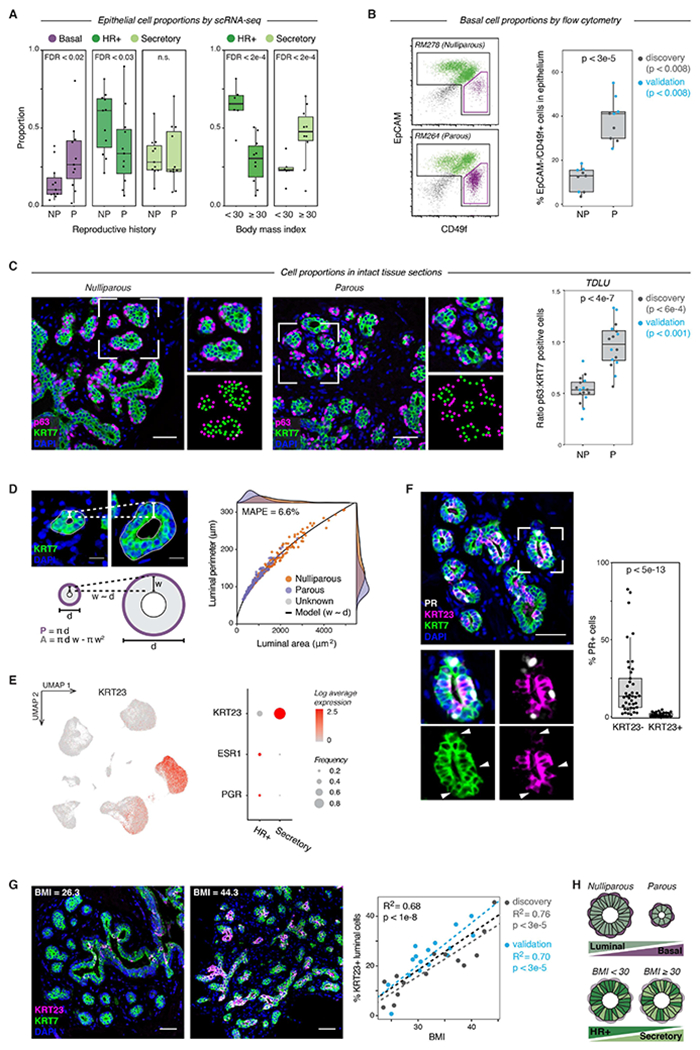
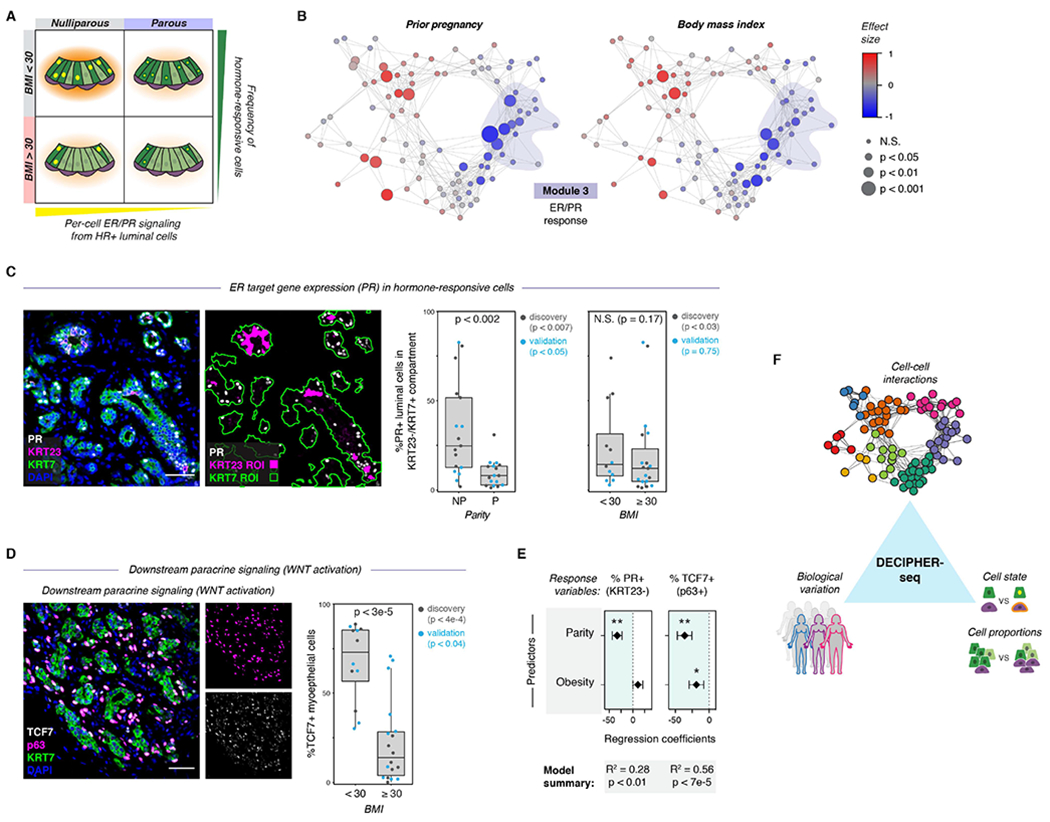
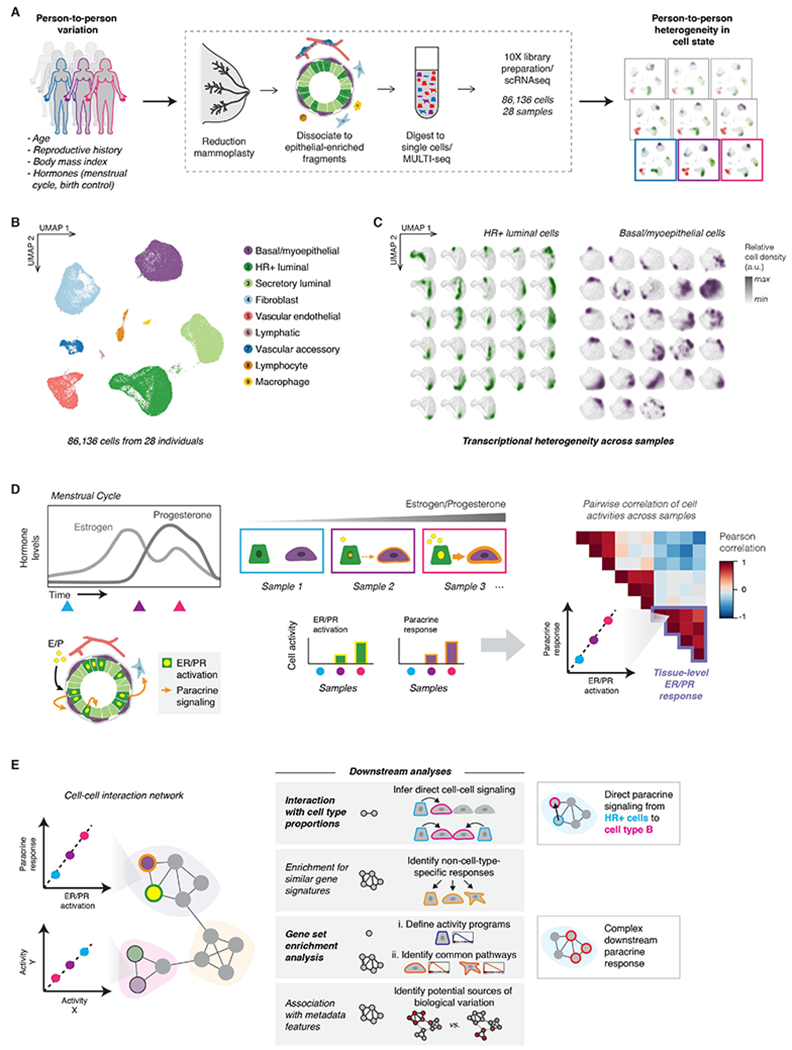
The rise and fall of estrogen and progesterone across menstrual cycles and during pregnancy regulates breast development and modifies cancer risk. How these hormones impact each cell type in the breast remains poorly understood because they act indirectly through paracrine networks. Using single-cell analysis of premenopausal breast tissue, we reveal a network of coordinated transcriptional programs representing the tissue-level response to changing hormone levels. Our computational approach, DECIPHER-seq, leverages person-to-person variability in breast composition and cell state to uncover programs that co-vary across individuals. We use differences in cell-type proportions to infer a subset of programs that arise from direct cell-cell interactions regulated by hormones. Further, we demonstrate that prior pregnancy and obesity modify hormone responsiveness through distinct mechanisms: obesity reduces the proportion of hormone-responsive cells, whereas pregnancy dampens the direct response of these cells to hormones. Together, these results provide a comprehensive map of the cycling human breast.
Keywords: cell-cell interactions; hormone signaling; human breast; sample heterogeneity; scRNA-seq; single-cell genomics.
Copyright © 2022 The Authors. Published by Elsevier Inc. All rights reserved.
Conflict of interest statement
Declaration of interests Z.J.G. and C.S.M. hold patents related to the MULTI-seq barcoding method. Z.J.G. is an equity holder in Scribe Biosciences and Provenance bio and a member of the scientific advisory board of Serotiny Bio. C.S.M. is a consultant for ImYoo. Since January 10, 2022, L.M.M. is an employee of Genentech, a member of the Roche group.
Figures
Similar articles
-
Estrogen and progesterone signalling in the normal breast and its implications for cancer development.Mol Cell Endocrinol. 2018 May 5;466:2-14. doi: 10.1016/j.mce.2017.08.011. Epub 2017 Aug 26. Mol Cell Endocrinol. 2018. PMID: 28851667 Review.
-
90 YEARS OF PROGESTERONE: Progesterone receptor signaling in the normal breast and its implications for cancer.J Mol Endocrinol. 2020 Jul;65(1):T81-T94. doi: 10.1530/JME-20-0091. J Mol Endocrinol. 2020. PMID: 32508307 Review.
-
Estrogens, progestogens, normal breast cell proliferation, and breast cancer risk.Epidemiol Rev. 1993;15(1):17-35. doi: 10.1093/oxfordjournals.epirev.a036102. Epidemiol Rev. 1993. PMID: 8405201 Review.
-
Progesterone and Overlooked Endocrine Pathways in Breast Cancer Pathogenesis.Endocrinology. 2015 Oct;156(10):3442-50. doi: 10.1210/en.2015-1392. Epub 2015 Aug 4. Endocrinology. 2015. PMID: 26241069 Free PMC article. Review.
-
Control of mammary stem cell function by steroid hormone signalling.Nature. 2010 Jun 10;465(7299):798-802. doi: 10.1038/nature09027. Epub 2010 Apr 11. Nature. 2010. PMID: 20383121
Cited by
-
Preneoplastic stromal cells promote BRCA1-mediated breast tumorigenesis.Nat Genet. 2023 Apr;55(4):595-606. doi: 10.1038/s41588-023-01298-x. Epub 2023 Mar 13. Nat Genet. 2023. PMID: 36914836 Free PMC article.
-
Microfluidics-free single-cell genomics with templated emulsification.Nat Biotechnol. 2023 Nov;41(11):1557-1566. doi: 10.1038/s41587-023-01685-z. Epub 2023 Mar 6. Nat Biotechnol. 2023. PMID: 36879006 Free PMC article.
-
Mammary Microvessels are Sensitive to Menstrual Cycle Sex Hormones.Adv Sci (Weinh). 2023 Dec;10(35):e2302561. doi: 10.1002/advs.202302561. Epub 2023 Oct 28. Adv Sci (Weinh). 2023. PMID: 37897317 Free PMC article.
-
Oncogene activated human breast luminal progenitors contribute basally located myoepithelial cells.Breast Cancer Res. 2024 Dec 18;26(1):183. doi: 10.1186/s13058-024-01939-x. Breast Cancer Res. 2024. PMID: 39695857 Free PMC article.
-
Configurational entropy is an intrinsic driver of tissue structural heterogeneity.bioRxiv [Preprint]. 2023 Jul 2:2023.07.01.546933. doi: 10.1101/2023.07.01.546933. bioRxiv. 2023. PMID: 37425903 Free PMC article. Preprint.
References
Publication types
MeSH terms
Substances
Grants and funding
LinkOut - more resources
Full Text Sources
Molecular Biology Databases