


Long-Term Outcomes of the 150 mm Drug-Coated Balloon Cohort from the IN.PACT Global Study
- PMID: 35864209
- PMCID: PMC9458561
- DOI: 10.1007/s00270-022-03214-y
Long-Term Outcomes of the 150 mm Drug-Coated Balloon Cohort from the IN.PACT Global Study
Abstract
Purpose: Data on the long-term safety and effectiveness of drug-coated balloons (DCBs) for the treatment of long femoropopliteal atherosclerotic lesions in the real-world setting are rare. This study reports 3 year and 5 year outcomes of the pre-specified 150 mm balloon sub-cohort of the IN.PACT Global Study.
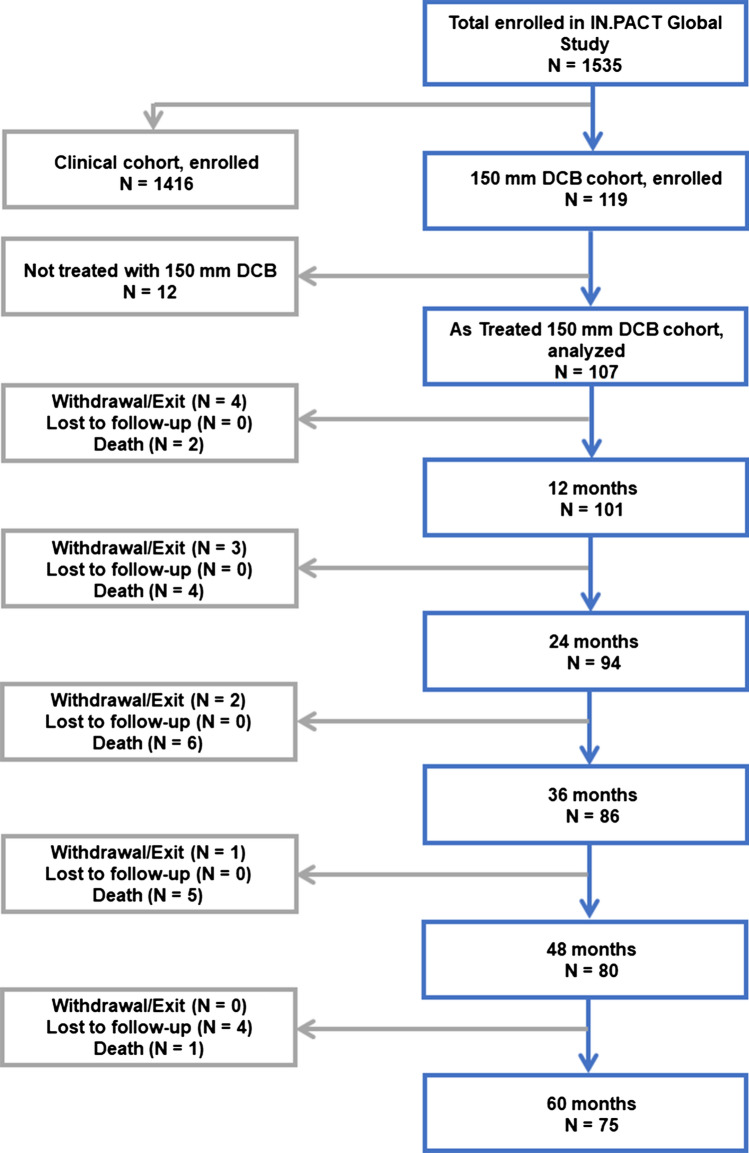
Methods: The IN.PACT Global Study was a prospective, multicentre, international, single-arm study evaluating the performance of the IN.PACT Admiral DCB in real-world patients with femoropopliteal atherosclerotic disease. This pre-specified 150 mm DCB cohort analysis comprised 107 participants (111 lesions) with all target lesions treated with at least one 150 mm DCB.
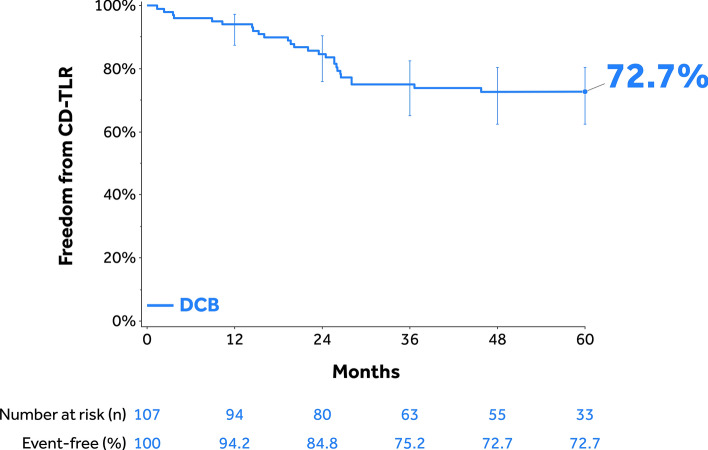
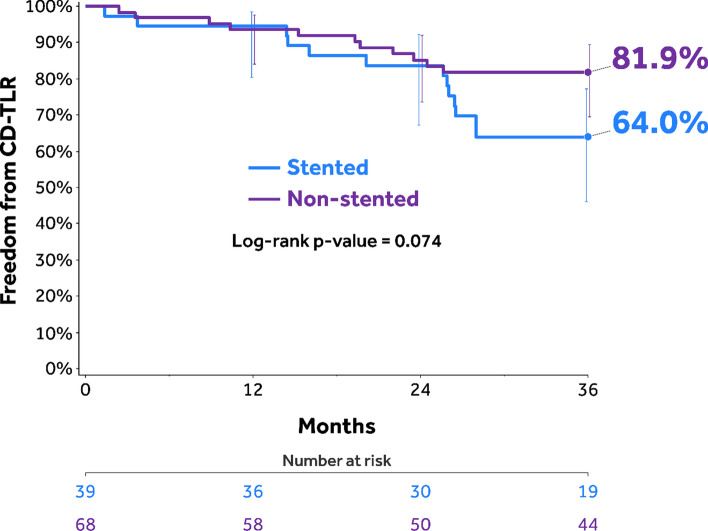
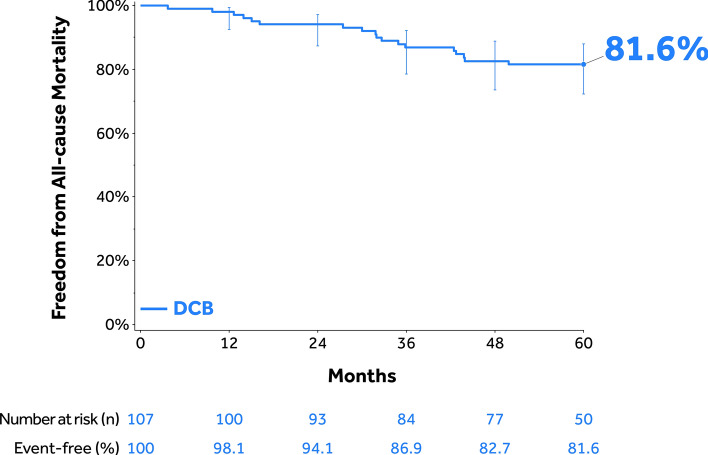
Results: Mean lesion length was 20.3 ± 9.2 cm; 18.0% had in-stent restenosis, 58.6% were totally occluded, and 17.1% were severely calcified. Through 60 months, the Kaplan-Meier estimate of freedom from clinically driven target lesion revascularization (CD-TLR) was 72.7% [95% confidence interval (CI):62.4%-80.5%]. The safety composite endpoint (freedom from device/procedure-related death through 30 days; freedom from target limb major amputation and clinically driven target vessel revascularization through 5 years) was 70.5%. The cumulative incidence of major amputation was 1.0% and all-cause mortality was 18.4% through 60 months. Freedom from CD-TLR rates in the provisional stented and non-stented subgroups through 36 months were 64.0% [95% CI: 46.1%-77.3%] and 81.9% [95% CI: 69.7%-89.6%] (log-rank p = 0.074), respectively.
Conclusions: The results demonstrate sustained long-term safety of the 150 mm IN.PACT Admiral DCB for long femoropopliteal atherosclerotic lesions in real-world patients. In particular, the results show that DCB angioplasty is an effective revascularization modality in long complex lesions.
Clinicaltrials: gov identifier: NCT01609296.
Level of evidence: Level 3, Cohort Study.
Keywords: Drug-coated balloon; Femoropopliteal; Long lesions; Peripheral artery disease; Target lesion revascularization.
© 2022. The Author(s).
Conflict of interest statement
Marianne Brodmann has received speaking honoraria from Bard Peripheral Vascular, Biotronik, Medtronic, Philips‐Spectranetics, Shockwave, Bayer Healthcare, and VIVA Physicians; and is a consultant for Bard Peripheral Vascular, Bayer, Biotronik, Intact Vascular, Medtronic, Philips‐Spectranetics, Sanofi, and Shockwave.
Wouter Lansink has received speaking honoraria from Abbott, Bard Peripheral, Biotronik, Boston Scientific, Medtronic, and Philips-Spectranetics and has received clinical trial funds from Bard Peripheral, Biotronik, Boston Scientific, I-vascular, Medtronic, and Philips-Spectranetics.
Katharina Guetl has nothing to disclose.
Antonio Micari has served as a member of the advisory board for Boston Scientific and Medtronic and has served as a consultant for Bard, Boston Scientific, and Terumo.
Jeremiah Menk is a full-time employee of Medtronic Inc., Minneapolis, MN.
Thomas Zeller has received honoraria from Abbott Vascular, Biotronik, Boston Scientific, Cook Medical, Gore and Associates, Medtronic, Philips‐Spectranetics, TriReme, Shockwave, and Veryan; has served as a consultant for Bayer, B. Braun, Boston Scientific, Cook Medical, Gore and Associates, Intact Vascular, Medtronic, Shockwave, Philips-Spectranetics, Veryan, and Vesper Medical; has received research, clinical trial, or drug study funds from 480 biomedical, Bard Peripheral Vascular, B. Braun, Biotronik, Cook Medical, Gore and Associates, Intact Vascular, Med Alliance, Medtronic, Philips-Spectranetics, Terumo, TriReme, and Shockwave; and owns common stock in QT Medical and Veryan.
All procedures performed in studies involving human participants were in accordance with the ethical standards of the institutional and/or national research committee and with the 1964 Helsinki Declaration and its later amendments or comparable ethical standards.
The Institutional Review Board or Ethics Committee at each study site approved the study protocol.
Figures
References
-
- Aboyans V, Ricco JB, Bartelink MEL, et al. 2017 ESC Guidelines on the Diagnosis and Treatment of Peripheral Arterial Diseases, in collaboration with the European Society for Vascular Surgery (ESVS): Document covering atherosclerotic disease of extracranial carotid and vertebral, mesenteric, renal, upper and lower extremity arteriesEndorsed by: the European Stroke Organization (ESO)The Task Force for the Diagnosis and Treatment of Peripheral Arterial Diseases of the European Society of Cardiology (ESC) and of the European Society for Vascular Surgery (ESVS) Eur Heart J. 2018;39(9):763–816. doi: 10.1093/eurheartj/ehx095. - DOI - PubMed
-
- Tepe G, Laird J, Schneider P, et al. Drug-coated balloon versus standard percutaneous transluminal angioplasty for the treatment of superficial femoral and popliteal peripheral artery disease: 12-month results from the in: PACT SFA randomized trial. Circulation. 2015;131(5):495–502. doi: 10.1161/CIRCULATIONAHA.114.011004. - DOI - PMC - PubMed
-
- Iida O, Soga Y, Urasawa K, et al. Drug-coated balloon vs standard percutaneous transluminal angioplasty for the treatment of atherosclerotic lesions in the superficial femoral and proximal popliteal arteries: 1 year results of the MDT-2113 SFA Japan randomized trial. J Endovasc Ther. 2018;25(1):109–117. doi: 10.1177/1526602817745565. - DOI - PMC - PubMed
MeSH terms
Substances
Associated data
LinkOut - more resources
Full Text Sources
Medical
Research Materials
Miscellaneous
