Prevalence of Anemia, Iron Deficiency, Iron Deficiency Anemia and Diagnostic Performance of Hematologic and Biochemical Markers of Sideropenia in 1- to 5-Year-Old Children in Thrace Greece
- PMID: 35865402
- PMCID: PMC9266606
- DOI: 10.4084/MJHID.2022.054
Prevalence of Anemia, Iron Deficiency, Iron Deficiency Anemia and Diagnostic Performance of Hematologic and Biochemical Markers of Sideropenia in 1- to 5-Year-Old Children in Thrace Greece
Abstract
Background and objective: Iron deficiency (ID) is a major public health problem with high prevalence in early childhood. We assessed the prevalence of anemia, ID, and iron deficiency anemia (IDA) in healthy children of Thrace, Greece, its correlation with several factors, and evaluated the diagnostic performance of hematologic and biochemical markers of sideropenia.
Patients and methods: For 202 healthy children 1-5 years old, a questionnaire was filled out describing their nutritional habits during infancy and early childhood. Venous hemograms along with serum ferritin, TIBC, %TS, and CRP were obtained from all studied children. In a subset of 156 children, the concentration of sTfR was also determined.
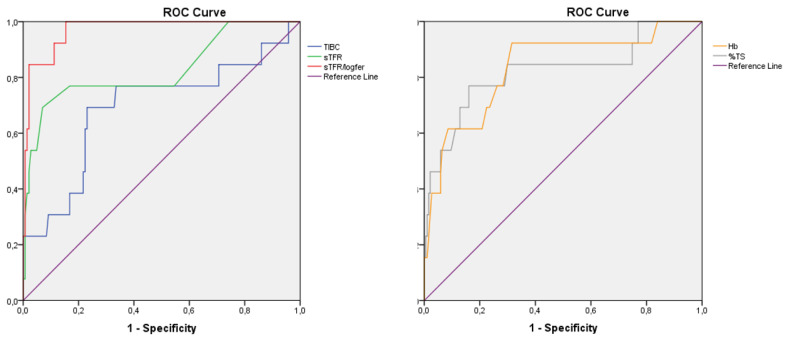
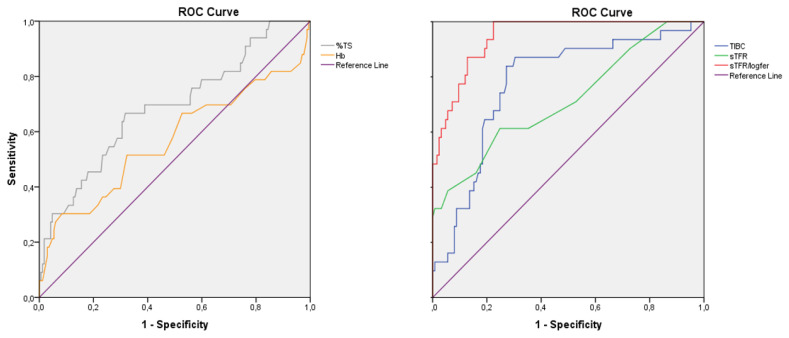
Results: Children with ID and IDA had significantly lower beef consumption than children without sideropenia (p=0.044). Using the WHO cutoff values of Hb <11g/dl and ferritin <12μg/l, the prevalence of anemia, ID, and IDA was 9.41%, 6.44%, and 3.47%, respectively. If Hb <12g/dl and ferritin<18μg/l were used as cutoffs, the prevalence of anemia, ID, and IDA was 26.73%, 16.33%, and 5.94%, respectively. ROC analysis revealed that at ferritin <12μg/l, the AUC of sTfR alone (0.827) was substantially better than that of TIBC (0.691), while at serum ferritin cutoff of 18μg/l, the AUC of TIBC (0.770) was better than that of sTfR (0.716).
Conclusions: The prevalence of ID and IDA in children 1-5 years old in Thrace is like in other developed countries. The chosen cutoff of serum ferritin affects the evaluation of the diagnostic significance of the different sideropenia markers.
Keywords: Anemia; Ferritin; Iron deficiency; Iron deficiency anemia; Sideropenia biomarkers.
Conflict of interest statement
Competing interests: The authors declare no conflict of Interest.
Figures
Similar articles
-
Usefulness of serum ferritin levels in the assessment of iron status in non-pregnant Zairean women of childbearing age.J Trop Med Hyg. 1994 Jun;97(3):171-9. J Trop Med Hyg. 1994. PMID: 8007058
-
Evaluation of serum transferrin receptor concentration in diagnosing and differentiating iron deficiency anaemia from anaemia of chronic disorders.J Pak Med Assoc. 2005 Jan;55(1):13-6. J Pak Med Assoc. 2005. PMID: 15816689
-
The Lack of Association of Iron Deficiency With Anemia in First Graders.J Pediatr Hematol Oncol. 2015 Oct;37(7):524-8. doi: 10.1097/MPH.0000000000000423. J Pediatr Hematol Oncol. 2015. PMID: 26334429
-
Iron Deficiency and Blood Donation: Links, Risks and Management.J Blood Med. 2022 Dec 10;13:775-786. doi: 10.2147/JBM.S375945. eCollection 2022. J Blood Med. 2022. PMID: 36531435 Free PMC article. Review.
-
Defining Global Thresholds for Serum Ferritin: A Challenging Mission in Establishing the Iron Deficiency Diagnosis in This Era of Striving for Health Equity.Diagnostics (Basel). 2025 Jan 26;15(3):289. doi: 10.3390/diagnostics15030289. Diagnostics (Basel). 2025. PMID: 39941219 Free PMC article. Review.
Cited by
-
Adolescent pregnancy and anemia. Ten years of referrals in Northern Greece.Hippokratia. 2024 Jan-Mar;28(1):11-16. Hippokratia. 2024. PMID: 39399407 Free PMC article.
-
Effect of Iron Polymaltose Complex Prophylaxis on Frequency of Iron Deficiency and Iron Deficiency Anemia.Indian J Pediatr. 2025 Feb;92(2):157-163. doi: 10.1007/s12098-023-04930-0. Epub 2023 Dec 5. Indian J Pediatr. 2025. PMID: 38051446
References
-
- Assessing the iron status of populations: including literature reviews Report of a Joint World Health Organization/Centers for Disease Control and Prevention. Technical Consultation on the Assessment of Iron Status at the Population Level; Geneva, Switzerland. 6–8 April 2004;
-
- WHO. Nutrition for health and development. A global agenda for combating malnutrition. Geneva: 2000.
-
- Allen LH, Gillespie SR, editors. ACC/SCN. What Works? A Review of the Efficacy and Effectiveness of Nutrition Interventions. ACC/SCN; Geneva in collaboration with the Asian Development Bank, Manila.: 2001.
LinkOut - more resources
Full Text Sources
Research Materials
Miscellaneous