


Achieving high immunogenicity against poliovirus with fractional doses of inactivated poliovirus vaccine in Ecuador-results from a cross-sectional serological survey
- PMID: 35865654
- PMCID: PMC9283112
- DOI: 10.1016/j.lana.2022.100235
Achieving high immunogenicity against poliovirus with fractional doses of inactivated poliovirus vaccine in Ecuador-results from a cross-sectional serological survey
Abstract
Background: In January 2018, Ecuador changed its routine immunization schedule by replacing one full dose of inactivated poliovirus vaccine (IPV) administered intramuscularly at 2 months of age with two doses of fractional IPV (1/5th of full dose, fIPV) administered intradermally at 2 and 4 months of age; and bivalent oral poliovirus vaccine (serotypes 1 and 3, bOPV) continues to be used. We compared seroprevalence and titres of polio antibodies achieved by the past and the current immunization schedules.
Methods: This was a cross-sectional serological survey in children in Ecuador who received bOPV and either one IPV dose in 2017 or two fIPV doses in 2018. One blood sample was collected between October 2020 and March 2021 and analysed for presence of poliovirus neutralizing antibodies at CDC, Atlanta by microneutralization assay.
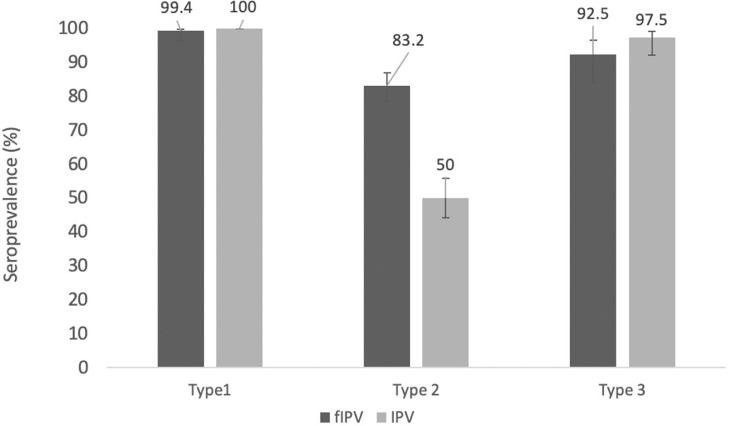
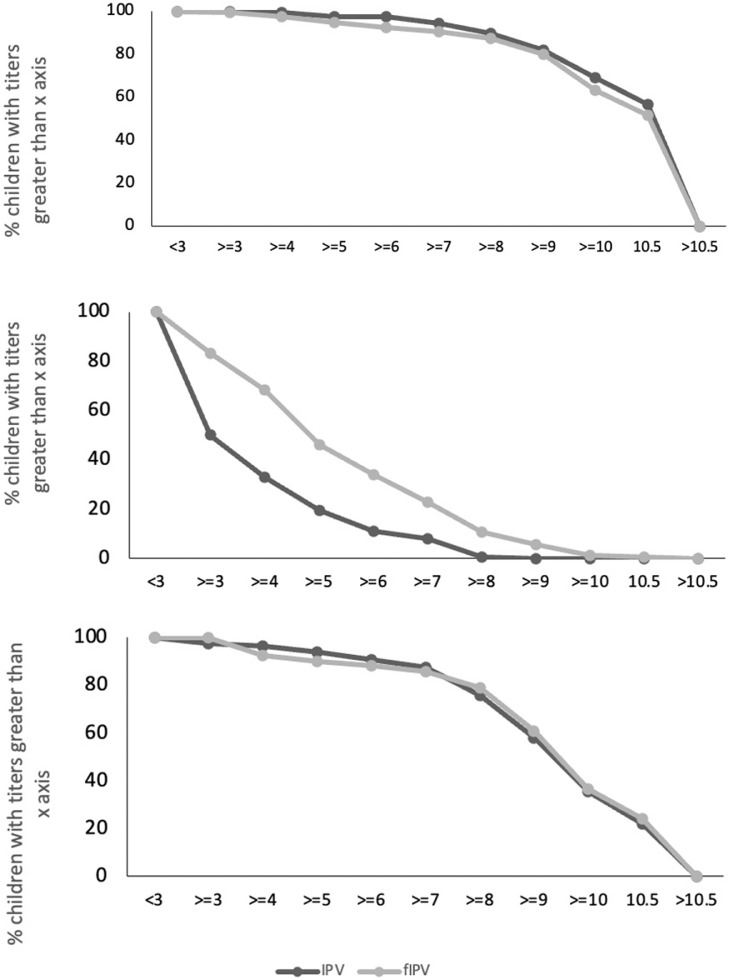
Findings: We obtained 321 analysable samples from 329 (97·6%) enrolled children (160 received IPV and 161 fIPV). For serotype 2, seroprevalence was 50·0% (CI95%= 44·2-55·8%) for IPV and 83·2% (CI95%=78·5-87·1%) for fIPV recipients (p<0·001). Median antibody titers for serotype 2 were significantly lower for IPV than for fIPV recipients (3·0, CI95%= 3 - 3·5 vs. 4·8, CI95%= 4·5 - 5·2, p<0·001). Seroprevalence for serotypes 1 and 3 was above 90% and was not significantly different between IPV and fIPV recipients.
Interpretation: Ecuador achieved significantly better poliovirus serotype 2 immunogenicity with two fIPV doses than with one IPV dose, while preserving vaccine supply and reducing costs. Our data provide further evidence that fIPV is a beneficial and potentially a cost-effective option in polio immunization.
Funding: WHO obtained funds for the study from Rotary International.
Keywords: Ecuador; Fractional dose inactivated poliovirus vaccine; Poliomyelitis; Routine immunization; Seroprevalence assay.
© 2022 World Health Organization.
Conflict of interest statement
None declared, all authors.
Figures
References
-
- Robbins F.C., de Quadros C.A. Certification of the eradication of indigenous transmission of wild poliovirus in the Americas. J Infect Dis. 1997;175(1):S281–S285. - PubMed
-
- Cases of Wild Poliovirus by country and year: Online Reference Table. Retrieved 10/02/2022, from http://www.polioeradication.org/Dataandmonitoring/Poliothisweek/Wildpoli....
-
- Minor P. Vaccine-derived poliovirus (VDPV): impact on poliomyelitis eradication. Vaccine. 2009;27(20):2649–2652. - PubMed
-
- Kew O.M., Sutter R.W., de Gourville E.M., Dowdle W.R., Pallansch M.A. Vaccine-derived polioviruses and the endgame strategy for global polio eradication. Ann Rev Microbiol. 2005;59:587–635. - PubMed
Grants and funding
LinkOut - more resources
Full Text Sources
Miscellaneous
