Review
. 2022 Jan-Dec;14(1):2096995.
doi: 10.1080/19490976.2022.2096995.

Impact of gut microbiome on skin health: gut-skin axis observed through the lenses of therapeutics and skin diseases

Affiliations
Review

Impact of gut microbiome on skin health: gut-skin axis observed through the lenses of therapeutics and skin diseases

Md Rayhan Mahmud et al. Gut Microbes. 2022 Jan-Dec.

Abstract

The human intestine hosts diverse microbial communities that play a significant role in maintaining gut-skin homeostasis. When the relationship between gut microbiome and the immune system is impaired, subsequent effects can be triggered on the skin, potentially promoting the development of skin diseases. The mechanisms through which the gut microbiome affects skin health are still unclear. Enhancing our understanding on the connection between skin and gut microbiome is needed to find novel ways to treat human skin disorders. In this review, we systematically evaluate current data regarding microbial ecology of healthy skin and gut, diet, pre- and probiotics, and antibiotics, on gut microbiome and their effects on skin health. We discuss potential mechanisms of the gut-skin axis and the link between the gut and skin-associated diseases, such as psoriasis, atopic dermatitis, acne vulgaris, rosacea, alopecia areata, and hidradenitis suppurativa. This review will increase our understanding of the impacts of gut microbiome on skin conditions to aid in finding new medications for skin-associated diseases.

Keywords: Gut microbiome; dietary components; gastrointestinal health; gut dysbiosis; prebiotics; probiotics; skin disease; skin-gut axis.


Conflict of interest statement

No potential conflict of interest was reported by the authors.

Figures
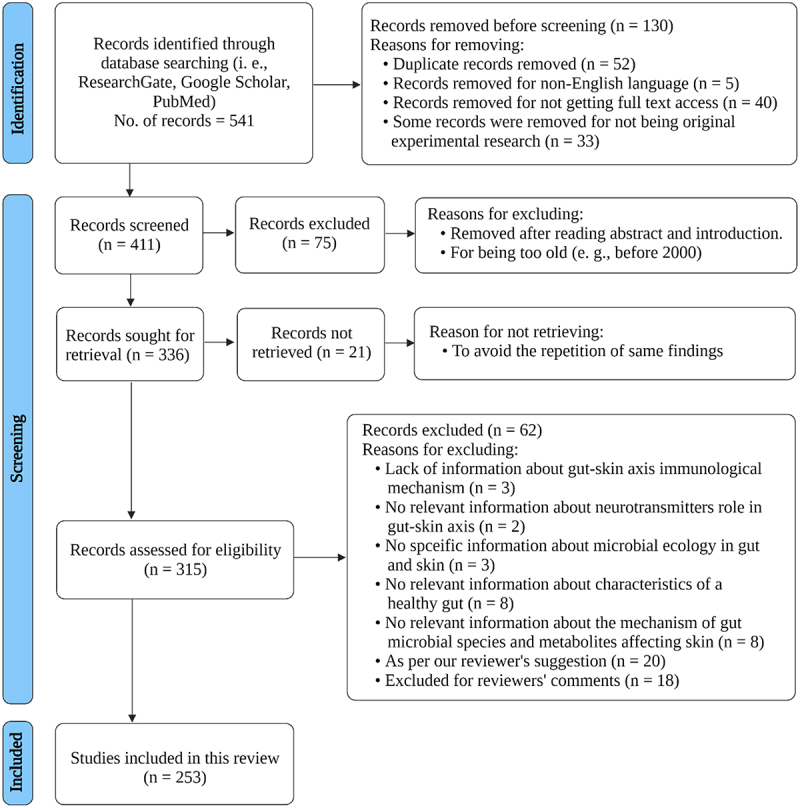
Figure 1.
Figure 1.
Prisma flowchart. This diagram represents the Prisma flowchart and demonstrates database searching, screening, excluding, retrieval, and eligibility findings for the final full-text studies used in this review. This illustration is based on and created with BioRender.com (2022).
Figure 2.
Figure 2.
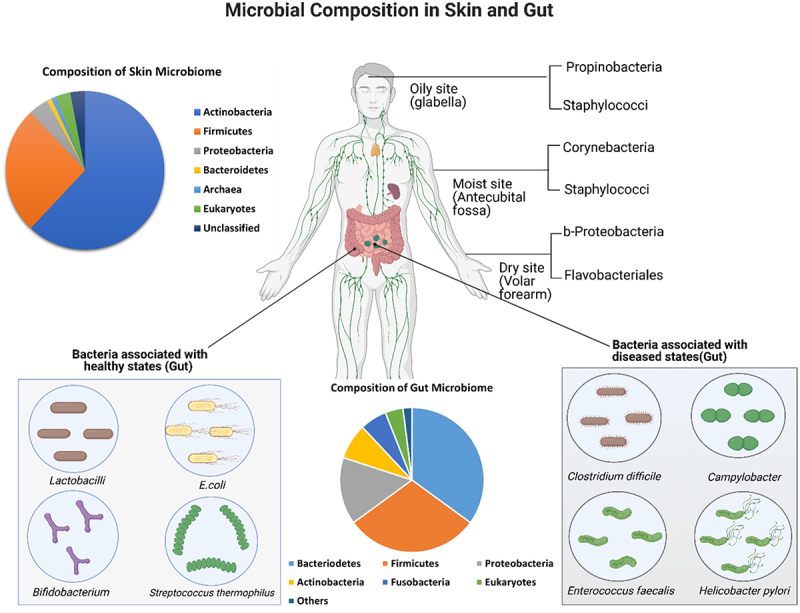
Microbial composition of gut and skin. Skin, the largest organ of the human body, shelters numerous commensal microbes (bacteria, fungi and viruses) and prevents entry by foreign pathogens by acting as a physical barrier. Skin can be broadly categorized as sebaceous or oily (glabella), moist (antecubital fossa) or dry (volar forearm), according to the physiological characteristics of each skin site. Specific microbial groups dominate different skin sites. Like skin, human gut is a home to innumerable amounts of microbes. A number of gut bacteria (e.g, Lactobacilli, E. coli, Bifidobacterium, Streptococcus thermophilus) contribute to maintenance of human health state, whereas others (e.g., Clostridium difficile, Campylobacter, Enterococcus faecalis, Helicobacter pylori) are more prevalent in disease states. The illustration was adapted from “Immune Organs in the Human Body”, by BioRender.com (2022). Retrieved from https://app.biorender.com/biorender-templates, associated information based on .,
Figure 3.
Figure 3.
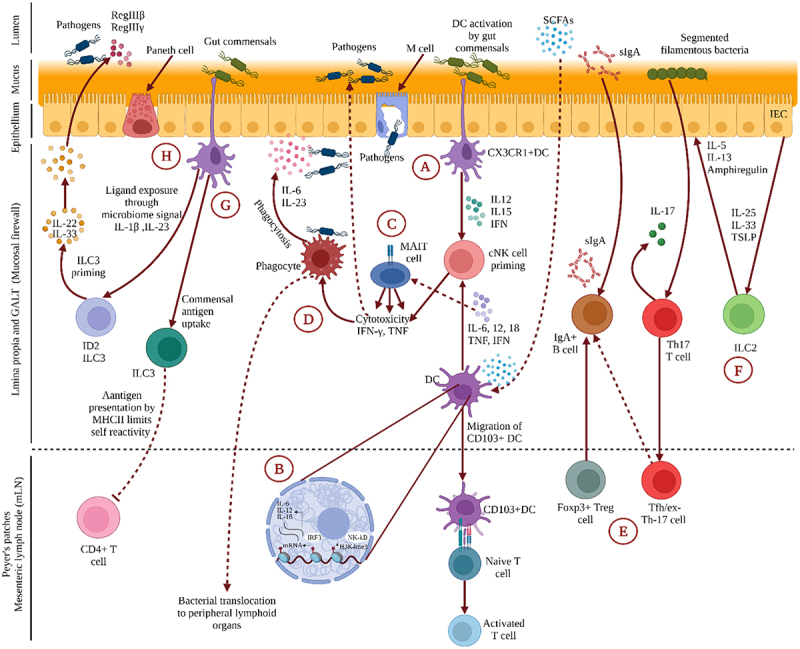
Gut-Skin communication through immuno-cross-linking. This illustration represents the immunological crosstalk between the gut and skin. (A) CX3CR1+ DCs generate dendrites for phagocytosis at homeostatic condition, whereas CD103+ DCs relocate to Peyer’s patches or mesenteric lymph nodes to deliver antigens to naive T lymphocytes. DC secretes interleukin (IL)-12, IL-15, and interferon (IFN) in response to commensal activation to stimulate conventional NK (cNK) cells. (B) As metabolic by-products, short-chain fatty acids (SCFAs) upregulate H3K4me3 in DC and enhance the production of IL-6, IL-12, IFN, and tumor necrosis factor (TNF), which is an alternative way to train cNK cells. Trained cNK cells have the necessary cytotoxicity and cytokine production capacity to fight bacteria and viruses. (C) MAIT cells can be directly stimulated to create IFN-γ by IL-12 or IL-15 in combination with IL-18 produced by APCs in response to TLR ligands. (D) TNF-like protein, a gut-associated pro-inflammatory cytokine, activates MAIT cells when coupled with IL-12 and IL-18. Phagocytes help the body defend itself by phagocytosing and producing cytokines like IL-6 and IL-23. (E) Foxp3+ Treg cells and Tfh/ex-Th17 cells cluster in Peyer’s patches, promoting B cell class switching and secretory (s)IgA production. These help to compartmentalize the commensal microbiome and modulate the diversity of the homeostatic microbiome. (F) ILC2 is activated by IL-25, IL-33, and thymic stromal lymphopoietin (TSLP) produced by intestinal epithelial cells (IEC) in response to commensal bacteria. (G) ILC3 expressing MHC II is capable of delivering commensal antigens to CD4 + T cells, reducing their self-reactivity. (H) In an ID2-dependent manner, microbial signals are also used to prime ILC3. ILC3, which has been primed secretes IL-22 and participates in the pathogen defense by stimulating the synthesis of antimicrobial peptides, such as REGIIIβ and REGIIIγ. This illustration was based on and created in BioRender.com (2022).
Figure 4.
Figure 4.
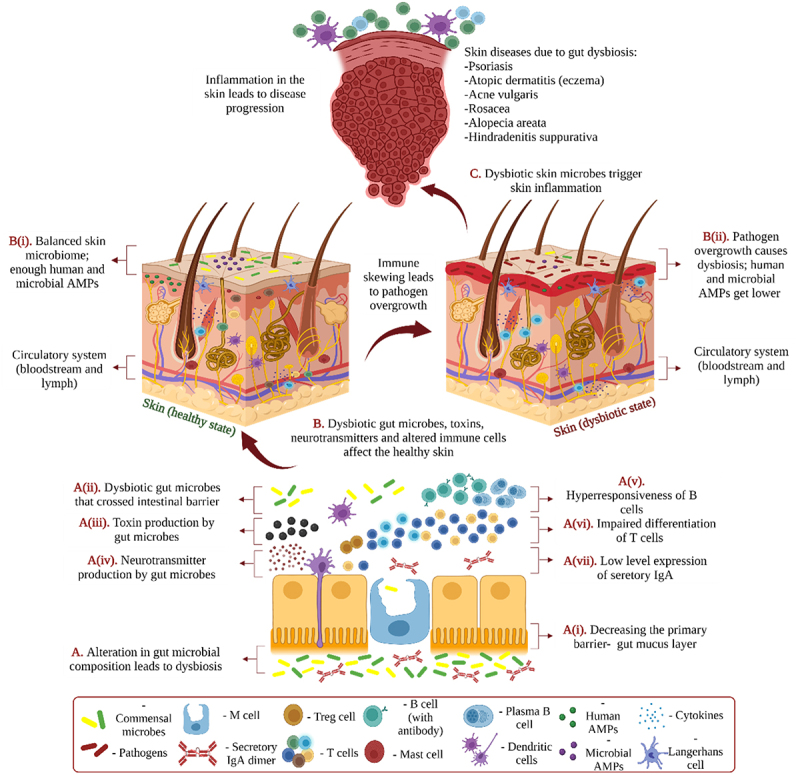
Mechanisms of the interaction at the gut-skin axis. This illustration represents the underlying mechanisms of gut-skin interaction. Various dietary components, illnesses, lifestyles, prebiotics, antibiotics, probiotics, and novel biological drugs can alter gut microbial communities. A. The alteration can lead to dysbiosis, which can further (i) decrease the gut mucus layer, (ii) results in the passage of microbes through the intestinal barrier, (iii) cause the production of toxic products, (iv) induce harmful effects by neurotransmitters of the gut microbes or the host, (v) produce B cell hyperresponsiveness, (vi) impair T cell differentiation, (vii) create low levels of IgA secretion. B. Dysbiotic gut microbes, toxic products, neurotransmitters, and altered immune cells pass through the circulatory system turning the skin condition from healthy (left) to dysbiotic (right). (i) Healthy skin possesses a balanced composition of microbes and proper quantities of human and microbial AMPs. (ii) A dysbiotic skin condition is induced by the pathogen due to improper immune system functioning and low quantities of human and microbial AMPs. C. Dysbiotic skin microbes trigger skin inflammation and can be involved in the onset of a variety of skin illnesses. This illustration is based on and and created with BioRender.com (2022).

References

    1. Coates M, Lee MJ, Norton D, MacLeod AS, Norton D, MacLeod AS, MacLeod AS.. The skin and intestinal microbiota and their specific innate immune systems. Front Immunol. 2019;10:10. doi: 10.3389/fimmu.2019.02950. - DOI - PMC - PubMed
    1. Salem I, Ramser A, Isham N, Ghannoum MA. The gut microbiome as a major regulator of the gut-skin axis. Front Microbiol. 2018;9:1459. doi: 10.3389/fmicb.2018.01459. - DOI - PMC - PubMed
    1. O’Neill CA, Monteleone G, McLaughlin JT, Paus R. The gut-skin axis in health and disease: a paradigm with therapeutic implications. BioEssays. 2016;38(11):1167–29. doi: 10.1002/bies.201600008. - DOI - PubMed
    1. Hsu DK, Fung MA, Chen HL. Role of skin and gut microbiota in the pathogenesis of psoriasis, an inflammatory skin disease. Med Microecol. 2020;4:100016. doi: 10.1016/j.medmic.2020.100016. - DOI
    1. Ellis SR, Nguyen M, Vaughn AR, Notay M, Burney WA, Sandhu S, Sivamani RK. The skin and gut microbiome and its role in common dermatologic conditions. Microorganisms. 2019;7(11):550. doi: 10.3390/microorganisms7110550. - DOI - PMC - PubMed

Publication types