Aetiology of childhood pneumonia in low- and middle-income countries in the era of vaccination: a systematic review
- PMID: 35866332
- PMCID: PMC9305023
- DOI: 10.7189/jogh.12.10009
Aetiology of childhood pneumonia in low- and middle-income countries in the era of vaccination: a systematic review
Abstract
Background: This systematic review aimed to describe common aetiologies of severe and non-severe community acquired pneumonia among children aged 1 month to 9 years in low- and middle-income countries.
Methods: We searched the MEDLINE, EMBASE, and PubMed online databases for studies published from January 2010 to August 30, 2020. We included studies on acute community-acquired pneumonia or acute lower respiratory tract infection with ≥1 year of continuous data collection; clear consistent case definition for pneumonia; >1 specimen type (except empyema studies where only pleural fluid was required); testing for >1 pathogen including both viruses and bacteria. Two researchers reviewed the studies independently. Results were presented as a narrative summary. Quality of evidence was assessed with the Quality Assessment Tool for Quantitative Studies. The study was registered on PROSPERO [CRD42020206830].
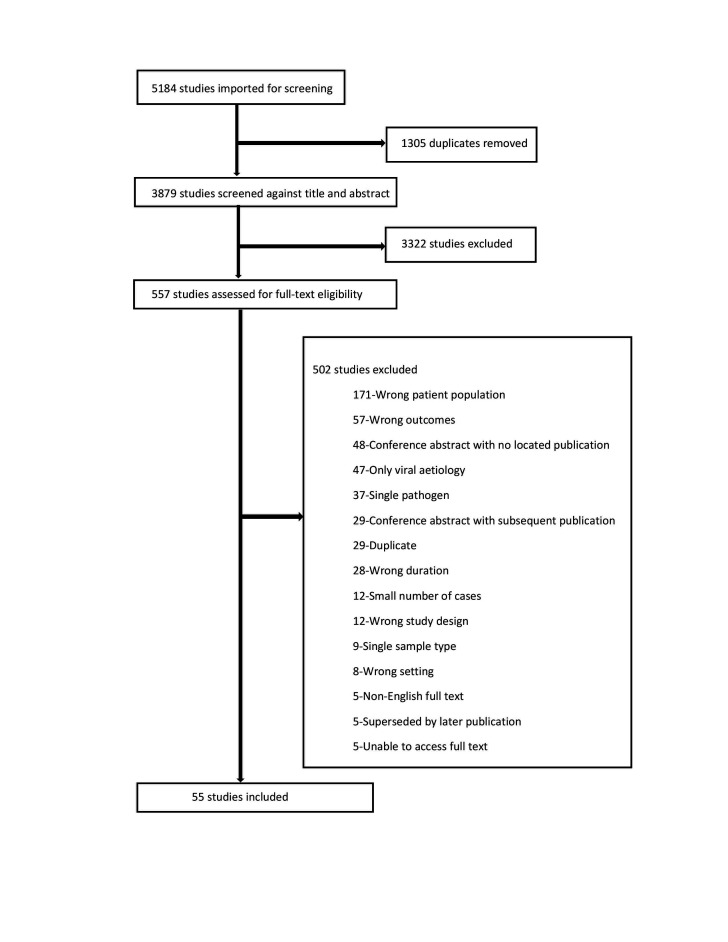
Results: We screened 5184 records; 1305 duplicates were removed. The remaining 3879 titles and abstracts were screened. Of these, 557 articles were identified for full-text review, and 55 met the inclusion criteria - 10 case-control studies, three post-mortem studies, 11 surveillance studies, eight cohort studies, five cross-sectional studies, 12 studies with another design and six studies that included patients with pleural effusions or empyema. Studies which described disease by severity showed higher bacterial detection (Streptococcus pneumoniae, Staphylococcus aureus) in severe vs non-severe cases. The most common virus causing severe disease was respiratory syncytial virus (RSV). Pathogens varied by age, with RSV and adenovirus more common in younger children. Influenza and atypical bacteria were more common in children 5-14 years than younger children. Malnourished and HIV-infected children had higher rates of pneumonia due to bacteria or tuberculosis.
Conclusions: Several viral and bacterial pathogens were identified as important targets for prevention and treatment. Bacterial pathogens remain an important cause of moderate to severe disease, particularly in children with comorbidities despite widespread PCV and Hib vaccination.
Copyright © 2022 by the Journal of Global Health. All rights reserved.
Conflict of interest statement
Competing interests: The authors completed the ICMJE Unified Competing Interest Form (available upon request from the corresponding author) and declare no conflicts of interest.
Figures
References
-
- O’Brien KL, Baggett HC, Brooks WA, Feikin DR, Hammitt LL, Higdon MM, et al. Causes of severe pneumonia requiring hospital admission in children without HIV infection from Africa and Asia: the PERCH multi-country case-control study. Lancet. 2019;394:757-79. 10.1016/S0140-6736(19)30721-4 - DOI - PMC - PubMed
-
- Bénet T, Sanchez Picot V, Messaoudi M, Chou M, Eap T, Wang J, et al. Microorganisms Associated With Pneumonia in Children <5 Years of Age in Developing and Emerging Countries: The GABRIEL Pneumonia Multicenter, Prospective, Case-Control Study. Clin Infect Dis. 2017;65:604-12. 10.1093/cid/cix378 - DOI - PMC - PubMed
-
- World Health Organization. Pocket book of hospital care for children: guidelines for the management of common illnesses with limited resources. 2005. Available: http://whqlibdoc.who.int/publications/2005/9241546700.pdf. Accessed: 20 February 2021.
Publication types
MeSH terms
LinkOut - more resources
Full Text Sources
Medical
Miscellaneous