


A platform trial design for preventive vaccines against Marburg virus and other emerging infectious disease threats
- PMID: 35866633
- PMCID: PMC9679315
- DOI: 10.1177/17407745221110880
A platform trial design for preventive vaccines against Marburg virus and other emerging infectious disease threats
Abstract
Background: The threat of a possible Marburg virus disease outbreak in Central and Western Africa is growing. While no Marburg virus vaccines are currently available for use, several candidates are in the pipeline. Building on knowledge and experiences in the designs of vaccine efficacy trials against other pathogens, including SARS-CoV-2, we develop designs of randomized Phase 3 vaccine efficacy trials for Marburg virus vaccines.
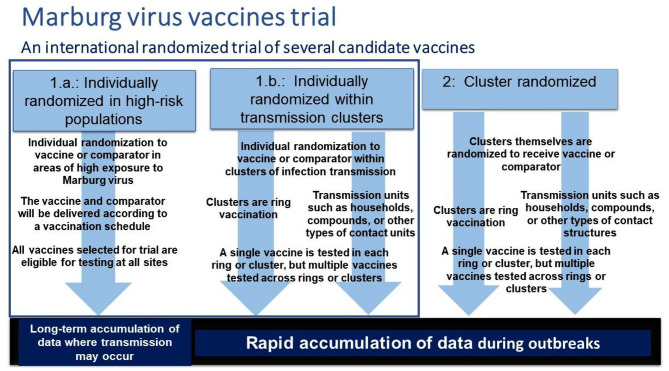
Methods: A core protocol approach will be used, allowing multiple vaccine candidates to be tested against controls. The primary objective of the trial will be to evaluate the effect of each vaccine on the rate of virologically confirmed Marburg virus disease, although Marburg infection assessed via seroconversion could be the primary objective in some cases. The overall trial design will be a mixture of individually and cluster-randomized designs, with individual randomization done whenever possible. Clusters will consist of either contacts and contacts of contacts of index cases, that is, ring vaccination, or other transmission units.
Results: The primary efficacy endpoint will be analysed as a time-to-event outcome. A vaccine will be considered successful if its estimated efficacy is greater than 50% and has sufficient precision to rule out that true efficacy is less than 30%. This will require approximately 150 total endpoints, that is, cases of confirmed Marburg virus disease, per vaccine/comparator combination. Interim analyses will be conducted after 50 and after 100 events. Statistical analysis of the trial will be blended across the different types of designs. Under the assumption of a 6-month attack rate of 1% of the participants in the placebo arm for both the individually and cluster-randomized populations, the most likely sample size is about 20,000 participants per arm.
Conclusion: This event-driven design takes into the account the potentially sporadic spread of Marburg virus. The proposed trial design may be applicable for other pathogens against which effective vaccines are not yet available.
Keywords: Marburg virus; Randomized placebo-controlled vaccine trial; cluster-randomized vaccine trial; emerging infectious disease threat; vaccine efficacy.
Conflict of interest statement
The author(s) declared no potential conflicts of interest with respect to the research, authorship, and/or publication of this article.
Figures
References
-
- Mahase E. Guinea reports west Africa’s first ever case of Marburg virus disease. BMJ 2021; 374: n1988. - PubMed
-
- World Health Organization. Guinea declares end of Marburg virus disease outbreak, https://www.afro.who.int/news/guinea-declares-end-marburg-virus-disease-...
-
- WHO Ebola Response Team. After Ebola in West Africa – unpredictable risks, preventable epidemics. N Engl J Med 2016; 375: 587–596. - PubMed
Publication types
MeSH terms
Substances
Grants and funding
LinkOut - more resources
Full Text Sources
Medical
Miscellaneous
