


Machine Learning-Enabled Multimodal Fusion of Intra-Atrial and Body Surface Signals in Prediction of Atrial Fibrillation Ablation Outcomes
- PMID: 35867397
- PMCID: PMC9972736
- DOI: 10.1161/CIRCEP.122.010850
Machine Learning-Enabled Multimodal Fusion of Intra-Atrial and Body Surface Signals in Prediction of Atrial Fibrillation Ablation Outcomes
Abstract
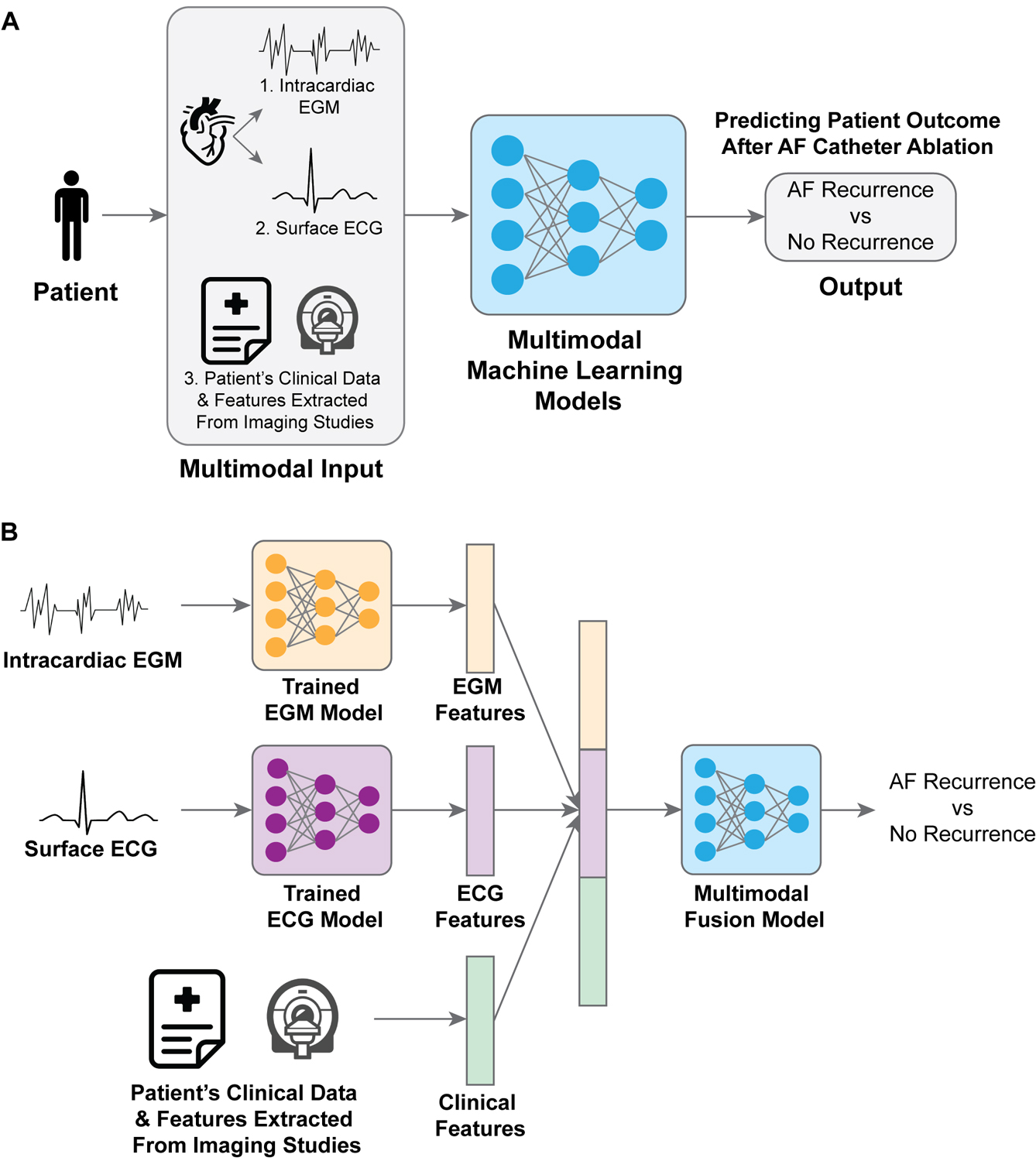
Background: Machine learning is a promising approach to personalize atrial fibrillation management strategies for patients after catheter ablation. Prior atrial fibrillation ablation outcome prediction studies applied classical machine learning methods to hand-crafted clinical scores, and none have leveraged intracardiac electrograms or 12-lead surface electrocardiograms for outcome prediction. We hypothesized that (1) machine learning models trained on electrograms or electrocardiogram (ECG) signals can perform better at predicting patient outcomes after atrial fibrillation ablation than existing clinical scores and (2) multimodal fusion of electrogram, ECG, and clinical features can further improve the prediction of patient outcomes.
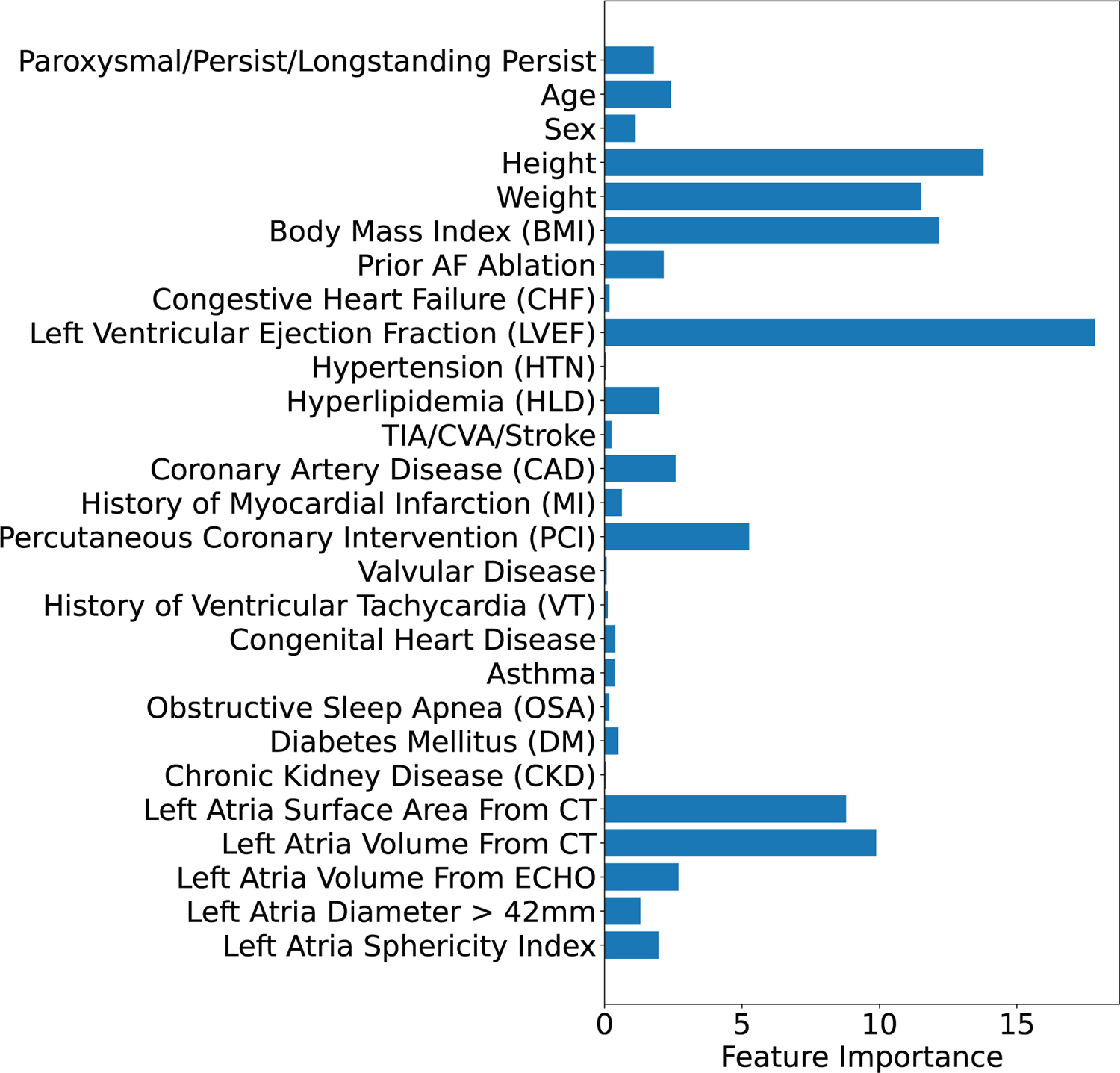
Methods: Consecutive patients who underwent catheter ablation between 2015 and 2017 with panoramic left atrial electrogram before ablation and clinical follow-up for at least 1 year following ablation were included. Convolutional neural network and a novel multimodal fusion framework were developed for predicting 1-year atrial fibrillation recurrence after catheter ablation from electrogram, ECG signals, and clinical features. The models were trained and validated using 10-fold cross-validation on patient-level splits.
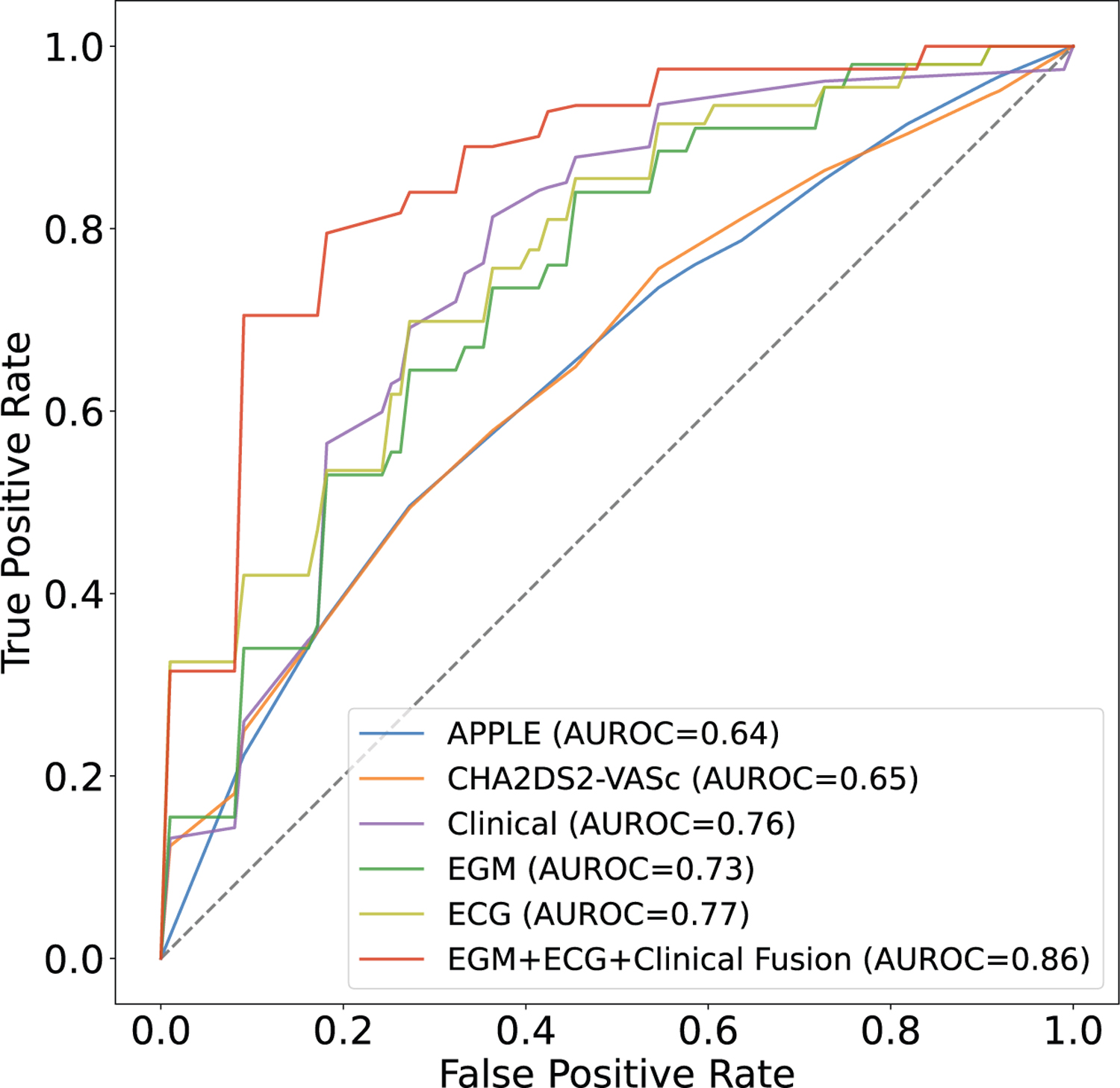
Results: One hundred fifty-six patients (64.5±10.5 years, 74% male, 42% paroxysmal) were analyzed. Using electrogram signals alone, the convolutional neural network achieved an area under the receiver operating characteristics curve (AUROC) of 0.731, outperforming the existing APPLE scores (AUROC=0.644) and CHA2DS2-VASc scores (AUROC=0.650). Similarly using 12-lead ECG alone, the convolutional neural network achieved an AUROC of 0.767. Combining electrogram, ECG, and clinical features, the fusion model achieved an AUROC of 0.859, outperforming single and dual modality models.
Conclusions: Deep neural networks trained on electrogram or ECG signals improved the prediction of catheter ablation outcome compared with existing clinical scores, and fusion of electrogram, ECG, and clinical features further improved the prediction. This suggests the promise of using machine learning to help treatment planning for patients after catheter ablation.
Keywords: Machine learning; atrial fibrillation; cardiac electrophysiology; catheter ablation.
Figures
References
-
- Packer DL, Mark DB, Robb RA, Monahan KH, Bahnson TD, Poole JE, Noseworthy PA, Rosenberg YD, Jeffries N, Mitchell LB, Flaker GC, Pokushalov E, Romanov A, Bunch TJ, Noelker G, Ardashev A, Revishvili A, Wilber DJ, Cappato R, Kuck K-H, Hindricks G, Davies DW, Kowey PR, Naccarelli GV, Reiffel JA, Piccini JP, Silverstein AP, Al-Khalidi HR, Lee KL, CABANA Investigators. Effect of Catheter Ablation vs Antiarrhythmic Drug Therapy on Mortality, Stroke, Bleeding, and Cardiac Arrest Among Patients With Atrial Fibrillation: The CABANA Randomized Clinical Trial. JAMA 2019;321:1261–1274. - PMC - PubMed
-
- Marrouche NF, Brachmann J, Andresen D, Siebels J, Boersma L, Jordaens L, Merkely B, Pokushalov E, Sanders P, Proff J, Schunkert H, Christ H, Vogt J, Bänsch D, CASTLE-AF Investigators. Catheter Ablation for Atrial Fibrillation with Heart Failure. N Engl J Med 2018;378:417–427. - PubMed
-
- Jacobs V, May HT, Bair TL, Crandall BG, Cutler M, Day JD, Weiss JP, Osborn JS, Muhlestein JB, Anderson JL, Mallender C, Bunch TJ. The impact of risk score (CHADS2 versus CHA2DS2-VASc) on long-term outcomes after atrial fibrillation ablation. Heart Rhythm 2015;12:681–686. - PubMed
Publication types
MeSH terms
Grants and funding
LinkOut - more resources
Full Text Sources
Other Literature Sources
Medical
