


TiO2 Nanotopography-Driven Osteoblast Adhesion through Coulomb's Force Evolution
- PMID: 35867934
- PMCID: PMC9354007
- DOI: 10.1021/acsami.2c07652
TiO2 Nanotopography-Driven Osteoblast Adhesion through Coulomb's Force Evolution
Abstract
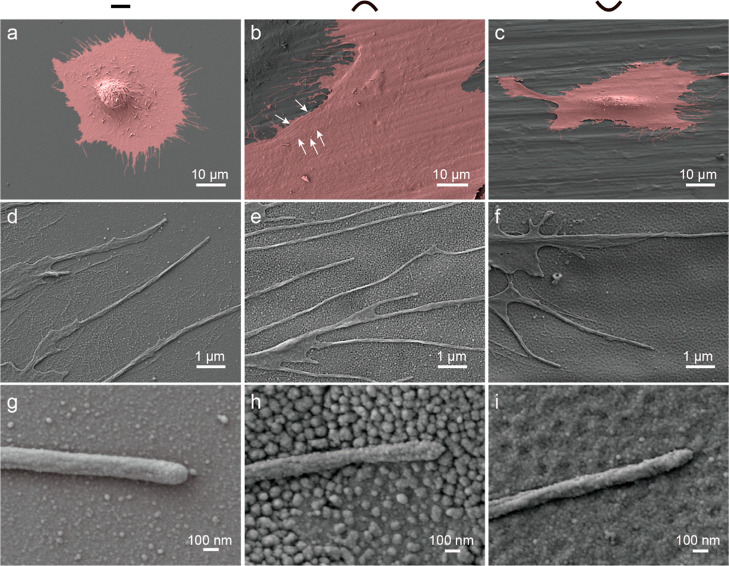
Nanotopography is an effective method to regulate cells' behaviors to improve Ti orthopaedic implants' in vivo performance. However, the mechanism underlying cellular matrix-nanotopography interactions that allows the modulation of cell adhesion has remained elusive. In this study, we have developed novel nanotopographic features on Ti substrates and studied human osteoblast (HOb) adhesion on nanotopographies to reveal the interactive mechanism regulating cell adhesion and spreading. Through nanoflat, nanoconvex, and nanoconcave TiO2 nanotopographies, the evolution of Coulomb's force between the extracellular matrix and nanotopographies has been estimated and comparatively analyzed, along with the assessment of cellular responses of HOb. We show that HObs exhibited greater adhesion and spreading on nanoconvex surfaces where they formed super matured focal adhesions and an ordered actin cytoskeleton. It also demonstrated that Coulomb's force on nanoconvex features exhibits a more intense and concentrated evolution than that of nanoconcave features, which may result in a high dense distribution of fibronectin. Thus, this work is meaningful for novel Ti-based orthopaedic implants' surface designs for enhancing their in vivo performance.
Keywords: Ti implant; cell adhesion; cell−material interaction; nanotopography; protein adsorption.
Conflict of interest statement
The authors declare no competing financial interest.
Figures




References
-
- Geetha M.; Singh A. K.; Asokamani R.; Gogia A. K. Ti based biomaterials, the ultimate choice for orthopaedic implants - A review. Prog. Mater. Sci. 2009, 54, 397–425. 10.1016/j.pmatsci.2008.06.004. - DOI
