


Spatial modelling and inequalities of environmental noise in Accra, Ghana
- PMID: 35868576
- PMCID: PMC9441709
- DOI: 10.1016/j.envres.2022.113932
Spatial modelling and inequalities of environmental noise in Accra, Ghana
Abstract
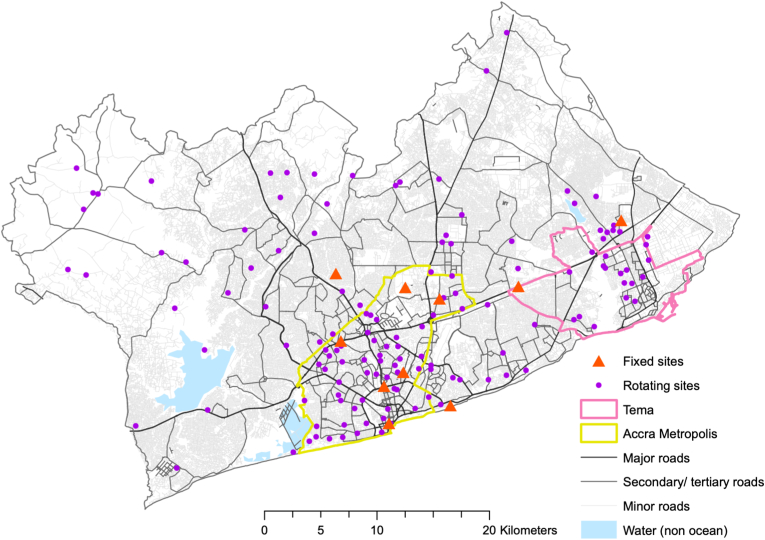
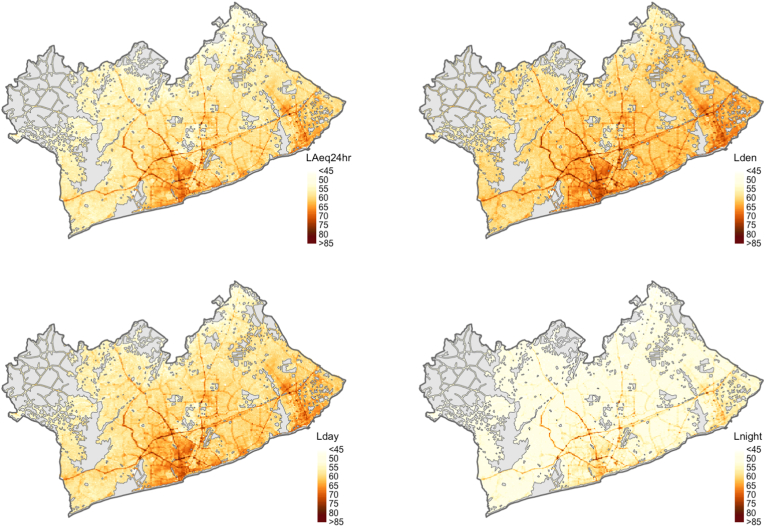
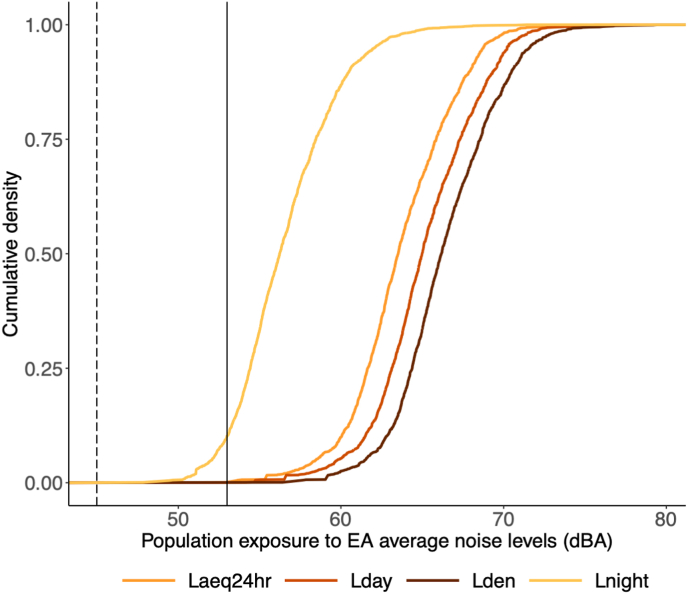
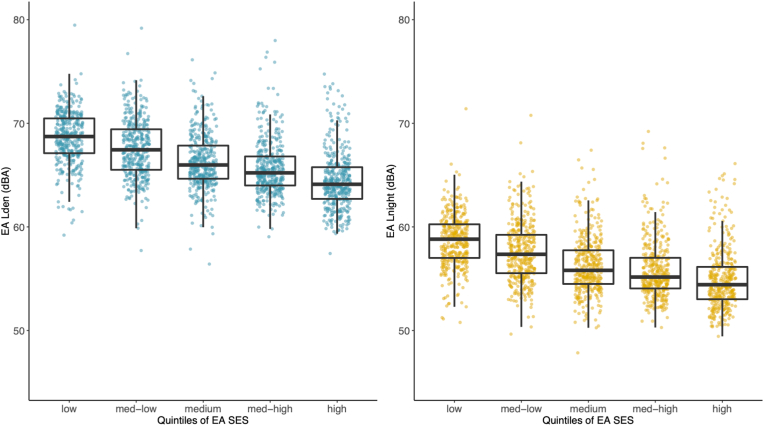
Noise pollution is a growing environmental health concern in rapidly urbanizing sub-Saharan African (SSA) cities. However, limited city-wide data constitutes a major barrier to investigating health impacts as well as implementing environmental policy in this growing population. As such, in this first of its kind study in West Africa, we measured, modelled and predicted environmental noise across the Greater Accra Metropolitan Area (GAMA) in Ghana, and evaluated inequalities in exposures by socioeconomic factors. Specifically, we measured environmental noise at 146 locations with weekly (n = 136 locations) and yearlong monitoring (n = 10 locations). We combined these data with geospatial and meteorological predictor variables to develop high-resolution land use regression (LUR) models to predict annual average noise levels (LAeq24hr, Lden, Lday, Lnight). The final LUR models were selected with a forward stepwise procedure and performance was evaluated with cross-validation. We spatially joined model predictions with national census data to estimate population levels of, and potential socioeconomic inequalities in, noise levels at the census enumeration-area level. Variables representing road-traffic and vegetation explained the most variation in noise levels at each site. Predicted day-evening-night (Lden) noise levels were highest in the city-center (Accra Metropolis) (median: 64.0 dBA) and near major roads (median: 68.5 dBA). In the Accra Metropolis, almost the entire population lived in areas where predicted Lden and night-time noise (Lnight) surpassed World Health Organization guidelines for road-traffic noise (Lden <53; and Lnight <45). The poorest areas in Accra also had significantly higher median Lden and Lnight compared with the wealthiest ones, with a difference of ∼5 dBA. The models can support environmental epidemiological studies, burden of disease assessments, and policies and interventions that address underlying causes of noise exposure inequalities within Accra.
Keywords: Environmental noise; Intermittency ratio; Land use regression; Road-traffic noise; Socioeconomic status; Sub-Saharan Africa.
Copyright © 2022 The Authors. Published by Elsevier Inc. All rights reserved.
Conflict of interest statement
The authors declare that they have no known competing financial interests or personal relationships that could have appeared to influence the work reported in this paper.
Figures
References
-
- Acheampong R.A., Siiba A., Okyere D.K., Tuffour J.P. Mobility-on-demand: an empirical study of internet-based ride-hailing adoption factors, travel characteristics and mode substitution effects. Transport. Res. C Emerg. Technol. 2020;115 doi: 10.1016/j.trc.2020.102638. - DOI
-
- Addae B., Oppelt N. Land-use/land-cover change analysis and urban growth modelling in the greater Accra metropolitan area (GAMA), Ghana. Urban Sci. 2019;3:26. doi: 10.3390/urbansci3010026. - DOI
-
- Aguilera I., Foraster M., Basagaña X., Corradi E., Deltell A., Morelli X., Phuleria H.C., Ragettli M.S., Rivera M., Thomasson A., Slama R., Künzli N. Application of land use regression modelling to assess the spatial distribution of road traffic noise in three European cities. J. Expo. Sci. Environ. Epidemiol. 2015;25:97–105. doi: 10.1038/jes.2014.61. - DOI - PubMed
-
- Alam M.S., Corcoran L., King E.A., McNabola A., Pilla F. Modelling of intra-urban variability of prevailing ambient noise at different temporal resolution. Noise Mapp. 2017;4:20–44. doi: 10.1515/noise-2017-0002. - DOI
-
- Ali S.A., Tamura A. Road traffic noise levels, restrictions and annoyance in Greater Cairo, Egypt. Appl. Acoust. 2003;64:815–823. doi: 10.1016/S0003-682X(03)00031-8. - DOI
MeSH terms
Grants and funding
LinkOut - more resources
Full Text Sources
Research Materials
