


[Genetic testing and analysis of 2 cases of trisomy 11 mosaicism]
- PMID: 35869770
- PMCID: PMC9308877
- DOI: 10.12122/j.issn.1673-4254.2022.07.14
[Genetic testing and analysis of 2 cases of trisomy 11 mosaicism]
Abstract
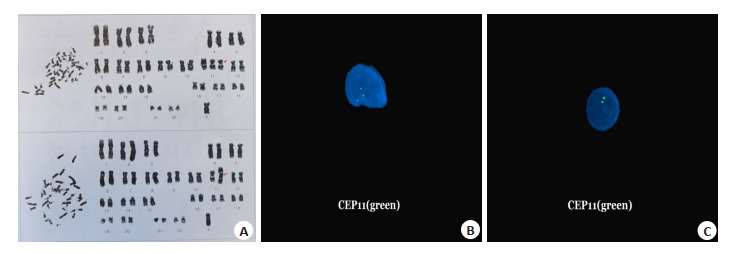
Trisomy 11 mosaicism is clinically rare, for which making diagnostic and treatment decisions can be challenging. In this study, we used noninvasive prenatal testing, chromosome karyotype analysis, chromosome microarray analysis, copy number variation sequencing and fluorescence in situ hybridization for detecting trisomy 11 mosaicism in two cases and provided them with genetic counseling. In one of the cases, the fetus with confined placental mosaicism trisomy 11 presented with severe growth restriction and a placental mosaic level of 44%, and pregnancy was terminated at 25+3 weeks of gestation. In the other case with true low-level fetal mosaicism of trisomy 11, the pregnancy continued after exclusion of the possibility of uniparental disomy and structural abnormalities and careful prenatal counseling. The newborn was followed up for more than one year, and no abnormality was found. Noninvasive prenatal testing is capable of detecting chromosomal mosaicism but may cause missed diagnosis of true fetal mosaicism. For cases with positive noninvasive prenatal testing but a normal karyotype of the fetus, care should be taken in prenatal counseling and pregnancy management.
11号染色体三体嵌合体临床罕见,决策困难。本研究综合运用非侵入性产前检测、染色体核型分析、染色体微阵列分析、染色体拷贝数变异测序、荧光原位杂交等技术,对2例11号染色体三体嵌合体病例进行检测及遗传咨询。2例病例获得不同的妊娠结局,11号染色体三体的限制性胎盘嵌合胎儿表现为严重生长受限,孕25+3周终止妊娠,胎盘嵌合比例达44%;而11号染色体三体的胎儿真性低比例嵌合体,排除了单亲二倍体且超声无异常,经慎重的产前咨询后,选择继续妊娠至足月分娩,新生儿随访一年余,发育未见异常,妊娠结局良好。非侵入性产前检测对限制性胎盘嵌合具有一定的检测效能,但也可能漏诊胎儿真性嵌合体病例,非侵入性产前检测结果阳性而侵入性产前检测未发现异常的病例,需重视咨询并加强妊娠期管理。
Keywords: confined placental mosaicism; invasive prenatal testing; noninvasive prenatal testing; trisomy 11 mosaicism; true fetal mosaicism.
Figures


References
-
- Zheng JL, Yang XY, Lu HY, et al. Prenatal diagnosis of sex chromosome mosaicism with two marker chromosomes in three cell lines and a review of the literature. Mol Med Rep. 2019;19(3):1791–6. - PubMed
Publication types
MeSH terms
LinkOut - more resources
Full Text Sources