. 2022 Sep:167:107412.
doi: 10.1016/j.envint.2022.107412. Epub 2022 Jul 14.

Ambient temperature and term birthweight in Latin American cities

Affiliations

Ambient temperature and term birthweight in Latin American cities

Maryia Bakhtsiyarava et al. Environ Int. 2022 Sep.

Abstract

Background: Extreme temperatures may lead to adverse pregnancy and birth outcomes, including low birthweight. Studies on the impact of temperature on birthweight have been inconclusive due to methodological challenges related to operationalizing temperature exposure, the definitions of exposure windows, accounting for gestational age, and a limited geographic scope.

Methods: We combined data on individual-level term live births (N≈15 million births) from urban areas in Brazil, Chile, and Mexico from 2010 to 2015 from the SALURBAL study (Urban Health in Latin America) with high-resolution daily air temperature data and computed average ambient temperature for every month of gestation for each newborn. Associations between full-term birthweight and average temperature during gestation were analyzed using multi-level distributed lag non-linear models that adjusted for newborn's sex, season of conception, and calendar year of child's birth; controlled for maternal age, education, partnership status, presence of previous births, and climate zone; and included a random term for the sub-city of mother's residence.

Findings: Higher temperatures during the entire gestation are associated with lower birthweight, particularly in Mexico and Brazil. The cumulative effect of temperature on birthweight is mostly driven by exposure to higher temperatures during months 7-9 of gestation. Higher maternal education can attenuate the temperature-birthweight associations.

Interpretation: Our work shows that climate-health impacts are likely to be context- and place-specific and warrants research on temperature and birthweight in diverse climates to adequately anticipate global climate change. Given the high societal cost of suboptimal birthweight, public health efforts should be aimed at diminishing the detrimental effect of higher temperatures on birthweight.

Funding: The Wellcome Trust.

Keywords: Birthweight; Latin America; Temperature; Urban.


Conflict of interest statement

The authors declare that they have no known competing financial interests or personal relationships that could have appeared to influence the work reported in this paper.

Figures

Fig. 1
Fig. 1
Map of average monthly temperature during 2010–2015 in 909 sub-cities of Brazil, Chile, and Mexico.
Fig. 2
Fig. 2
Seasonal patterns of sub-city daily mean temperature in Brazil, Mexico, and Chile during the 2010–2015 study period.
Fig. 3
Fig. 3
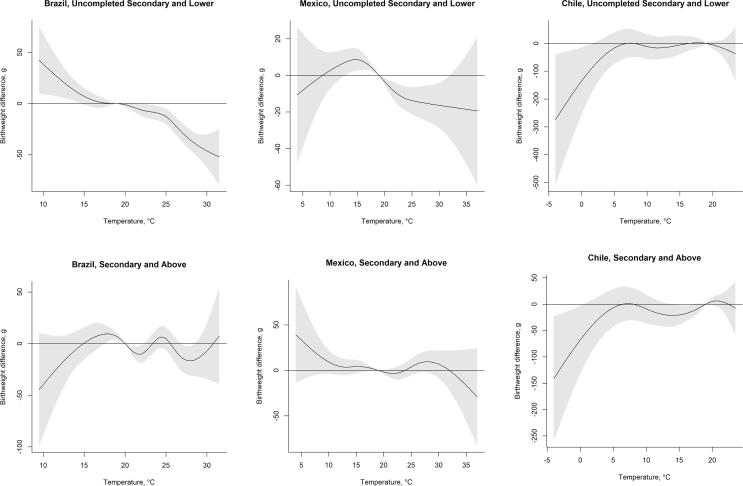
Cumulative associations between average monthly temperature during nine months of gestation and term birthweight for term newborns in 2010–2015. The curves depict an estimated difference in birthweight associated with average temperature during gestation relative to a reference temperature of 19 °C (average monthly temperature across the countries). The curves are derived from distributed lag non-linear models adjusted for child sex, mother’s age, education, partnership status, whether she had previous births, calendar year of child’s birth, season of conception, climate zone, and include random intercepts for the sub-city of mother’s residence at the time of the child’s birth (Tables S5-S7 in Supplementary Material). Temperature on the x-axis refers to the average monthly temperature during the entire gestation. The estimates relative to each country’s average temperature are reported in Supplementary Material Table S9.
Fig. 4
Fig. 4
Difference in mean birthweight (with 95% CI) associated with a 5 °C higher temperature in each month of gestation relative to a 19 °C gestation average (average across the countries) among term newborns in 2010–2015. The estimates are obtained from distributed lag non-linear models and adjusted for child sex, mother’s age, education, partnership status, whether the mother had previous births, calendar year of child’s birth, season of conception, climate zone, and include a random intercept for the sub-city of mother’s residence at the time of the child’s birth. Estimates for every exposure window account for temperature exposure during all the other exposure windows during the gestational period. Numerical estimates and the confidence intervals from the figure are provided in Supplementary Material Table S8. An equivalent figure with estimates derived relative to country-specific average temperatures is available in Supplementary Material Fig. S10.
Fig. 5
Fig. 5
Difference in birthweight associated with a 5 °C higher temperature in each month of gestation, relative to a 19 °C gestation average (average across the countries), stratified by maternal education. See Table 3 for technical details.

References

    1. Bakhtsiyarava M., Grace K., Nawrotzki R.J. Climate, birth weight, and agricultural livelihoods in Kenya and Mali. Am. J. Public Health. 2018;108(S2):S144–S150. - PMC - PubMed
    1. Basu R., Rau R., Pearson D., Malig B. Temperature and term low birth weight in California. Am. J. Epidemiol. 2018;187(11):2306–2314. - PubMed

    1. Beck H.E., Zimmermann N.E., McVicar T.R., Vergopolan N., Berg A., Wood E.F. Present and future Köppen-Geiger climate classification maps at 1-km resolution. Scientific Data. 2018;5(1):1–12. - PMC - PubMed
    1. Bell M.L., Belanger K. Review of research on residential mobility during pregnancy: consequences for assessment of prenatal environmental exposures. J. Eposure Sci. Environ. Epidemiol. 2012;22(5):429–438. - PMC - PubMed
    1. Beltran A.J., Wu J., Laurent O. Associations of meteorology with adverse pregnancy outcomes: a systematic review of preeclampsia, preterm birth and birth weight. Int. J. Environ. Res. Public Health. 2014;11(1):91–172. - PMC - PubMed

Publication types