Review
. 2022 Nov:218:102326.
doi: 10.1016/j.pneurobio.2022.102326. Epub 2022 Jul 21.

The hearing hippocampus

Affiliations
Review

The hearing hippocampus

Alexander J Billig et al. Prog Neurobiol. 2022 Nov.

Abstract

The hippocampus has a well-established role in spatial and episodic memory but a broader function has been proposed including aspects of perception and relational processing. Neural bases of sound analysis have been described in the pathway to auditory cortex, but wider networks supporting auditory cognition are still being established. We review what is known about the role of the hippocampus in processing auditory information, and how the hippocampus itself is shaped by sound. In examining imaging, recording, and lesion studies in species from rodents to humans, we uncover a hierarchy of hippocampal responses to sound including during passive exposure, active listening, and the learning of associations between sounds and other stimuli. We describe how the hippocampus' connectivity and computational architecture allow it to track and manipulate auditory information - whether in the form of speech, music, or environmental, emotional, or phantom sounds. Functional and structural correlates of auditory experience are also identified. The extent of auditory-hippocampal interactions is consistent with the view that the hippocampus makes broad contributions to perception and cognition, beyond spatial and episodic memory. More deeply understanding these interactions may unlock applications including entraining hippocampal rhythms to support cognition, and intervening in links between hearing loss and dementia.

Keywords: Auditory; Auditory cognition; Hearing; Hippocampus; Medial temporal lobe; Perception; Sound.


Figures

Fig. 1
Fig. 1
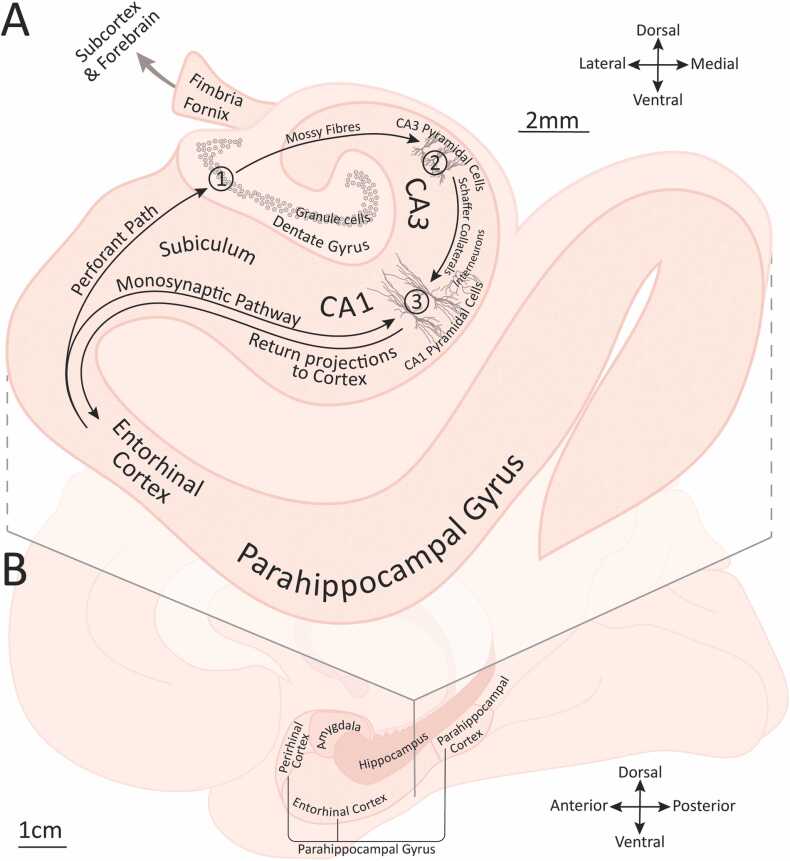
(A) Coronal cross-section of human medial temporal lobe showing parahippocampal gyrus, entorhinal cortex, hippocampus with primary subfields, and key pathways. Numbers 1–3 indicate synapses of the trisynaptic pathway. Pyramidal cells, interneurons and granule cells not shown to scale. (B) Medial sagittal view of human brain showing medial temporal lobe structures (including amygdala) and indicating the position of the cross-section shown in A.
Fig. 2
Fig. 2
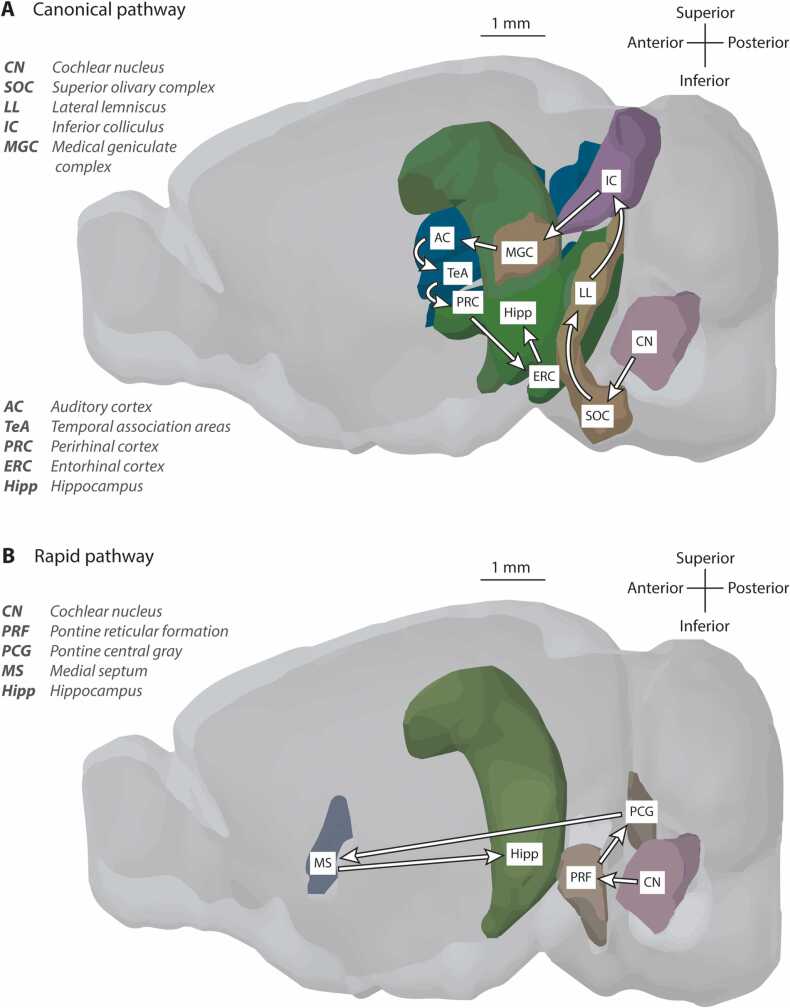
Lateral view of mouse brain showing pathways from auditory brainstem structures to hippocampus. (A) Canonical pathway consisting of at least ten synapses and (B) A rapid five-synapse pathway. Adapted from Allen Reference Atlas - Mouse Brain (available from atlas.brain-map.org).
Fig. 3
Fig. 3
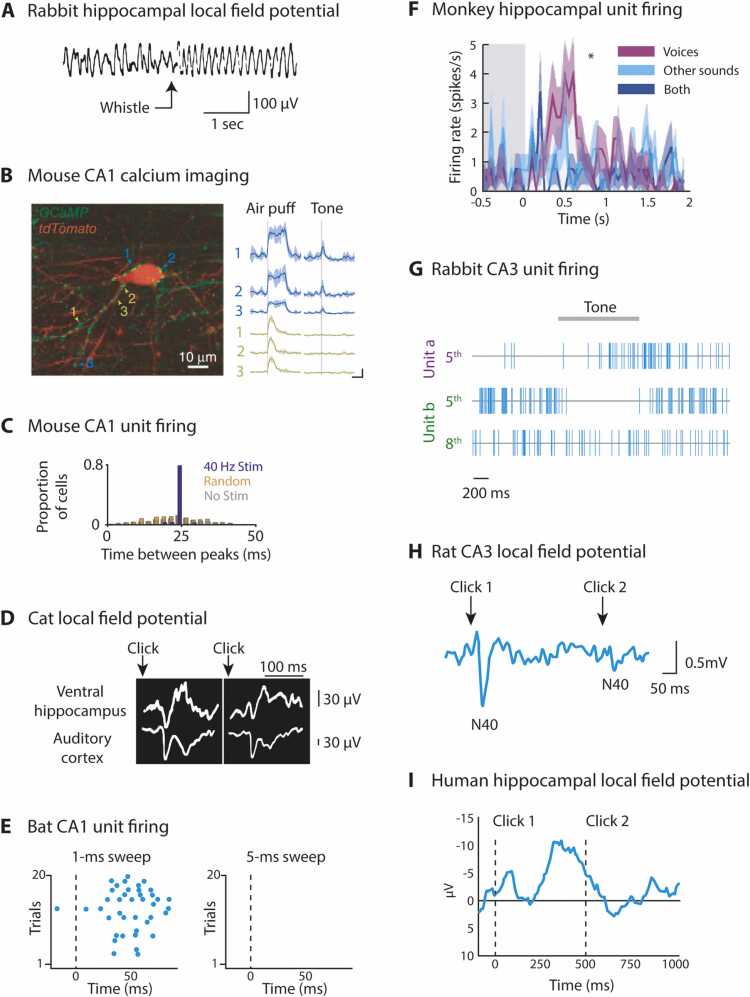
Selection of hippocampal responses to sound in the absence of a task. (A) Bilateral LFP responses in rabbit hippocampus to a whistle. Adapted from Green, J.D., Arduini, A.A., 1954. Hippocampal electrical activity in arousal. J. Neurophysiol. 17, 533–557. Green and Arduini (1954). (B) Left: Postsynaptic CA1 interneurons expressing tdTomato (red) and septo-hippocampal GABA axons expressing GCaMP5 (green) in mouse hippocampus with six labelled boutons. Right: Stimulus-triggered Ca2+ averages (+/- SEM) at the same six boutons in response to air-puffs or a 20-s 10-kHz tone. Scale bars show 50% ΔF/F and 3 s. Adapted by permission from Springer Nature Customer Service Centre GmbH: Springer. Nature Neuroscience. Septo-hippocampal GABAergic signaling across multiple modalities in awake mice. Kaifosh, P., Lovett-Barron, M., Turi, G.F., Reardon, T.R., Losonczy, A., 2013. Nat. Neurosci. 16, 1182-1184. Copyright © 2013 Nature America, Inc. Kaifosh et al. (2013). (C) Intervals between firing rate peaks in 338 CA1 cells in 5 mice during 40 Hz click stimulation (blue), random-interval click stimulation (orange) and no stimulation (gray). Reprinted from Cell, 177, Martorell, A.J., Paulson, A.L., Suk, H.-J., Abdurrob, F., Drummond, G.T., Guan, W., Young, J.Z., Kim, D.N.-W., Kritskiy, O., Barker, S.J., Mangena, V., Prince, S.M., Brown, E.N., Chung, K., Boyden, E.S., Singer, A.C., Tsai, L.-H, Multi-sensory gamma stimulation ameliorates Alzheimer’s-associated pathology and improves cognition, 256-271, Copyright © 2019 Elsevier Inc., with permission from Elsevier. Martorell et al. (2019). (D) Similar-latency LFP responses in cat ventral hippocampus and auditory cortex. Responses to two successive clicks separated by 15 s are shown side by side. Reprinted from Electroencephalography and Clinical Neurophysiology, 8, Green, J.D., Adey, W.R., Electrophysiological studies of hippocampal connections and excitability, 245-262, Copyright © 1956 Published by Elsevier Ireland Ltd., with permission from Elsevier. Green and Adey (1956). (E) Spike rasters for a single cell in bat CA1 show selective responses to frequency sweeps of 1-ms duration (left) but not 5-ms duration (right) duration presented at 0 ms. Adapted with permission from Yu, C., Moss, C.F., 2022. Natural acoustic stimuli evoke selective responses in the hippocampus of passive listening bats. Hippocampus 32, 298-309. Copyright © 2022 The Authors. Hippocampus published by Wiley Periodicals LLC. Yu and Moss (2022). (F) Mean firing rate (+/- SEM) of single cell in monkey hippocampus in response to voices and other sounds. Adapted from Sliwa, J., Planté, A., Duhamel, J.-R., Wirth, S. Independent neuronal representation of facial and vocal identity in the monkey hippocampus and inferotemporal cortex. Cerebral Cortex, 2014, 26, 950-966, by permission of Oxford University Press. Sliwa et al. (2014). (G) Spike trains of rabbit CA3 neurons. Top: Activatory response at Unit A to 5th presentation of a 900 Hz tone. Middle/Bottom: Responses at Unit B to 5th and 8th presentations of an 800 Hz tone, showing suppression that habituates over trials. After Vinogradova (1975a). (H) Grand average evoked LFP response from CA3 in 12 rat hippocampi to pairs of clicks presented 500 ms apart. Reprinted from Biological Psychiatry, 27, Bickford-Wimer, P.C., Nagomoto, H., Johnson, R., Adler, L.E., Egan, M., Rose, G.M., Freedman, R., Auditory sensory gating in hippocampal neurons: A model system in the rat, 183-192, Copyright © 1990 Published by Elsevier Inc., with permission from Elsevier. Bickford-Wimer et al. (1990). (I) Grand average evoked response recorded intracranially in 21 human posterior hippocampi to clicks presented at 0 and 500 ms (dashed lines). Adapted with permission from Boutros, N.N., Mears, R., Pflieger, M.E., Moxon, K.A., Ludowig, E., Rosburg, T. Sensory gating in the human hippocampal and rhinal regions: Regional differences. Hippocampus 18, 310-316. Copyright © 2007 Wiley-Liss, Inc. Boutros et al. (2008).
Fig. 4
Fig. 4
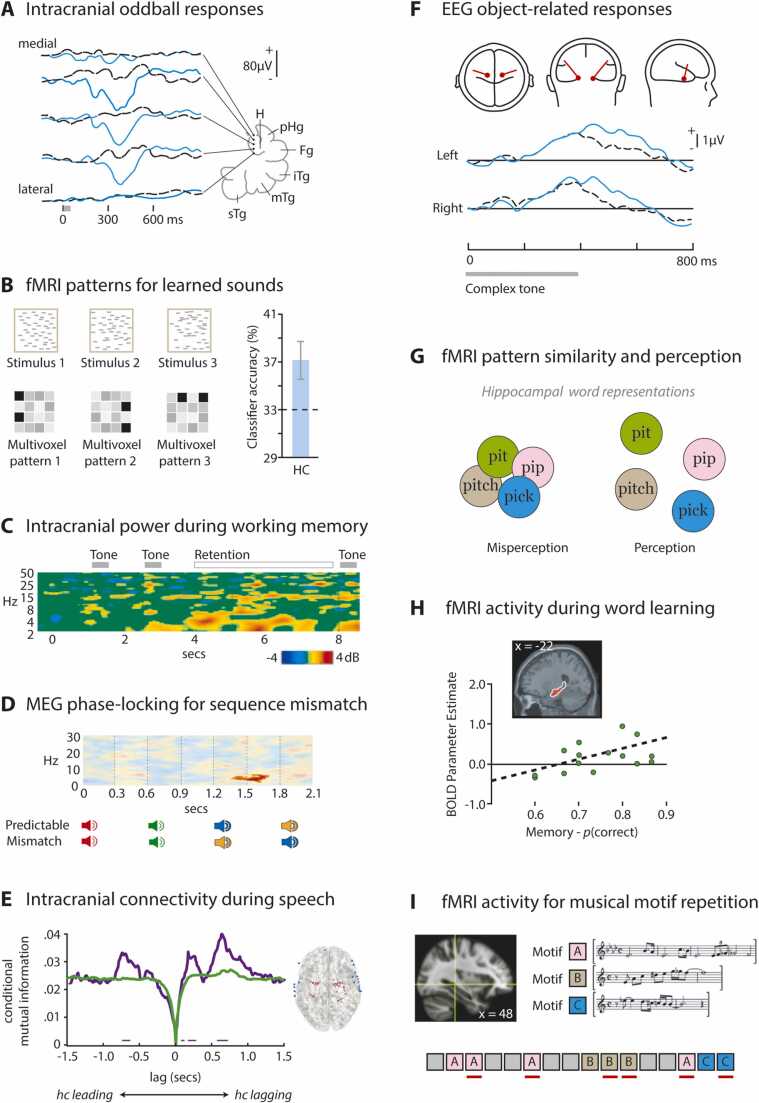
Selection of human studies with attentive or task-based listening. (A) Left: Intracranial potentials elicited by frequent (dashed black traces) and rare (solid blue traces) pure tones of different frequencies in medial temporal lobe of a single patient. Right: Electrode locations indicated on line drawing of brain, lateral surface at bottom. H=hippocampus, pHg=parahippocampal gyrus, Fg=fusiform gyrus, iTg=inferior temporal gyrus, mTg=medial temporal gyrus, sTg=superior temporal gyrus. Reprinted from Electroencephalography and Clinical Neurophysiology, 76, Smith, M.E., Halgren, E., Sokolik, M., Baudena, P., Musolino, A., Liegeois-Chauvel, C., Chauvel, P., The intracranial topography of the P3 event-related potential elicited during auditory oddball, 235-248, Copyright © 1990 Elsevier Scientific Publishers Ireland, Ltd, with permission from Elsevier. Smith et al. (1990). (B) Top: Cartoon time-frequency spectrograms of three 1.5-s complex noise stimuli consisting of overlapping pure-tone pips. Bottom: Cartoon hippocampal multivoxel BOLD activity patterns elicited by each of these stimuli after implicit learning through repeated exposure in a stream of other noise stimuli. Right: Above-chance decoding of the same stimuli from the multivoxel patterns in 7 subjects (mean and standard error). Adapted from Fig. 4 in Kumar S., Bonnici H.M., Teki, S., Agus, T.R., Pressnitzer, D., Maguire, E.A., Griffiths, T.D., 2014. Representations of specific acoustic patterns in the auditory cortex and hippocampus. Proc. R. Soc. B 281: 20141000. Licensed under CC-BY. Kumar et al. (2014). (C) Event-related spectral perturbation at a hippocampal electrode during a working memory task. Subjects heard tones of two frequencies (first two gray lines) then received a retro-cue advising which to hold in mind over a delay period until comparing to a target tone (third gray line). A pronounced increase in delta-theta power is apparent during the delay period compared to a pre-trial baseline. Adapted from Fig. 3 in Kumar S., Gander, P.E., Berger, J.I., Billig, A.J., Nourski, K.V., Oya, H., Kawasaki, H., Howard, M.A., Griffiths, T.D., 2021. Oscillatory correlates of auditory working memory examined with human electrocorticography. Neuropsychologia, 150. Licensed under CC-BY. Kumar et al. (2021). (D) Source-localized hippocampal inter-trial phase coherence of MEG recordings during implicit comparison of pure tone sequences. Saturated red region reflects significantly greater theta coherence when frequencies of third and fourth tones in the sequence mismatch implicit predictions compared to when they match. Adapted from Figs. 1, 3 in Recasens, M., Gross, J., Uhlhaas, P.J., 2018. Low-frequency oscillatory correlates of auditory predictive processing in cortical-subcortical networks: A MEG-study. Sci. Rep., 8, 14007. Licensed under CC-BY. Recasens et al. (2018). (E) Nine participants heard two repetitions of a story. Intracranial electrode sites were identified where 70–200 Hz activity showed signs of predictive recall during the second repetition; these included auditory cortex. Left: Connectivity was assessed between these sites and either hippocampus (purple trace) or all other sites (green trace) at moments of peak predictive recall. Mutual information in the neural time series (y-axis) is shown at different lags (x-axis) (excluding influences at zero lag). Purple horizontal bars indicate lags for which mutual information between hippocampus and predictive recall sites was significantly greater than chance. Left-most bar and peak indicates information flow from hippocampus to sites including auditory cortex 720 ms prior to predictive recall. Right: Ventral view of brain showing hippocampal electrode sites (red) and neocortical predictive recall sites (blue) included in the analysis. Adapted from Figs. 3, 5 in Michelmann, S., Price, A.R., Aubrey, B., Strauss, C.K., Doyle, W.K., Friedman, D., Dugan, P.C., Devinsky, O., Devore, S., Flinker, A., Hasson, U., Norman, K.A., 2021. Moment-by-moment tracking of naturalistic learning and its underlying hippocampo-cortical interactions. Nat Commun. 12, 5394. Licensed under CC-BY. Michelmann et al. (2021). (F) Subjects listened to a complex tone, which sometimes contained a mistuned harmonic, and reported whether they heard one or two sounds. Top: Location (red dots) and orientation (red lines) of pair of equivalent current dipoles in medial temporal lobes contributing to EEG scalp activity during the task. Bottom: Activity projected to left and right hemisphere dipoles when the complex tone (gray bar) did (solid blue traces) or did not (dashed black traces) contain a mistuned harmonic. From Alain, C., Arnott, S. R., & Picton, T. W. (2001). Bottom-up and top-down influences on auditory scene analysis: Evidence from event-related brain potentials. Journal of Experimental Psychology: Human Perception and Performance, 27(5), 1072-1089. Copyright © 2001 American Psychological Association. Reproduced and adapted with permission. Alain et al. (2001). (G) Cartoon of hippocampal representations of candidate words during a degraded speech task. Closer circles reflect more overlapping representations, as assessed by similarity of multivoxel BOLD activity patterns. When 24 participants heard a degraded word preceded by a partially mismatching visual cue, those whose hippocampal representations of mismatching candidate words were more distinct were more likely to perceive the correct spoken word. Based on results from Blank et al. (2018). (H) Univariate BOLD activity in anterior and middle hippocampus (top) during exposure to novel pseudo-words correlates positively across 16 participants with their ability to subsequently recognize the stimuli (bottom). Copyright © 2008 Massachusetts Institute of Technology. Adapted with permission. Davis, M.H., Di Betta., A.M., Macdonald, M.J.E., Gaskell, M.G., 2009. Learning and consolidation of novel spoken words. J. Cogn. Neurosci. 21, 803-820. Davis et al. (2009). (I) 11 participants listened to a live recording of a multi-instrumental piece of tango music, containing a number of repeating motifs (right). After key acoustic features were modelled out from the univariate BOLD signal, repetitions (but not first occurrences) of the motifs activated regions including hippocampus (left). Bottom: Indicative illustration of motifs with repeats underlined in red, and intervening non-motivic material in gray. Reprinted from Cortex, 57, Burunat, I., Alluri, V., Toiviainen, P., Numminen, J., Brattico, E. Dynamics of brain activity underlying working memory for music in a naturalistic condition, 254-269, Copyright © 2014 Elsevier Ltd., with permission from Elsevier. Burunat et al. (2014).
Fig. 5
Fig. 5
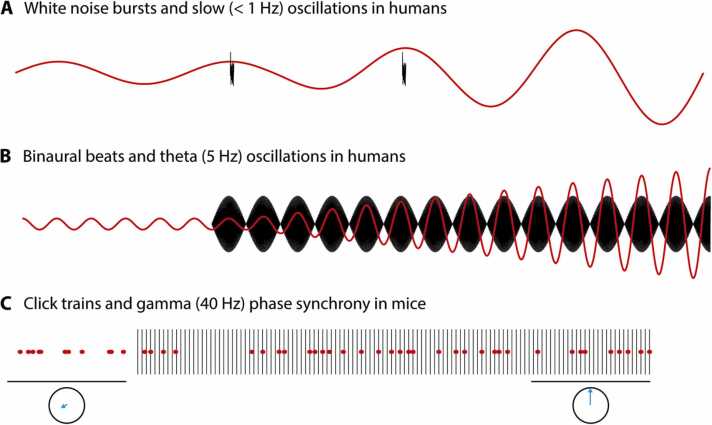
Auditory entrainment of hippocampal rhythms (see Section 18 of main text for related behavioral outcomes). (A) Suitably timed white noise bursts (black) boost widespread cortical slow (< 1 Hz) oscillations (red), which propagate to hippocampus and synchronize sharp-wave ripples (not shown) in humans (Ngo et al., 2013). (B) Dichotically presented pure tones separated in frequency by 5 Hz generate binaural beats (black) and boost hippocampal theta oscillations (red) in humans (Derner et al., 2018). (C) 40 Hz click trains (black) affect firing of hippocampal CA1 units (red dots), increasing phase synchrony (blue arrows) at the same (gamma) frequency in mice (Martorell et al., 2019).
Fig. 6
Fig. 6
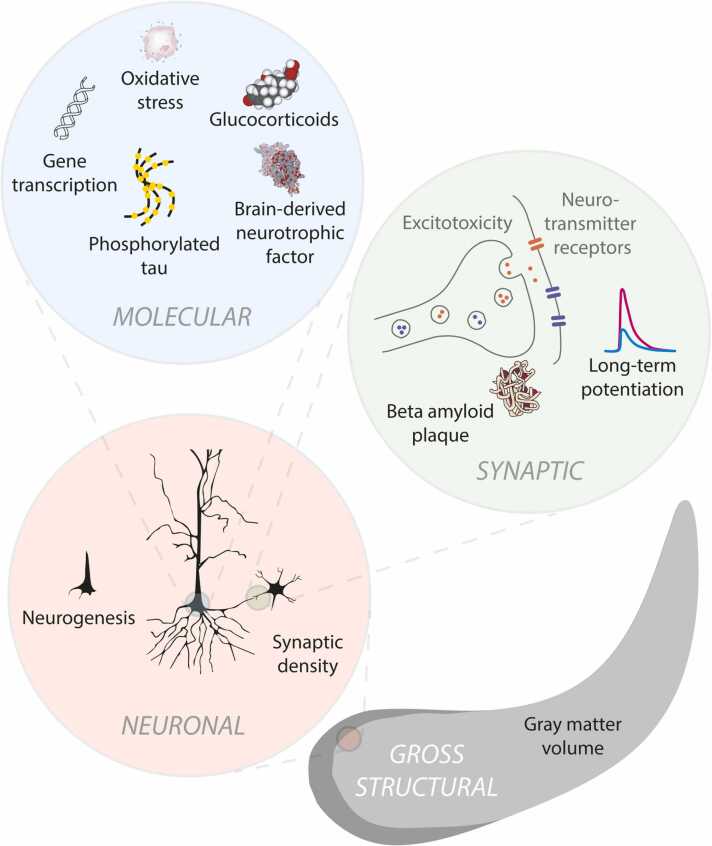
Examples of processes at molecular, synaptic, neuronal and gross structural hippocampal levels on which auditory experience (such as music listening or training, noise exposure, and auditory deprivation) can act. See Section 19 of main text and Supplementary Table N for details and references. The causal pathways underlying such effects are largely yet to be established.

References

    1. Abe, R., Sakaguchi, T., Kitajo, K., Ishikawa, D., Matsumoto, N., Matsuki, N., Ikegaya, Y., 2014a. Sound-induced modulation of hippocampal θ oscillations.: NeuroReport 25 2014a 1368 1374 doi: 10.1097/WNR.0000000000000274. - PubMed
    1. Abe, R., Sakaguchi, T., Matsumoto, N., Matsuki, N., Ikegaya, Y., 2014b. Sound-induced hyperpolarization of hippocampal neurons: NeuroReport 25, 1013–1017. https://doi.org/10.1097/WNR.0000000000000206. - PubMed
    1. Abousetta A., Makhlouf N.A., El-Beshbishy R.A. The effects of concomitant Ginkgo intake on noise induced Hippocampus injury. Possible auditory clinical correlate. Egypt. J. Ear Nose Throat Allied Sci. 2014;15:231–239. doi: 10.1016/j.ejenta.2014.05.003. - DOI
    1. Abrams D.A., Chen T., Odriozola P., Cheng K.M., Baker A.E., Padmanabhan A., Ryali S., Kochalka J., Feinstein C., Menon V. Neural circuits underlying mother’s voice perception predict social communication abilities in children. Proc. Natl. Acad. Sci. U.S.A. 2016;113:6295–6300. doi: 10.1073/pnas.1602948113. - DOI - PMC - PubMed
    1. Adey W.R., Dunlop C.W., Hendrix C.E. Hippocampal slow waves: distribution and phase relationships in the course of approach learning. Arch. Neurol. 1960;3:74. doi: 10.1001/archneur.1960.00450010074007. - DOI - PubMed

Publication types