. 2022 Jul 23;12(1):12609.
doi: 10.1038/s41598-022-16964-z.

In vitro activity of therapeutic antibodies against SARS-CoV-2 Omicron BA.1, BA.2 and BA.5

Affiliations

In vitro activity of therapeutic antibodies against SARS-CoV-2 Omicron BA.1, BA.2 and BA.5

Franck Touret et al. Sci Rep. .

Abstract

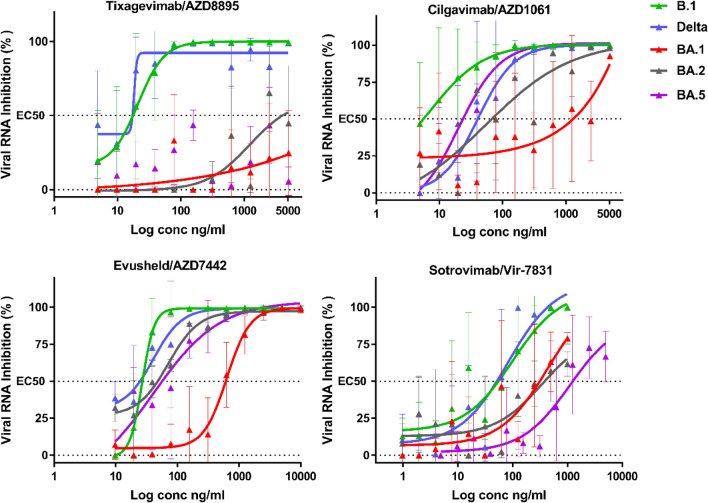
The replacement of the Omicron BA.1 variant of SARS-CoV-2 by the BA.2 and the rapid growth of the BA.5 sub lineage, which have both different sets of mutations in the spike glycoprotein, alters the spectrum of activity of therapeutic antibodies currently licensed in the European Union. Using clinical strains of the Omicron BA.2 and BA.5 variants, we compared the neutralising power of monoclonal antibodies against the Omicron BA.1, BA.2 and BA.5 variants, using an ancestral strain (lineage B.1, D614G) and a Delta variant strain as reference. Sotrovimab/Vir-7831 is less active against BA.2 than against BA.1 (fold change reduction ~ 1,4) and even less active against BA.5 (fold change reduction ~ 2.7). Within the Evusheld /AZD7442 cocktail, Cilgavimab/AZD1061 is more active against BA.2 and BA.5 than against BA.1 (fold change increase ~ 32), whilst the very low activity of Tixagevimab/AZD8895 against BA.1 is not enhanced against BA.2 nor BA.5. In total, compared to BA.1, the activity of the Evusheld/AZD7442 is significantly improved against BA.2 while BA.5 is intermediate but closer to BA.2.


Conflict of interest statement

The authors declare no competing interests.

Figures
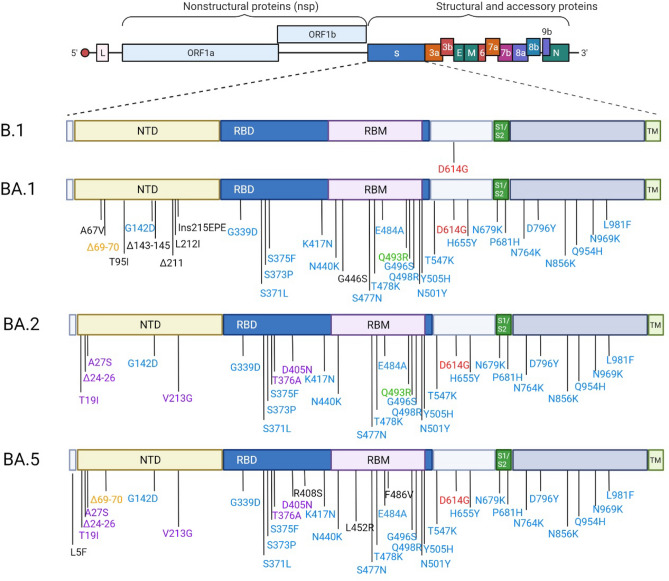
Figure 1
Figure 1
Spike substitutions in SARS-COV-2 variants Omicron BA.1, BA.2 and BA.5 compared to the ancestral strain B.1. Omicron BA.1, BA.2 and BA.5 sequences used for the representation are the one from the strains used in this study BA.1:EPI_ISL_7899754, BA.2: EPI_ISL_9426119 and BA.5: EPI_ISL_12852091.Red color indicates the mutation that is present in all strains. The blue color indicates the mutations which are common to BA.1, BA.2 and BA.5. The orange color indicates the mutations which are common to BA.1/BA.5. The purple color indicated the mutations which are common to BA.2/BA.5. This figure was created with BioRender.com.
Figure 2
Figure 2
Dose response curves reporting the susceptibility of the SARS-CoV-2 BavPat1 D614G (B.1) ancestral strain,Delta BA.1 BA.2 and BA.5 variant to active therapeutic monoclonal antibodies Sotrovimab/Vir-7831,Tixagevimab/AZD8895, Cilgavimab/AZD1061 and Evusheld/AZD7742. Data presented are from one representative experiment. Data presented are from three technical replicates in VeroE6-TMPRSS2 cells, and error bars show mean ± s.d.

References

    1. Campbell F, et al. Increased transmissibility and global spread of SARS-CoV-2 variants of concern as at June 2021. Eurosurveillance. 2021;26:2100509. doi: 10.2807/1560-7917.ES.2021.26.24.2100509. - DOI - PMC - PubMed
    1. Planas D, et al. Considerable escape of SARS-CoV-2 Omicron to antibody neutralization. Nature. 2021 doi: 10.1038/d41586-021-03827-2. - DOI - PubMed
    1. Bruel T, et al. Serum neutralization of SARS-CoV-2 Omicron sublineages BA.1 and BA.2 in patients receiving monoclonal antibodies. Nat. Med. 2022;28:1297–1302. doi: 10.1038/s41591-022-01792-5. - DOI - PubMed
    1. Tegally H, et al. Emergence of SARS-CoV-2 Omicron lineages BA.4 and BA.5 in South Africa. Nat. Med. 2022 doi: 10.1038/s41591-022-01911-2. - DOI - PMC - PubMed
    1. Touret, F., Baronti, C., Bouzidi, H. S. & Lamballerie, X. de. In vitro evaluation of therapeutic antibodies against a SARS-CoV-2 Omicron B.1.1.529 isolate. 10.1101/2022.01.01.474639v1 (2022). - PMC - PubMed

Publication types

Supplementary concepts