


In Vivo Reductionist Approach Identifies miR-15a Protecting Mice From Obesity
- PMID: 35873003
- PMCID: PMC9302447
- DOI: 10.3389/fendo.2022.867929
In Vivo Reductionist Approach Identifies miR-15a Protecting Mice From Obesity
Abstract
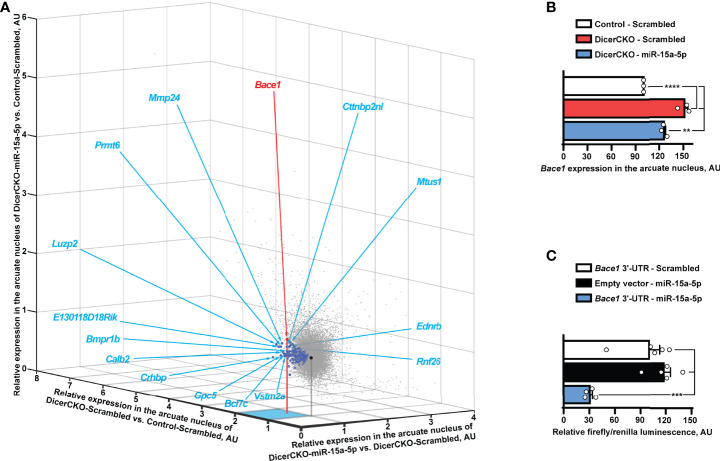
Obesity is a growing medical and social problem worldwide. The control of energy homeostasis in the brain is achieved by various regions including the arcuate hypothalamic nucleus (ARH). The latter comprises a number of neuronal populations including the first order metabolic neurons, appetite-stimulating agouti-related peptide (AgRP) neurons and appetite-suppressing proopiomelanocortin (POMC) neurons. Using an in vivo reductionist approach and POMCCre-dependent CRISPR-Cas9, we demonstrate that miR-15a-5p protects from obesity. Moreover, we have identified Bace1, a gene previously linked to energy metabolism imbalance, as a direct target of miR-15a-5p. This work warrants further investigations of non-coding RNA-mediated regulation of energy homeostasis and might contribute to the development of novel therapeutic approaches to treat metabolic diseases.
Keywords: Dicer; energy homeostasis; hypothalamus; in situ CRISPR/Cas9 knock-out; mice; microRNA; obesity.
Copyright © 2022 Murgia, Ma, Najam, Liu, Przybys, Guo, Konopka and Vinnikov.
Conflict of interest statement
The authors declare that the research was conducted in the absence of any commercial or financial relationships that could be construed as a potential conflict of interest.
Figures


References
MeSH terms
Substances
LinkOut - more resources
Full Text Sources
Molecular Biology Databases
Miscellaneous
