


Systematic Review of Safety and Efficacy of IL-1-Targeted Biologics in Treating Immune-Mediated Disorders
- PMID: 35874710
- PMCID: PMC9296857
- DOI: 10.3389/fimmu.2022.888392
Systematic Review of Safety and Efficacy of IL-1-Targeted Biologics in Treating Immune-Mediated Disorders
Abstract
Background: The cytokine interleukin (IL)-1 plays a pivotal role in immune-mediated disorders, particularly in autoinflammatory diseases. Targeting this cytokine proved to be efficacious in treating numerous IL-1-mediated pathologies. Currently, three IL-1 blockers are approved, namely anakinra, canakinumab and rilonacept, and two additional ones are expected to receive approval, namely gevokizumab and bermekimab. However, there is no systematic review on the safety and efficacy of these biologics in treating immune-mediated diseases.
Objective: To evaluate safety and efficacy of anakinra, canakinumab, rilonacept, gevokizumab, and bermekimab for the treatment of immune-mediated disorders compared to placebo, standard-of-care treatment or other biologics.
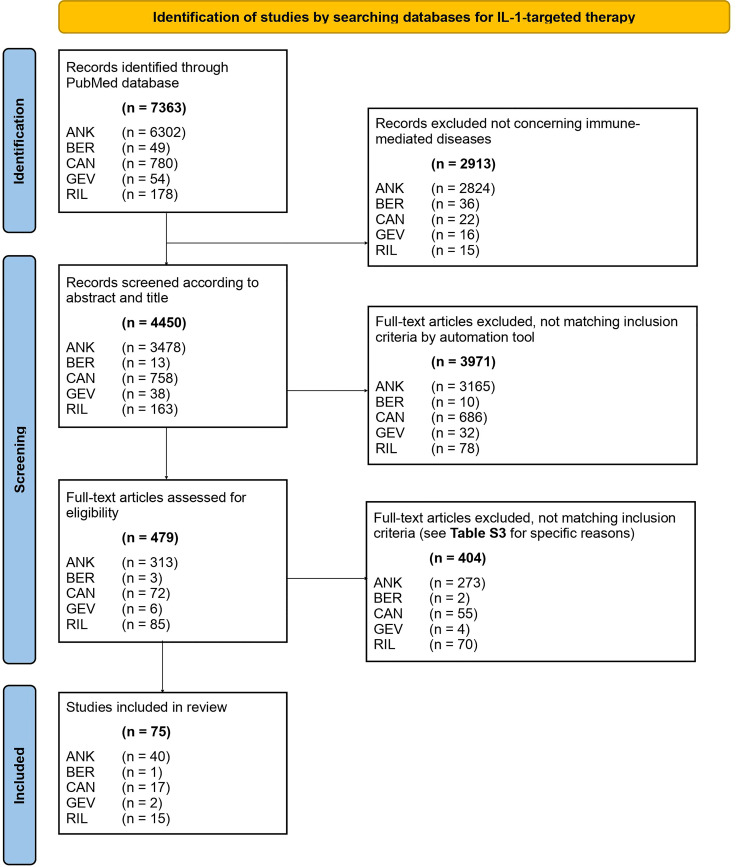
Methods: The PRISMA checklist guided the reporting of the data. We searched the PubMed database between 1 January 1984 and 31 December 2020 focusing on immune-mediated disorders. Our PubMed literature search identified 7363 articles. After screening titles and abstracts for the inclusion and exclusion criteria and assessing full texts, 75 articles were included in a narrative synthesis.
Results: Anakinra was both efficacious and safe in treating cryopyrin-associated periodic syndromes (CAPS), familial Mediterranean fever (FMF), gout, macrophage activation syndrome, recurrent pericarditis, rheumatoid arthritis (RA), and systemic juvenile idiopathic arthritis (sJIA). Conversely, anakinra failed to show efficacy in graft-versus-host disease, Sjögren's syndrome, and type 1 diabetes mellitus (T1DM). Canakinumab showed efficacy in treating CAPS, FMF, gout, hyper-IgD syndrome, RA, Schnitzler's syndrome, sJIA, and TNF receptor-associated periodic syndrome. However, use of canakinumab in the treatment of adult-onset Still's disease and T1DM revealed negative results. Rilonacept was efficacious and safe for the treatment of CAPS, FMF, recurrent pericarditis, and sJIA. Contrarily, Rilonacept did not reach superiority compared to placebo in the treatment of T1DM. Gevokizumab showed mixed results in treating Behçet's disease-associated uveitis and no benefit when assessed in T1DM. Bermekimab achieved promising results in the treatment of hidradenitis suppurativa.
Conclusions: This systematic review of IL-1-targeting biologics summarizes the current state of research, safety, and clinical efficacy of anakinra, bermekimab, canakinumab, gevokizumab, and rilonacept in treating immune-mediated disorders.
Systematic review registration: https://www.crd.york.ac.uk/PROSPERO/, identifier CRD42021228547.
Keywords: IL-1; anakinra; autoinflammatory disease; bermekimab; canakinumab; gevokizumab; immune-mediated; rilonacept.
Copyright © 2022 Arnold, Yalamanoglu and Boyman.
Conflict of interest statement
The authors declare that the research was conducted in the absence of any commercial or financial relationships that could be construed as a potential conflict of interest
Figures
References
Publication types
MeSH terms
Substances
LinkOut - more resources
Full Text Sources
Medical
Miscellaneous
