


The Future of Assisted Reproductive Technology Live Births in the United States
- PMID: 35874801
- PMCID: PMC9289087
- DOI: 10.1007/s11113-022-09731-5
The Future of Assisted Reproductive Technology Live Births in the United States
Abstract
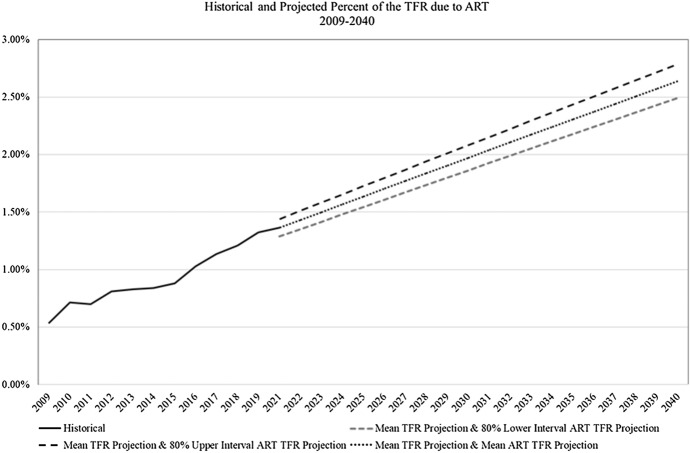
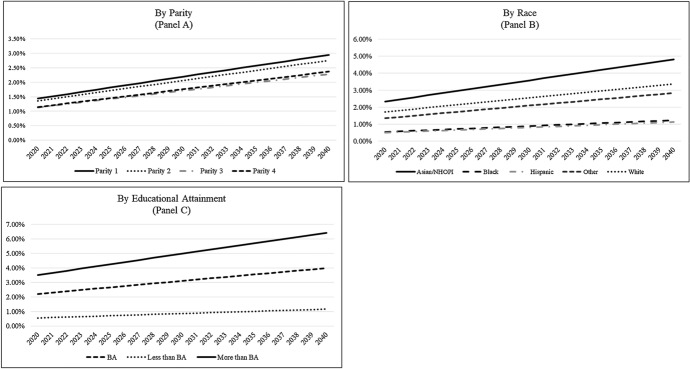
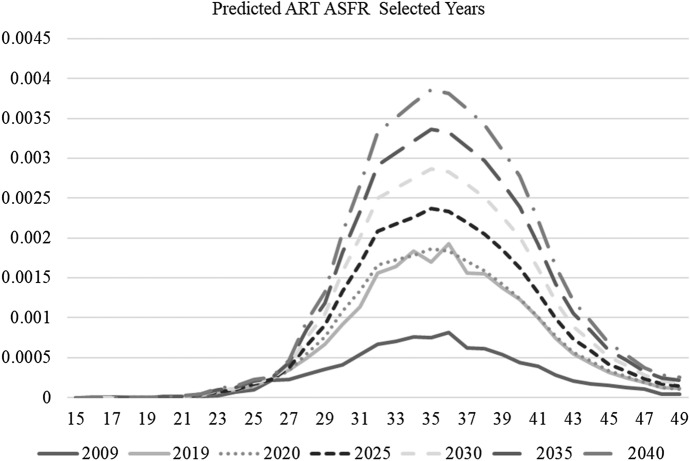
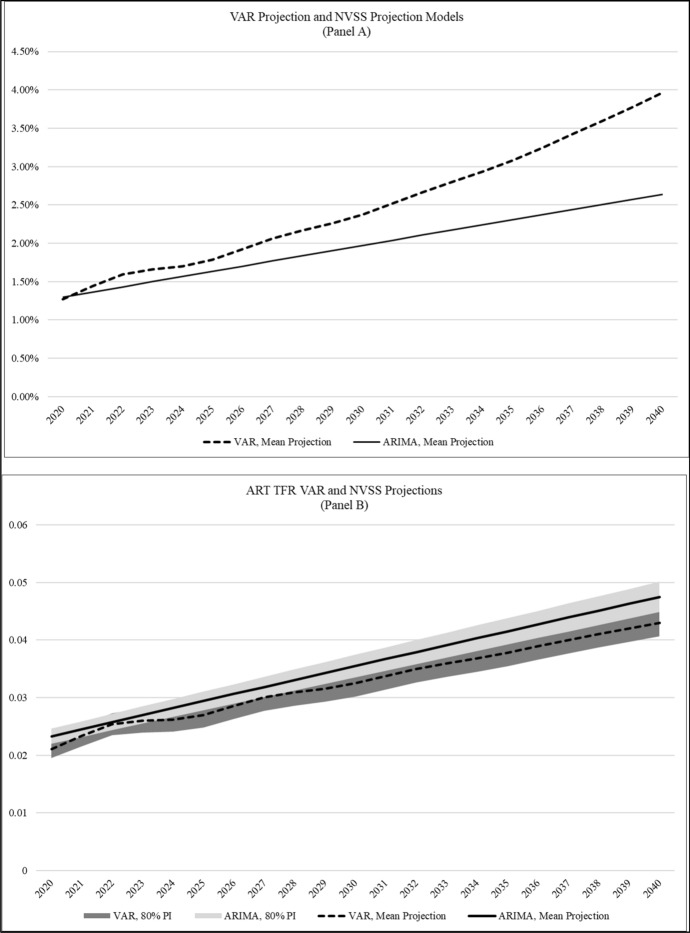
As postponement of first births continues in the United States, women and couples will likely continue to turn to assisted reproductive technologies (ART) to overcome biological barriers to childbearing. This paper uses stochastic projections to estimate the potential impacts of ART on the US total fertility rate (TFR) overall and across sociodemographic groups using publicly available data. Assuming the trends in ART continue and the TFR remains at the mean estimate, the projection shows the ART TFR will rise from 0.023 accounting for 1.29% of the mean projected TFR in 2020 to 0.048 or 2.64% of the TFR by 2040. However, for the TFR of women over 30, this percentage is estimated at 2.68% in 2020 and 5.60% by 2040. Group-level projections quantify stratification by parity, race, and education assuming trends across these groups continue. Overall, the results show that if current trends continue, growth in demand for ART will likely increase, especially at older maternal ages, even as inequalities by race and social class remain. These projections provide a picture of ART births if inequality in access and outcomes is not addressed and highlight the need for attention to policies that address these disparities.
Keywords: Assisted reproduction; Disparities; Infertility; Stochastic projection.
© The Author(s), under exclusive licence to Springer Nature B.V. 2022.
Conflict of interest statement
Conflict of InterestThe author has no conflict of interest to declare.
Figures
References
-
- 102d Congress. Fertility clinic success rate and certification act of 1992. , Pub. L. No. 102–493 (1992). Retrieved from https://www.gpo.gov/fdsys/granule/STATUTE-106/STATUTE-106-Pg3146/content...
-
- Athanasopoulos G, Ahmed RA, Hyndman RJ. Hierarchical forecasts for Australian domestic tourism. International Journal of Forecasting. 2009;25(1):146–166. doi: 10.1016/j.ijforecast.2008.07.004. - DOI
-
- Blyth E, Lee GL. Can assisted reproductive technology (ART) impact Singapore’s low fertility rate? Asian Population Studies. 2013;9(3):241–243. doi: 10.1080/17441730.2013.836395. - DOI
LinkOut - more resources
Full Text Sources
Research Materials