


COVIDMED - An early pandemic randomized clinical trial of losartan treatment for hospitalized COVID-19 patients
- PMID: 35874909
- PMCID: PMC9296371
- DOI: 10.1016/j.conctc.2022.100968
COVIDMED - An early pandemic randomized clinical trial of losartan treatment for hospitalized COVID-19 patients
Abstract
Objectives: To assess the efficacy and safety of losartan for COVID-19 patients.
Methods: COVIDMED was a double-blinded, placebo-controlled platform RCT. Enrollees were randomized to standard care plus hydroxychloroquine, lopinavir/ritonavir, losartan, or placebo. Hydroxychloroquine and lopinavir/ritonavir arms were discontinued early. We report losartan data vs. combined (lopinavir-ritonavir and placebo) and prespecified placebo-only controls. The primary endpoint was the mean COVID-19 Ordinal Severity Score (COSS) slope of change. Slow enrollment prompted early termination.
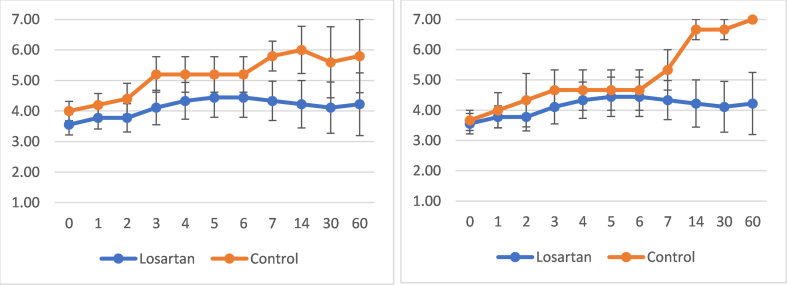
Results: Fourteen patients were included in our final analysis (losartan [N = 9] vs. control [N = 5] [lopinavir/ritonavir [N = 2], placebo [N = 3]]). Most baseline parameters were balanced. Losartan treatment was not associated with a difference in mean COSS slope of change vs. combined (p = 0.4) or placebo-only control (p = 0.05) (trend favoring placebo). 60-day mortality and overall AE/SAE rates were insignificantly higher with losartan.
Conclusion: In this small RCT in hospitalized COVID-19 patients, losartan did not improve outcome and was associated with adverse safety signals.
Keywords: Angiotensin II receptor Blocker (ARB); Angiotensin converting enzyme inhibitor (ACEi); COSS, COVID-19 Ordinal Severity Score; COVID-19; Losartan; Randomized clinical trial (RCT); SARS-CoV-2.
© 2022 The Authors.
Conflict of interest statement
The authors declare that they have no known competing financial interests or personal relationships that could have appeared to influence the work reported in this paper.
References
-
- Ishiyama Y., Gallagher P.E., Averill D.B., Tallant E.A., Brosnihan K.B., Ferrario C.M. Upregulation of angiotensin-converting enzyme 2 after myocardial infarction by blockade of angiotensin II receptors. Hypertension. 2004;43(5):970–976. - PubMed
LinkOut - more resources
Full Text Sources
Miscellaneous
