


Teachers, Stress, and the COVID-19 Pandemic: A Qualitative Analysis
- PMID: 35875185
- PMCID: PMC9288205
- DOI: 10.1007/s12310-022-09533-2
Teachers, Stress, and the COVID-19 Pandemic: A Qualitative Analysis
Abstract
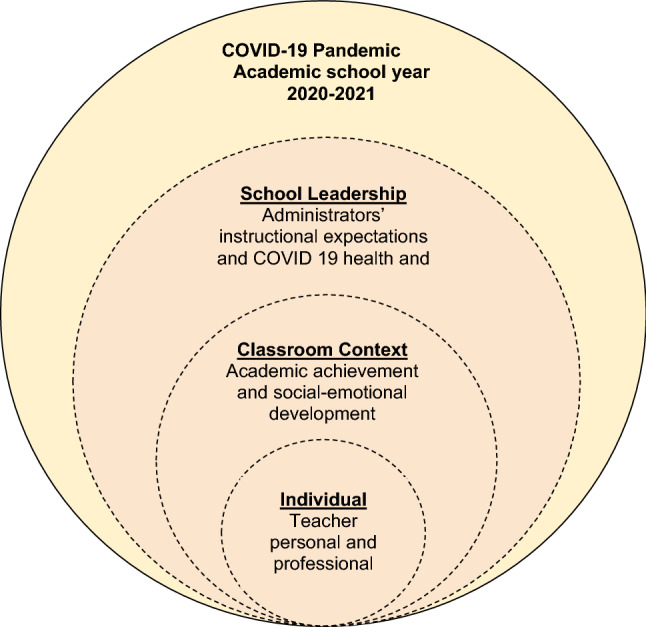
The 2020-2021 academic year brought numerous challenges to teachers across the country as they worked to educate students amidst the COVID-19 pandemic. The current study is a secondary data analysis of qualitative responses collected as part of a teacher survey to evaluate a social emotional learning curriculum implemented during the 2020-2021 academic year. The lived experiences of teachers (N = 52) across 11 elementary schools in the Great Plains region were captured through open-ended questions as the teachers transitioned from in-person to remote learning. A phenomenological approach was utilized to analyze the challenges expressed by teachers as they faced instability and additional professional demands. Given that stress and other factors that strain mental health exist within multiple layers of an individual's social ecology, a modified social-ecological framework was used to organize the results and themes. Findings suggest that during the academic year, teachers experienced stressors related to their personal and professional roles, concerns for students' well-being which extended beyond academics, and frustrations with administration and other institutional entities around COVID safety measures. Without adequate support and inclusion of teacher perspectives, job-related stress may lead to teacher shortages, deterioration of teacher mental health, and ultimately worse outcomes for students. Implications for policy, research, and practice are discussed.
Supplementary information: The online version contains supplementary material available at 10.1007/s12310-022-09533-2.
Keywords: COVID-19; Qualitative analysis; Teacher mental health.
© The Author(s), under exclusive licence to Springer Science+Business Media, LLC, part of Springer Nature 2022.
Conflict of interest statement
Conflict of interestThe authors declare that there is no conflict of interests.
References
-
- Allegretto, S., & Mishel, L. (2019). The teacher weekly wage penalty hit 21.4 percent in 2018, a record high: Trends in the teacher wage and compensation penalties through 2018. Economic Policy Institute. https://www.epi.org/publication/teacher-pay-gap-2018/
-
- American Federation of Teachers and Badass Teachers Association. (2017). Educator Quality of Work Life Survey. https://www.aft.org/sites/default/files/ 2017_eqwl_survey_web.pdf
-
- Ansari A, Hofkens TL, Pianta RC. Teacher-student relationships across the first seven years of education and adolescent outcomes. Journal of Applied Developmental Psychology. 2020;71:101200. doi: 10.1016/j.appdev.2020.101200. - DOI
-
- Arens AK, Morin AJS. Relations between teachers’ emotional exhaustion and students’ educational outcomes. Journal of Educational Psychology. 2016;108(6):800–813. doi: 10.1037/edu0000105. - DOI
LinkOut - more resources
Full Text Sources