


Understanding the challenges related to breastfeeding education and barriers to curricular change: a systems perspective for transforming health professions education
- PMID: 35875442
- PMCID: PMC9297256
- DOI: 10.36834/cmej.73178
Understanding the challenges related to breastfeeding education and barriers to curricular change: a systems perspective for transforming health professions education
Abstract
Objectives: A majority of women and families wish that their babies be breastfed. However, too many still receive insufficient or inappropriate initial care from health professionals (HPs) who have limited breastfeeding (BF) competencies. We investigated barriers and potential solutions to improve the undergraduate training programs for various HPs.
Methods: Focus groups were carried out in three universities in Quebec and one in Ontario (Canada), with 30 faculty and program directors from medicine, midwifery, nursing, nutrition, and pharmacy. Discussions were subjected to thematic content analysis, before being validated in a strategic planning workshop with 48 participants from the same disciplines, plus dentistry and chiropractic.
Findings: Substantive improvements of undergraduate training programs for BF could be obtained by addressing challenges related to the insufficient, or lack of, (i) interactions among various HPs, (ii) opportunities for practical learning, (iii) specific standards to guide course content, (iv) real-life experience with counselling, and (v) understanding of the influence of attitudes on professional practice. Several potential solutions were proposed and validated. The re-interpretation of the results in light of various literature led to an emerging framework that takes a systems perspective for enhancing the education of HPs on BF.
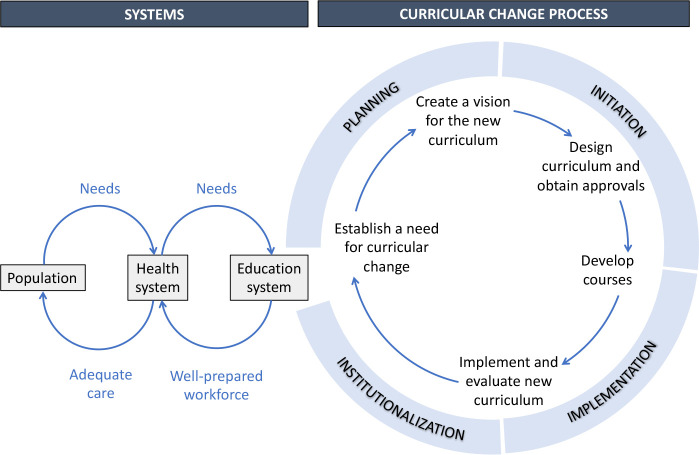
Conclusions: To improve the education of HPs so as to enable them to provide relevant support for future mothers, mothers and their families, solutions need to be carried out to address challenges in the health system, the education system as well as regarding the curricular change process.
Objectifs: La majorité des femmes et des familles souhaitent que leur bébé soit allaité. Toutefois, plusieurs ne reçoivent pas un soutien adéquat de la part de professionnels de la santé (PS) qui ont des compétences limitées en allaitement. Nous avons étudié les barrières et les solutions potentielles en vue de rehausser la formation initiale de divers PS.
Méthodes: Des groupes de discussion ont été organisés dans trois universités du Québec et une en Ontario (Canada) avec 30 directeurs de programmes et membres du corps professoral en médecine, pratique sage-femme, sciences infirmières, nutrition et pharmacie. Les discussions ont fait l’objet d’une analyse de contenu thématique laquelle fut ensuite validée dans un atelier de planification stratégique avec 48 participants des mêmes disciplines auxquelles se sont ajoutées dentisterie et chiropratique.
Résultats: Des améliorations substantielles des compétences en allaitement dans les programmes de formation initiale pourraient être obtenues en travaillant sur les défis associés à l’insuffisance, ou à l’absence de, (i) interactions entre les divers PS, (ii) opportunités d’apprentissages pratiques, (iii) normes spécifiques pour guider les contenus de cours, (iv) expériences réelles avec le counseling, et (v) compréhension de l’influence des attitudes sur la pratique professionnelle. La ré-interprétation des résultats à la lumière de la littérature a fait émerger un cadre conceptuel avec une perspective systémique pour guider le rehaussement de la formation en allaitement des divers PS.
Conclusions: Afin d’améliorer la formation des PS pour qu’ils/elles puissent fournir un soutien pertinent aux futures mères, aux mères et à leurs familles, des solutions visant à la fois les défis dans le système de santé, dans le système d’éducation et dans le processus de changement curriculaire doivent être mises en œuvre.
© 2022 Michaud-Létourneau, Gayard, Lauzière, Beaudry, Pascual, Chartier, Herzhaft-LeRoy, Chiasson, Fontaine-Bisson, Pound, Gaboury; licensee Synergies Partners.
Conflict of interest statement
All authors confirmed that they have no conflict of interest related to the content of this paper.
Figures
References
-
- 2021 Global Nutrition Report: The state of global nutrition. Bristol, UK: development initiatives; https://globalnutritionreport.org/documents/753/2021_Global_Nutrition_Re...
-
- Neill G, Beauvais B, Plante N. Recueil statistique sur l'allaitement maternel au Québec, 2005-2006. Institut de la statistique du Québec; 2006.
LinkOut - more resources
Full Text Sources
Miscellaneous