Desired Resources for Changing Diet Among Persons With Multiple Sclerosis: Qualitative Inquiry Informing Future Dietary Interventions
- PMID: 35875458
- PMCID: PMC9296057
- DOI: 10.7224/1537-2073.2021-052
Desired Resources for Changing Diet Among Persons With Multiple Sclerosis: Qualitative Inquiry Informing Future Dietary Interventions
Abstract
Background: There are approximately 1 million adults in the United States with multiple sclerosis (MS). Persons with MS are interested in diet as a second-line therapy for improving MS symptoms and disease progression. Examination of desired resources regarding diet among persons with MS is necessary for supporting behavior change.
Methods: Twenty-five adults with MS completed 1-on-1, online semistructured interviews. An inductive, 6-phase, semantic thematic analysis was applied to identify themes associated with participant preferences for dietary behavior change.
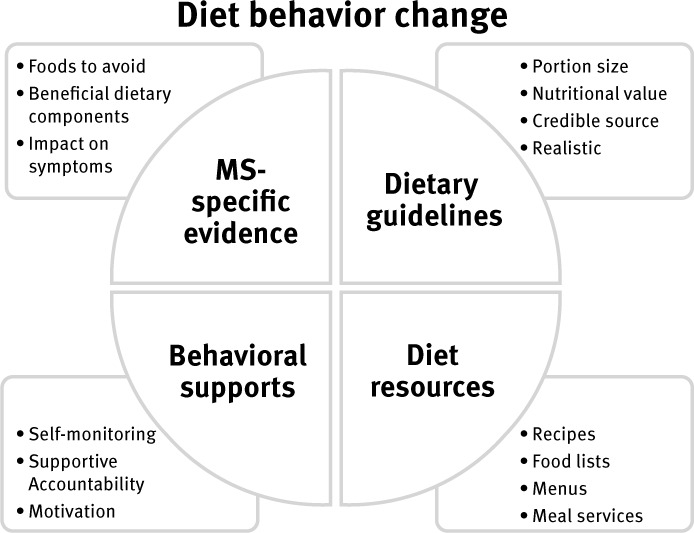
Results: The research team crafted 4 key themes from the data that encompassed participants' desired resources for dietary behavior change. Theme 1, MS-specific evidence, involved the need for clear information about the impact of diet regimens or specific foods on MS. Theme 2, dietary guidelines, was related to guidelines provided by a reliable source such as a registered dietitian. Theme 3, behavioral supports, underscored the need for support for behavior change, including accountability, self-monitoring, motivation, habituation, and incremental changes. Theme 4, diet resources, highlighted tangible resources for supporting dietary change, including recipes, food lists, meal services, or games.
Conclusions: This study provides a foundation for guiding dietary interventions for persons with MS that incorporates their needs and preferences and could improve their overall health. Such dietary change can be facilitated by theory-based behavioral interventions that incorporate behavior change techniques such as self-monitoring and goal setting for supporting behavior change.
Keywords: behavior change; diet; multiple sclerosis; qualitative; wellness.
© 2022 Consortium of Multiple Sclerosis Centers.
Conflict of interest statement
FINANCIAL DISCLOSURES: The authors declare no conflicts of interest.
Figures
References
Grants and funding
LinkOut - more resources
Full Text Sources