


Deep Learning-Based Recognition of Different Thyroid Cancer Categories Using Whole Frozen-Slide Images
- PMID: 35875502
- PMCID: PMC9298848
- DOI: 10.3389/fbioe.2022.857377
Deep Learning-Based Recognition of Different Thyroid Cancer Categories Using Whole Frozen-Slide Images
Abstract
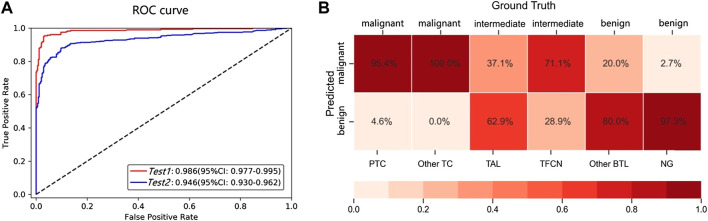
Introduction: The pathological rare category of thyroid is a type of lesion with a low incidence rate and is easily misdiagnosed in clinical practice, which directly affects a patient's treatment decision. However, it has not been adequately investigated to recognize the rare, benign, and malignant categories of thyroid using the deep learning method and recommend the rare to pathologists. Methods: We present an empirical decision tree based on the binary classification results of the patch-based UNet model to predict rare categories and recommend annotated lesion areas to be rereviewed by pathologists. Results: Applying this framework to 1,374 whole-slide images (WSIs) of frozen sections from thyroid lesions, we obtained an area under a curve of 0.946 and 0.986 for the test datasets with and without WSIs, respectively, of rare types. However, the recognition error rate for the rare categories was significantly higher than that for the benign and malignant categories (p < 0.00001). For rare WSIs, the addition of the empirical decision tree obtained a recall rate and precision of 0.882 and 0.498, respectively; the rare types (only 33.4% of all WSIs) were further recommended to be rereviewed by pathologists. Additionally, we demonstrated that the performance of our framework was comparable to that of pathologists in clinical practice for the predicted benign and malignant sections. Conclusion: Our study provides a baseline for the recommendation of the uncertain predicted rare category to pathologists, offering potential feasibility for the improvement of pathologists' work efficiency.
Keywords: WSI; deep learning model; pathology; rare category; thyroid cancer.
Copyright © 2022 Zhu, Chen, Guo, Ma, Sun and Lu.
Conflict of interest statement
CC and FS were employed by the company Digital Health China Technologies Corporation Limited. The remaining authors declare that the research was conducted in the absence of any commercial or financial relationships that could be construed as a potential conflict of interest.
Figures



References
-
- Böhland M., Tharun L., Scherr T., Mikut R., Hagenmeyer V., Thompson L. D. R., et al. (2021). Machine Learning Methods for Automated Classification of Tumors with Papillary Thyroid Carcinoma-Like Nuclei: A Quantitative Analysis. PLoS One 16 (9), e0257635. 10.1371/journal.pone.0257635 - DOI - PMC - PubMed
LinkOut - more resources
Full Text Sources
