


Prototype Pathogen Approach for Vaccine and Monoclonal Antibody Development: A Critical Component of the NIAID Plan for Pandemic Preparedness
- PMID: 35876700
- PMCID: PMC9384504
- DOI: 10.1093/infdis/jiac296
Prototype Pathogen Approach for Vaccine and Monoclonal Antibody Development: A Critical Component of the NIAID Plan for Pandemic Preparedness
Abstract
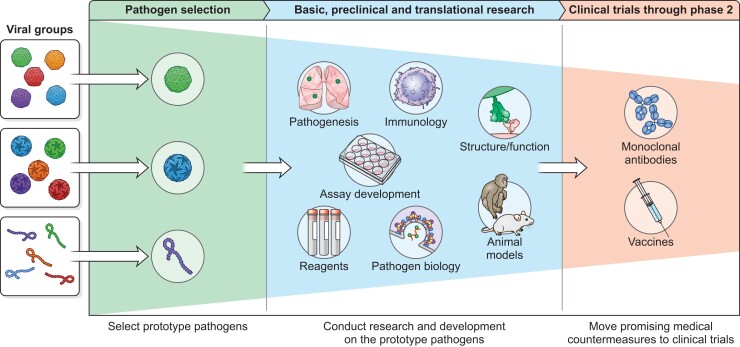
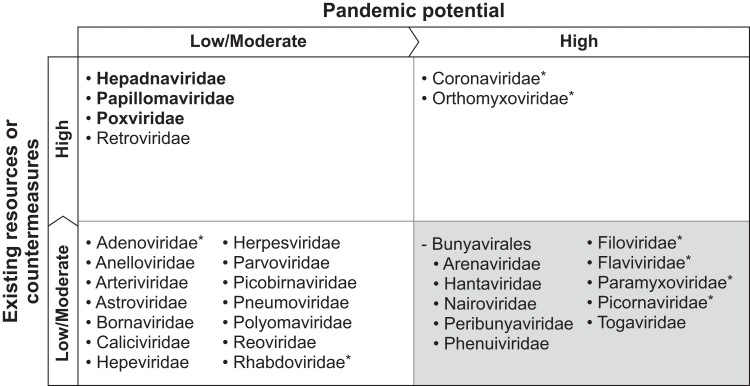
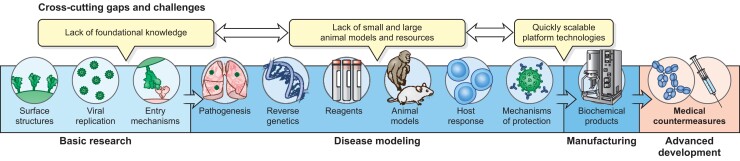
Severe acute respiratory syndrome coronavirus 1 (SARS-CoV-1) emerged 20 years ago, presaging a series of subsequent infectious disease epidemics of international concern. The recent emergence of SARS-CoV-2 has underscored the importance of targeted preparedness research to enable rapid countermeasure development during a crisis. In December 2021 the National Institute of Allergy and Infectious Diseases (NIAID), building upon the successful strategies developed during the SARS-CoV-2 response and to prepare for future pandemics, published a pandemic preparedness plan that outlined a research strategy focused on priority pathogens, technology platforms, and prototype pathogens. To accelerate the discovery, development, and evaluation of medical countermeasures against new or previously unknown pathogens of pandemic potential, we present here a strategy of research directed at select prototype pathogens. In this manner, leveraging a prototype pathogen approach may serve as a powerful cornerstone in biomedical research preparedness to protect public health from newly emerging and reemerging infectious diseases.
Keywords: monoclonal antibody; pandemic preparedness; platform technologies; prototype pathogen; vaccine.
Published by Oxford University Press on behalf of Infectious Diseases Society of America 2022.
Conflict of interest statement
Potential conflicts of interest. All authors: No reported conflicts of interest. All authors have submitted the ICMJE Form for Disclosure of Potential Conflicts of Interest. Conflicts that the editors consider relevant to the content of the manuscript have been disclosed.
Figures
References
-
- Wise PH, Barry M. Civil war and the global threat of pandemics. Daedalus 2017; 146:71–84.
-
- Office of Science and Technology Policy . American pandemic preparedness: transforming our capabilities.https://www.whitehouse.gov/wp-content/uploads/2021/09/American-Pandemic-.... Accessed 29 March 2022.
-
- National Institute of Allergy and Infectious Diseases . NIAID pandemic preparedness plan.https://www.niaid.nih.gov/research/pandemic-preparedness. Accessed 29 March 2022.
-
- Marston HD, Paules CI, Fauci AS. The critical role of biomedical research in pandemic preparedness. JAMA 2017; 318:1757–8. - PubMed
Publication types
MeSH terms
Substances
LinkOut - more resources
Full Text Sources
Medical
Miscellaneous
