


Locoregional Management of Breast Cancer: A Chronological Review
- PMID: 35877229
- PMCID: PMC9321012
- DOI: 10.3390/curroncol29070369
Locoregional Management of Breast Cancer: A Chronological Review
Abstract
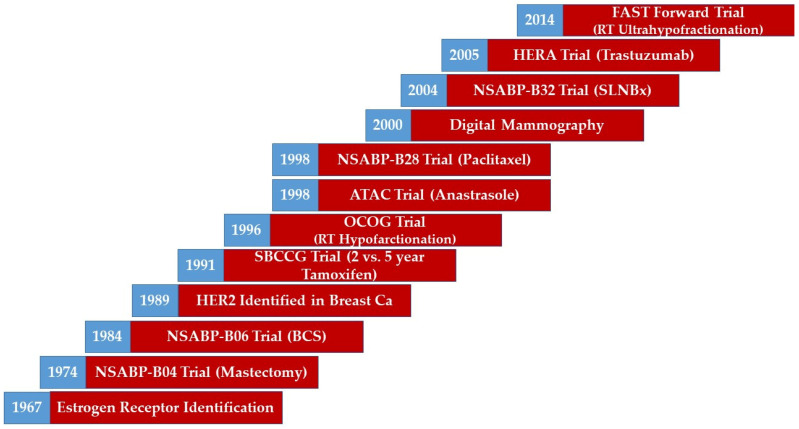
Locoregional management of breast cancer is founded on evidence generated over a vast time period, much longer than the career span of many practicing physicians. Oncologists rely on specific patient and tumour characteristics to recommend modern-day treatments. However, some of this information may not have been available during prior periods in which the evidence was generated. For example, the comprehensive Early Breast Cancer Trialists' Collaborative Group (EBCTCG) meta-analyses published in the 2000s typically included older trials accruing patients between the 1960s and 1980s. This raises some uncertainty about whether conclusions from studies conducted in prior eras are as relevant or applicable to modern-day patients and treatments. Reviewing the chronological order and details of the evidence can be beneficial to understanding these nuances. This review discusses the evolution of locoregional management through some key clinical trials. We aim to highlight the time period in which the evidence was generated and emphasize the 10-year outcomes for the comparability of results. Evidence supporting surgical management of the breast and axilla, as well as details of radiotherapy are discussed briefly for all stages of breast cancer.
Keywords: axilla; breast cancer; locoregional; management; radiotherapy; surgery.
Conflict of interest statement
JQC received honoraria from Roche, Pfizer, Novartis, AstraZeneca, Merck, and La Roche-Posay outside of the submitted work. The other authors have no conflicts of interest to declare.
Figures
References
-
- Cote R.J., Peterson H.F., Chaiwun B., Gelber R.D., Goldhirsch A., Castiglione-Gertsch M., Gusterson B., Neville A.M., International Breast Cancer Study Group Role of immunohistochemical detection of lymph-node metastases in management of breast cancer. Lancet. 1999;354:896–900. doi: 10.1016/S0140-6736(98)11104-2. - DOI - PubMed
-
- Milestones in Cancer History. [(accessed on 15 April 2022)]; Available online: https://www.cancer.gov/research/progress/250-years-milestones.
-
- Chen K., Beeraka N.M., Zhang J., Reshetov I.V., Nikolenko V.N., Sinelnikov M.Y., Mikhaleva L.M. Efficacy of da Vinci robot-assisted lymph node surgery than conventional axillary lymph node dissection in breast cancer—A comparative study. Int. J. Med. Robot. 2021;17:e23077. doi: 10.1002/rcs.2307. - DOI - PubMed
Publication types
MeSH terms
LinkOut - more resources
Full Text Sources
Medical
