


Evolution and dosage compensation of nucleolar organizing regions (NORs) mediated by mobile elements in turtles with female (ZZ/ZW) but not with male (XX/XY) heterogamety
- PMID: 35877473
- PMCID: PMC10087745
- DOI: 10.1111/jeb.14064
Evolution and dosage compensation of nucleolar organizing regions (NORs) mediated by mobile elements in turtles with female (ZZ/ZW) but not with male (XX/XY) heterogamety
Abstract
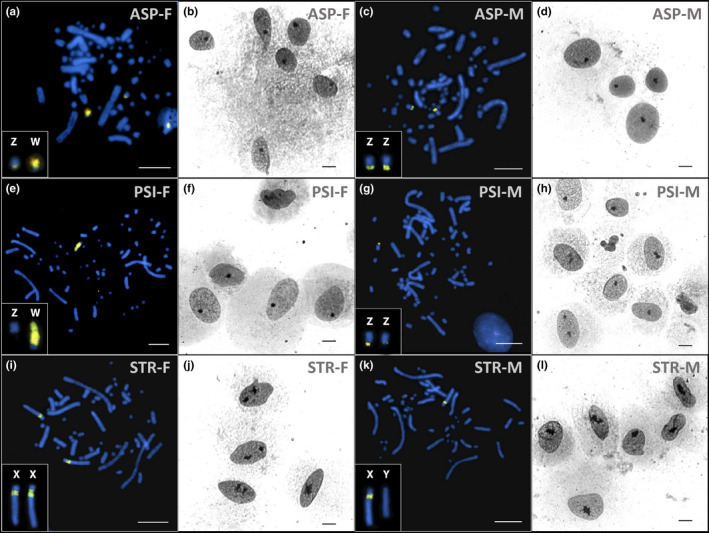
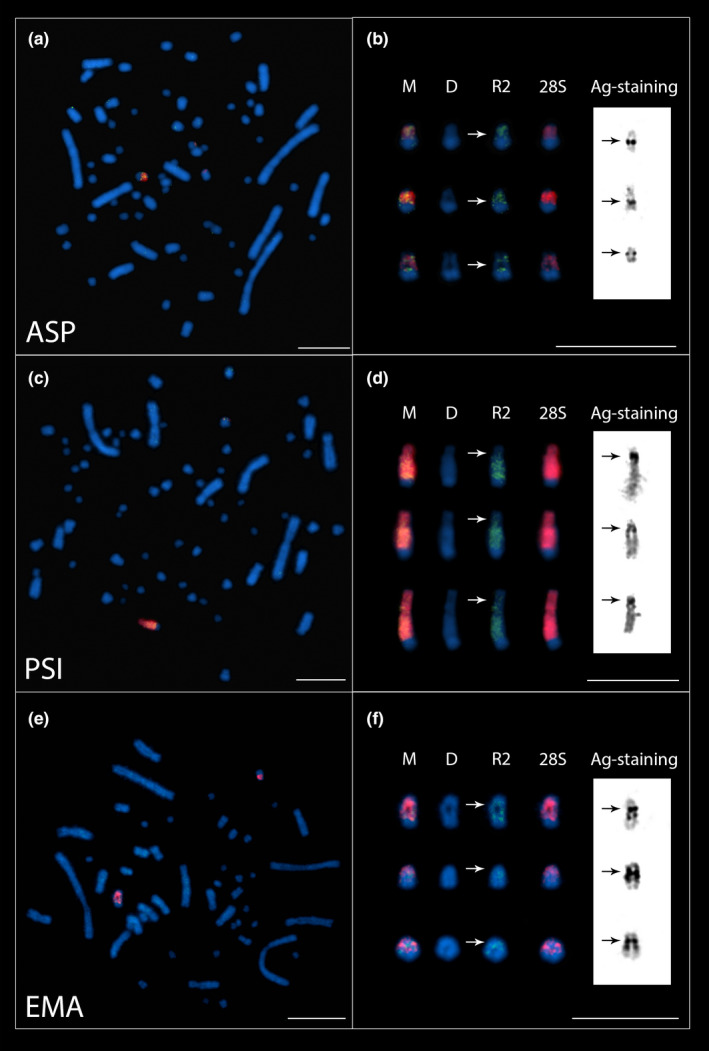
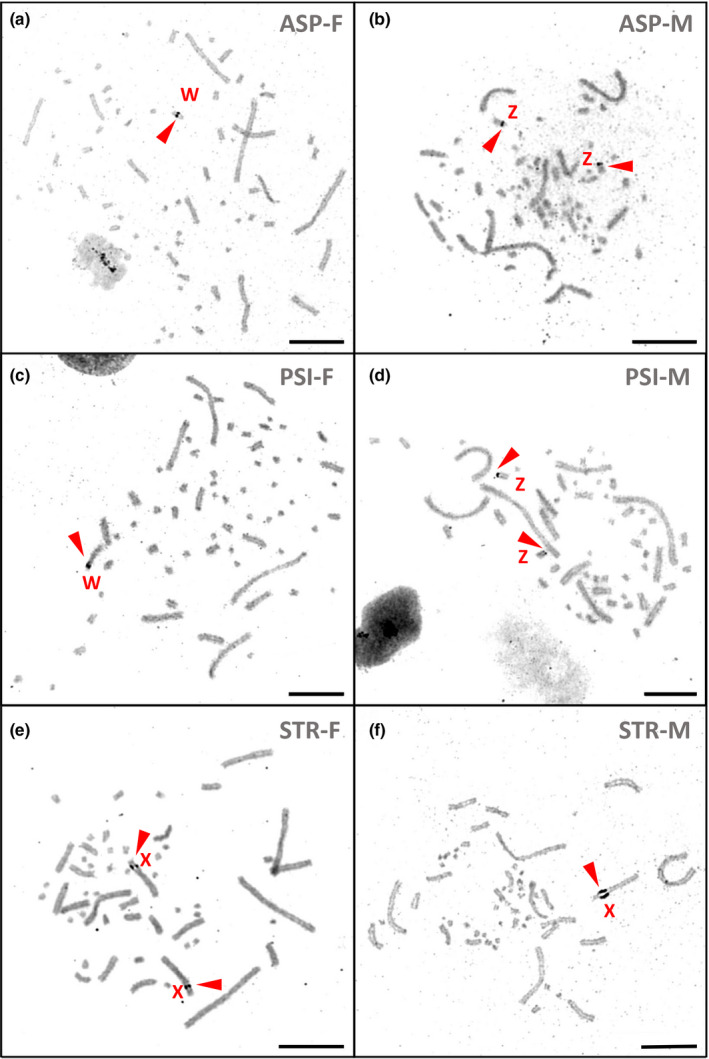
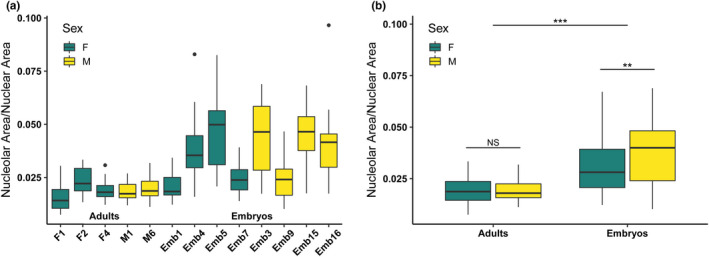
Understanding the evolution and regulation of nucleolar organizing regions (NORs) is important to elucidate genome structure and function. This is because ribosomal gene (rDNA) copy number and activity mediate protein biosynthesis, stress response, ageing, disease, dosage compensation and genome stability. Here, we found contrasting dosage compensation of sex-linked NORs in turtles with male and female heterogamety. Most taxa examined exhibit homomorphic rRNA gene clusters in a single autosome pair (determined by 28S rDNA fluorescence in situ hybridization), whereas NORs are sex-linked in Apalone spinifera, Pelodiscus sinensis and Staurotypus triporcatus. Full-dosage compensation upregulates the male X-NOR (determined via silver staining-AgNOR) in Staurotypus (who lacks Y-NOR) compared with female X-AgNORs. In softshell Apalone and Pelodiscus, who share homologous ZZ/ZW micro-chromosomes, their enlarged W-NOR is partially active (due to 28S rDNA invasion by R2 retroelements), whereas their smaller Z-NOR is silent in females but active in both male-Zs (presumably because the W-NOR meets cellular demands and excessive NOR activity is costly). We hypothesize that R2 disruption favoured W enlargement to add intact 28S-units, perhaps facilitated by reduced recombination during sex chromosome evolution. The molecular basis of the potentially adaptive female Z-silencing is likely intricate and perhaps epigenetic, as non-ribosomal Z genes are active in Apalone females. Yet, Emydura maquarii exhibit identical heteromorphism in their autosomal NOR (R2 invaded 28S-units and the small-autosome NOR is silent), suggesting that the softshell turtle pattern can evolve independent of sex chromosome evolution. Our study illuminates the complex sex chromosome evolution and dosage compensation of non-model systems that challenges classic paradigms.
Keywords: 18S/28S repetitive DNA; R2 retrotransposon retroelement transposable element; adaptive evolution of sex chromosome dosage compensation; gene regulation silencing; nucleolar organizing region; ribosomal RNA genes (rRNA, rDNA); silver-staining AgNOR; temperature-dependent (TSD) and ZZ/ZW XX/XY genotypic sex determination (GSD); turtle reptile vertebrates.
© 2022 The Authors. Journal of Evolutionary Biology published by John Wiley & Sons Ltd on behalf of European Society for Evolutionary Biology.
Conflict of interest statement
The authors have no conflict of interest to declare.
Figures
Similar articles
-
A ZZ/ZW microchromosome system in the spiny softshell turtle, Apalone spinifera, reveals an intriguing sex chromosome conservation in Trionychidae.Chromosome Res. 2013 Apr;21(2):137-47. doi: 10.1007/s10577-013-9343-2. Epub 2013 Mar 20. Chromosome Res. 2013. PMID: 23512312
-
Thermosensitive sex chromosome dosage compensation in ZZ/ZW softshell turtles, Apalone spinifera.Philos Trans R Soc Lond B Biol Sci. 2021 Sep 13;376(1833):20200101. doi: 10.1098/rstb.2020.0101. Epub 2021 Jul 26. Philos Trans R Soc Lond B Biol Sci. 2021. PMID: 34304598 Free PMC article.
-
Discovery of Putative XX/XY Male Heterogamety in Emydura subglobosa Turtles Exposes a Novel Trajectory of Sex Chromosome Evolution in Emydura.Cytogenet Genome Res. 2019;158(3):160-169. doi: 10.1159/000501891. Epub 2019 Aug 9. Cytogenet Genome Res. 2019. PMID: 31394537
-
Turtle Insights into the Evolution of the Reptilian Karyotype and the Genomic Architecture of Sex Determination.Genes (Basel). 2020 Apr 11;11(4):416. doi: 10.3390/genes11040416. Genes (Basel). 2020. PMID: 32290488 Free PMC article. Review.
-
The origin and evolution of vertebrate sex chromosomes and dosage compensation.Heredity (Edinb). 2012 Jan;108(1):50-8. doi: 10.1038/hdy.2011.106. Epub 2011 Nov 16. Heredity (Edinb). 2012. PMID: 22086077 Free PMC article. Review.
Cited by
-
Transcriptomic thermal plasticity underlying gonadal development in a turtle with ZZ/ZW sex chromosomes despite canalized genotypic sex determination.Ecol Evol. 2023 Feb 24;13(2):e9854. doi: 10.1002/ece3.9854. eCollection 2023 Feb. Ecol Evol. 2023. PMID: 36844670 Free PMC article.
-
De novo genome assemblies of two cryptodiran turtles with ZZ/ZW and XX/XY sex chromosomes provide insights into patterns of genome reshuffling and uncover novel 3D genome folding in amniotes.Genome Res. 2024 Oct 29;34(10):1553-1569. doi: 10.1101/gr.279443.124. Genome Res. 2024. PMID: 39414368 Free PMC article.
-
ZZ/ZW Sex Chromosomes in the Madagascar Girdled Lizard, Zonosaurus madagascariensis (Squamata: Gerrhosauridae).Genes (Basel). 2022 Dec 29;14(1):99. doi: 10.3390/genes14010099. Genes (Basel). 2022. PMID: 36672840 Free PMC article.
-
Occurrence of Sex Chromosomes in Fish of the Genus Ancistrus with a New Description of Multiple Sex Chromosomes in the Ecuadorian Endemic Ancistrus clementinae (Loricariidae).Genes (Basel). 2023 Jan 24;14(2):306. doi: 10.3390/genes14020306. Genes (Basel). 2023. PMID: 36833233 Free PMC article.
References
-
- Abramyan, J. , Ezaz, T. , Graves, J. A. M. , & Koopman, P. (2009). Z and W sex chromosomes in the cane toad (Bufo marinus). Chromosome Research, 17, 1015–1024. - PubMed
-
- Bachtrog, D. , Kirkpatrick, M. , Mank, J. E. , McDaniel, S. F. , Pires, J. C. , Rice, W. , & Valenzuela, N. (2011). Are all sex chromosomes created equal? Trends in Genetics, 27, 350–357. - PubMed
-
- Badenhorst, D. , Stanyon, R. , Engstrom, T. , & Valenzuela, N. (2013). A ZZ/ZW microchromosome system in the spiny softshell turtle, Apalone spinifera, reveals an intriguing sex chromosome conservation in Trionychidae. Chromosome Research, 21, 137–147. - PubMed
-
- Barbosa, M. O. , da Silva, R. R. , de Sena Correia, V. C. , dos Santos, L. P. , Garnero, A. D. V. , & Gunski, R. J. (2013). Nucleolar organizer regions in Sittasomus griseicapillus and Lepidocolaptes angustirostris (Aves, Dendrocolaptidae): Evidence of a chromosome inversion. Genetics and Molecular Biology, 36, 70–73. - PMC - PubMed
-
- Barr, H. J. , & Esper, H. (1963). Nucleolar size in cells of Xenopus laevis in relation to nucleolar competition. Experimental Cell Research, 31, 211–214.
