. 2022 Jul 25;13(1):4290.
doi: 10.1038/s41467-022-31964-3.

Revisiting stress-corrosion cracking and hydrogen embrittlement in 7xxx-Al alloys at the near-atomic-scale

Affiliations

Revisiting stress-corrosion cracking and hydrogen embrittlement in 7xxx-Al alloys at the near-atomic-scale

Martí López Freixes et al. Nat Commun. .

Abstract

The high-strength 7xxx series aluminium alloys can fulfil the need for light, high strength materials necessary to reduce carbon-emissions, and are extensively used in aerospace for weight reduction purposes. However, as all major high-strength materials, these alloys can be sensitive to stress-corrosion cracking (SCC) through anodic dissolution and hydrogen embrittlement (HE). Here, we study at the near-atomic-scale the intra- and inter-granular microstructure ahead and in the wake of a propagating SCC crack. Moving away from model alloys and non-industry standard tests, we perform a double cantilever beam (DCB) crack growth test on an engineering 7xxx Al-alloy. H is found segregated to planar arrays of dislocations and to grain boundaries that we can associate to the combined effects of hydrogen-enhanced localised plasticity (HELP) and hydrogen-enhanced decohesion (HEDE) mechanisms. We report on a Mg-rich amorphous hydroxide on the corroded crack surface and evidence of Mg-related diffusional processes leading to dissolution of the strengthening η-phase precipitates ahead of the crack.


Conflict of interest statement

The authors declare no competing interests.

Figures
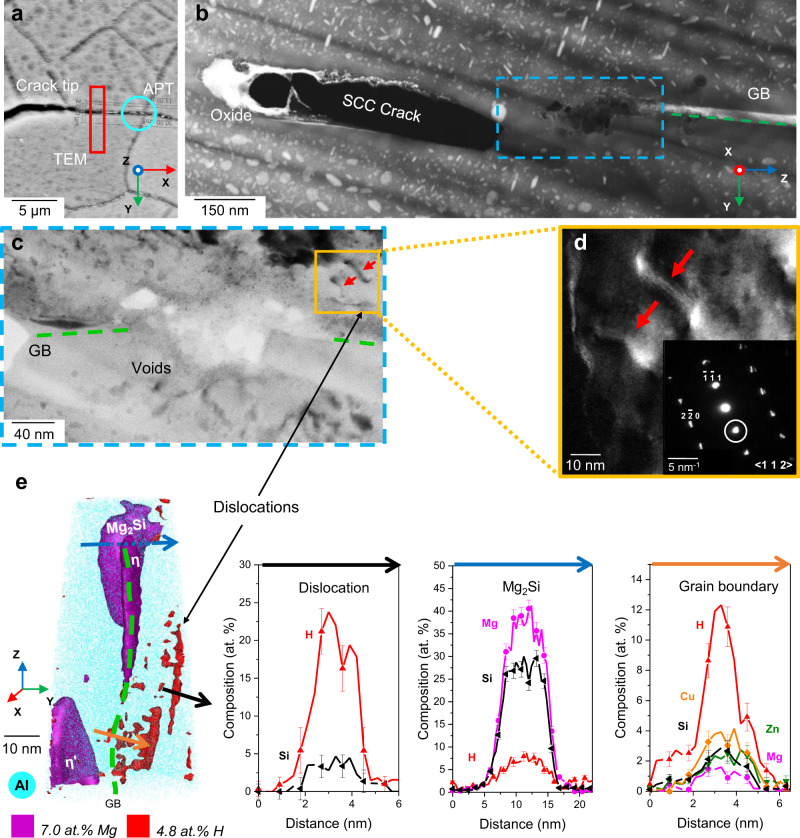
Fig. 1
Fig. 1. H effects on deformation behaviour near a stress-corrosion crack.
a SEM micrograph of the SCC crack tip, showing the indicative locations of APT and TEM analysis. b STEM image of the crack tip region revealing the presence of oxide and void-like structures. c TEM BF image showing dislocations near the void region, pointed by the red arrows. d DF image corresponding to the (111) diffraction spot of the dislocations imaged in b pointed by the red arrows. e APT reconstruction of the GB 4 µm ahead of the crack showing the presence of dislocations with H and Si segregation. 1D Composition profiles across the GB, the dislocation and the Mg2Si particle, respectively measured along the arrows shown in the APT reconstruction. The error bars correspond to the standard deviation within each of the bins in the profile. Grain boundary (GB). Transmission-Electron Microscopy (TEM). Atom Probe Tomography (APT).
Fig. 2
Fig. 2. Corrosion behaviour during stress-corrosion cracking of the 7449-T7651 alloy.
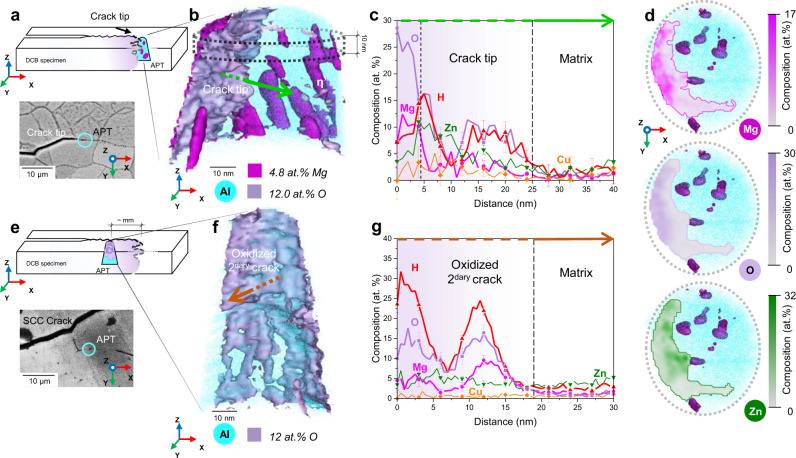
a Schematic of a DCB sample showing the APT crack tip sample location and orientation. b APT reconstruction of the crack tip of an SCC crack. c 1D composition profile across the oxide-matrix interface showing the oxide composition, measured within a 10 nm (ø) cylinder along the arrow in b. d 2D composition maps, obtained from a 10 nm slice, showing the 2D elemental distribution of Mg, O and Zn in the oxide within the dotted-line slice shown in b. e Schematic of a DCB sample showing the APT secondary crack sample location and orientation. f APT reconstruction of an oxidised secondary crack displaying the complex oxide morphology and absence of precipitation. g 1D composition profile across the oxide-matrix interface, measured within a 10 nm (ø) cylinder along the arrow in f. The error bars correspond to the standard deviation within each of the bins in the composition profiles shown. Double Cantilever Beam (DCB). Atom Probe Tomography (APT).
Fig. 3
Fig. 3. Matrix and η-phase precipitate compositional evolution during stress-corrosion cracking.
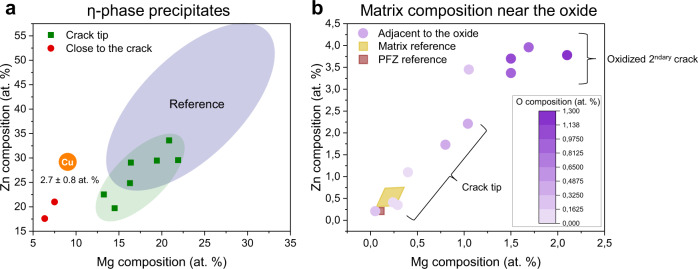
a η-phase precipitate composition around the crack tip and very close to the crack compared with reference values from Supplementary Fig. 1c. The composition of η-phase precipitates captured close to the crack, within 1 µm, in another dataset are also added to the analysis. Cu average composition in the η-phase precipitates at the crack tip and close to the crack is also reported, also showing a marked decrease in Cu content with respect to reference values from Supplementary Fig. 1c. The error values reported for Cu correspond to the standard deviation of all measurements; (b) matrix composition around the crack tip and adjacent to the oxidised secondary crack compared with reference values from Supplementary Fig. 1b. Matrix O levels are also displayed at each data point. Please refer to Supplementary Fig. 8b for error values for O measurements. Precipitate-Free Zone (PFZ).
Fig. 4
Fig. 4. Compositional fluctuation on the grain boundary ahead of the stress-corrosion crack.
a APT reconstruction of the grain boundary ahead of the crack; b Composition profile showing a η-phase grain boundary precipitate with an Mg composition increased with respect to the 33 at.% dictated by the stoichiometry of the Mg(Zn, Cu, Al)2 phase. The error bars correspond to the standard deviation within each of the bins in the profile. The displayed reference values are measured across the GBP shown in Supplementary Fig. 1a, with the average composition values shown in Table 1. Grain Boundary Precipitate (GBP). Precipitate-Free Zone (PFZ).

References

    1. Warner T. Recently-developed aluminium solutions for aerospace applications. Mater. Sci. Forum. 2006;519–521:1271–1278. doi: 10.4028/www.scientific.net/MSF.519-521.1271. - DOI
    1. Hatch, J. E. Aluminum: Properties and Physical Metallurgy (ASM International, 1984).
    1. Holroyd, N. J. H. Environment-induced cracking of high-strength aluminum alloys. In Proceedings of Environment-induced cracking of metals (eds Gangloff, R. P. & Ives M. B.) 311–345 (NACE, Houston, TX, 1990).
    1. Holroyd, N. J. H. & Scamans, G. M. Stress corrosion cracking in Al-Zn-Mg-Cu aluminum alloys in saline environments. in Metallurgical and Materials Transactions A: Physical Metallurgy and Materials Science vol. 44 1230–1253 (Springer, 2013).
    1. Knight SP, Birbilis N, Muddle BC, Trueman AR, Lynch SP. Correlations between intergranular stress corrosion cracking, grain-boundary microchemistry, and grain-boundary electrochemistry for Al-Zn-Mg-Cu alloys. Corros. Sci. 2010;52:4073–4080. doi: 10.1016/j.corsci.2010.08.024. - DOI