


Genome-wide association study in individuals of European and African ancestry and multi-trait analysis of opioid use disorder identifies 19 independent genome-wide significant risk loci
- PMID: 35879402
- PMCID: PMC9718667
- DOI: 10.1038/s41380-022-01709-1
Genome-wide association study in individuals of European and African ancestry and multi-trait analysis of opioid use disorder identifies 19 independent genome-wide significant risk loci
Abstract
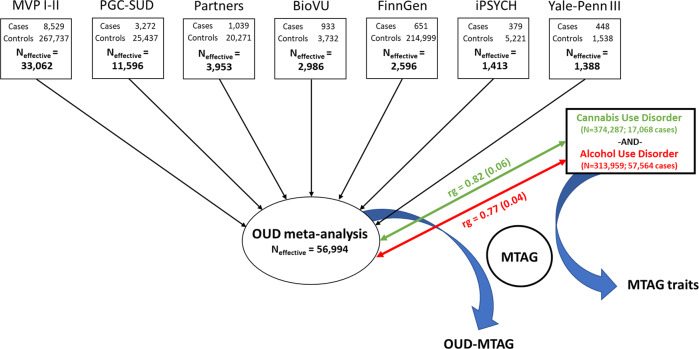
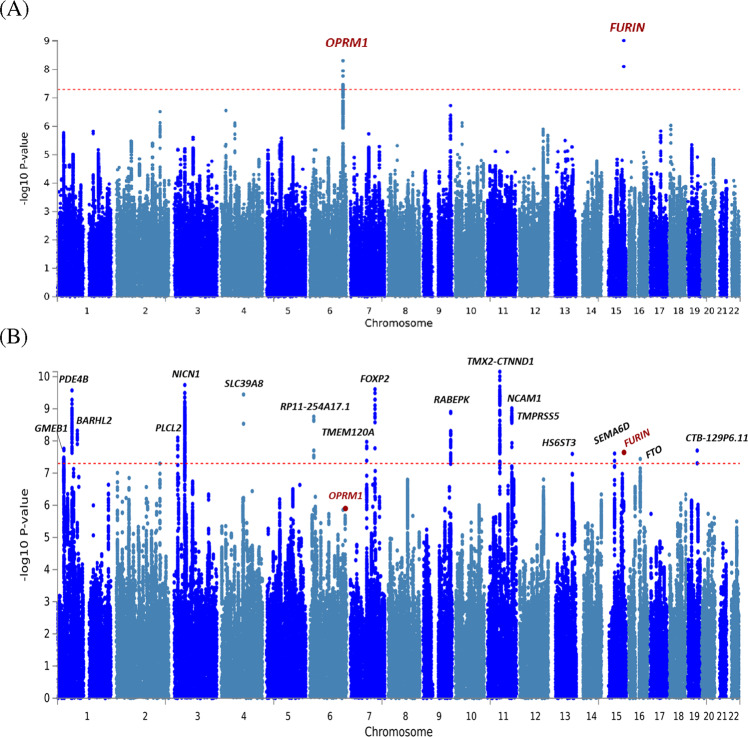
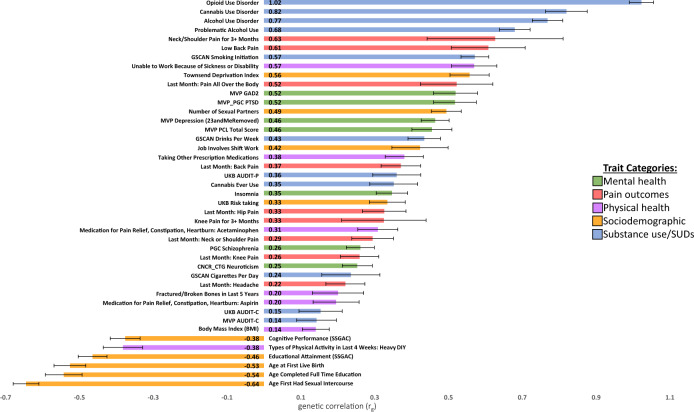
Despite the large toll of opioid use disorder (OUD), genome-wide association studies (GWAS) of OUD to date have yielded few susceptibility loci. We performed a large-scale GWAS of OUD in individuals of European (EUR) and African (AFR) ancestry, optimizing genetic informativeness by performing MTAG (Multi-trait analysis of GWAS) with genetically correlated substance use disorders (SUDs). Meta-analysis included seven cohorts: the Million Veteran Program, Psychiatric Genomics Consortium, iPSYCH, FinnGen, Partners Biobank, BioVU, and Yale-Penn 3, resulting in a total N = 639,063 (Ncases = 20,686;Neffective = 77,026) across ancestries. OUD cases were defined as having a lifetime OUD diagnosis, and controls as anyone not known to meet OUD criteria. We estimated SNP-heritability (h2SNP) and genetic correlations (rg). Based on genetic correlation, we performed MTAG on OUD, alcohol use disorder (AUD), and cannabis use disorder (CanUD). A leave-one-out polygenic risk score (PRS) analysis was performed to compare OUD and OUD-MTAG PRS as predictors of OUD case status in Yale-Penn 3. The EUR meta-analysis identified three genome-wide significant (GWS; p ≤ 5 × 10⁻⁸) lead SNPs-one at FURIN (rs11372849; p = 9.54 × 10⁻¹⁰) and two OPRM1 variants (rs1799971, p = 4.92 × 10-09; rs79704991, p = 1.11 × 10-08; r2 = 0.02). Rs1799971 (p = 4.91 × 10-08) and another OPRM1 variant (rs9478500; p = 1.95 × 10-08; r2 = 0.03) were identified in the cross-ancestry meta-analysis. Estimated h2SNP was 12.75%, with strong rg with CanUD (rg = 0.82; p = 1.14 × 10-47) and AUD (rg = 0.77; p = 6.36 × 10-78). The OUD-MTAG resulted in a GWAS Nequivalent = 128,748 and 18 independent GWS loci, some mapping to genes or gene regions that have previously been associated with psychiatric or addiction phenotypes. The OUD-MTAG PRS accounted for 3.81% of OUD variance (beta = 0.61;s.e. = 0.066; p = 2.00 × 10⁻¹⁶) compared to 2.41% (beta = 0.45; s.e. = 0.058; p = 2.90 × 10⁻¹³) explained by the OUD PRS. The current study identified OUD variant associations at OPRM1, single variant associations with FURIN, and 18 GWS associations in the OUD-MTAG. The genetic architecture of OUD is likely influenced by both OUD-specific loci and loci shared across SUDs.
© 2022. The Author(s).
Conflict of interest statement
HRK is a member of scientific advisory boards for Dicerna Pharmaceuticals, Sophrosyne Pharmaceuticals, and Enthion Pharmaceuticals; a consultant to Sophrosyne Pharmaceuticals; and a member of the American Society of Clinical Psychopharmacology’s Alcohol Clinical Trials Initiative, which during the past three years was supported by Alkermes, Dicerna, Ethypharm, Lundbeck, Mitsubishi, and Otsuka. HRK and JG are named as inventors on PCT patent application #15/878,640 entitled: “Genotype-guided dosing of opioid agonists,” filed January 24, 2018 and issued on January 26, 2021 as U.S. Patent No. 10,900,082. JG and RP were paid for editorial work for the journal “Complex Psychiatry.” All other authors report no biomedical financial interests or potential conflicts of interest.
Figures
References
-
- Hedegaard, M, Miniño, A, & Warner, M NCHS data brief: January 2020: Drug overdose deaths in the United States, 1999–2018. 2020; Retrieved from https://stacks.cdc.gov/view/cdc/84647-h.pdf. - PubMed
-
- American Psychiatric Association. Diagnostic and statistical manual of mental disorders: Diagnostic and statistical manual of mental disorders, fifth edition. 2013; Arlington, VA: American Psychiatric Association.
Publication types
MeSH terms
Substances
Grants and funding
- T32 AA028259/AA/NIAAA NIH HHS/United States
- K02 DA032573/DA/NIDA NIH HHS/United States
- I01 BX004820/BX/BLRD VA/United States
- I01 CX001734/CX/CSRD VA/United States
- UL1 TR001863/TR/NCATS NIH HHS/United States
- I01 CX001849/CX/CSRD VA/United States
- U10 AA013566/AA/NIAAA NIH HHS/United States
- K01 AA028292/AA/NIAAA NIH HHS/United States
- R33 DA047527/DA/NIDA NIH HHS/United States
- U24 AA020794/AA/NIAAA NIH HHS/United States
- R01 DA051906/DA/NIDA NIH HHS/United States
- U24 AA022001/AA/NIAAA NIH HHS/United States
- R01 DA054869/DA/NIDA NIH HHS/United States
- F32 MH122058/MH/NIMH NIH HHS/United States
- R01 AA026364/AA/NIAAA NIH HHS/United States
- U01 MH109514/MH/NIMH NIH HHS/United States
- DP1 DA054394/DA/NIDA NIH HHS/United States
- U01 AA020790/AA/NIAAA NIH HHS/United States
LinkOut - more resources
Full Text Sources
Other Literature Sources
Medical
